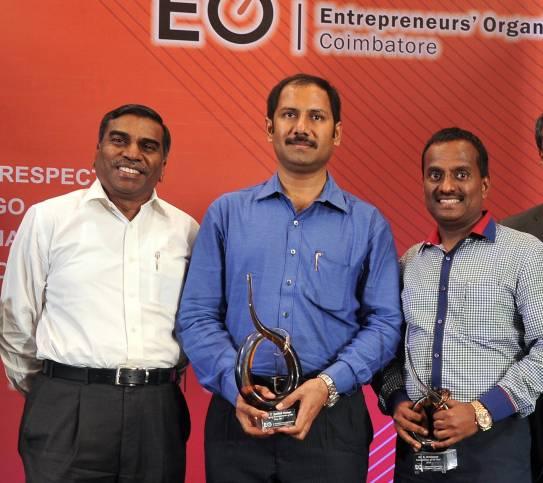
iGate gets MMA award for managerial excellence

Wabco wins for manufacturing

Chennai :

Wabco India Ltd, a braking systems maker in the automobile industry, has bagged the Madras Management Association’s Award for Managerial Excellence in the manufacturing category, while iGate Global Solutions has won the award in the services category.

Vaishnavi Biotech

Vaishnavi Biotech is the winner in the small firms segment and National Institute of Technology, Trichy’s department of management studies, has bagged it in the institutions category.

R Chandrasekaran, Vice-Chairman, Cognizant, and Chairman of Nasscom; and Gopal Srinivasan, Chairman and Managing Director, TVS Capital Funds, will be guests of honour at the awards function.

The companies, chosen for their business philosophies, will make presentations about their journey.

This is the 13th MMA Award for Managerial Excellence and is supported by the Murugappa Group and Mercedes Benz.

The awards will be given away at an event at Le Royal Meridien on Friday.

source: http://www.thehindubusinessline.com / Business Line / Home> News> National / by The Hindu Bureau / Chennai – July 02nd, 2014

The puzzle that binds them

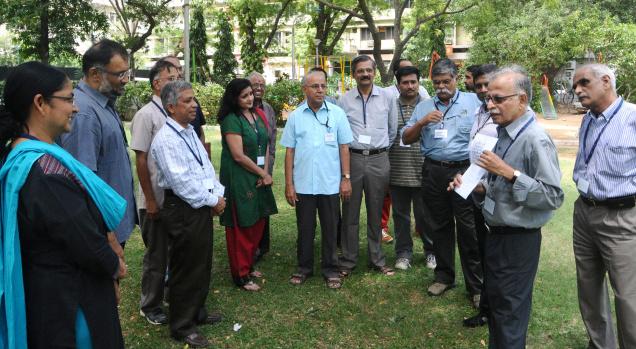
Members of the group have met six times since 2010 — Photo: R. Ragu / The Hindu

Fans of The Hindu’s crossword exchanged notes on a hobby that borders on obsession

Five-thirty p.m. is sacred to Gita Iyer, a program manager at an IT firm in Granite Bay, California. If she has a meeting then, she tells her colleagues she has an emergency, hurries to her cubicle, logs on to the internet and opens the one thing that makes her day — The Hindu’s crossword puzzle.

“If the puzzle is not there by 5.30 p.m., I keep checking until 6 p.m. and it stresses me out,” she said, laughing.

Gita was one of several fans and aficionados of The Hindu’s crossword puzzle, who met at the Presidency Club on Saturday, for an afternoon of discussing crosswords, old books, old films and music and generally bonding with like-minded souls.

Septuagenarian C.G. Rishikesh, who first founded the Orkut community that brought the group together, said this was their sixth meeting since 2010. The community, built through comments and participation on Orkut and later, on a blog created by retired Col. Deepak Gopinath, spans several cities and continents, including participants from Bangalore, Australia and the United States among others.

From a 26-year-old employee of an IT firm to a retired chartered accountant, the fans came from all walks of life. While some have been solving crosswords from childhood, others only started a few years ago. And while for some, the solving is the fun part, for others, it’s setting crossword puzzles that appeals. But for all of them, doing the crossword first thing in the morning (or evening depending on the time zone) is a must.

For the ‘setters’ or those who create The Hindu’s cryptic crossword, the challenge is to ensure it is doable, but not very easy. “It’s the way in which you word the clues that’s special and sets the puzzle apart,” said one setter, who goes by pseudonym xChequer. The puzzles fall into a range of difficulty levels, he explained and each setter has his own way of devising them, within the ambit of the rules.

Several of the fans do the crosswords in other newspapers as well, notably The Guardian. While some enjoy doing it with pen and paper, others use an app created by a friend of the community on a Facebook page, or do it online and then discuss how they got to the answer. They may be of all ages and from various professions – but a passion for the language, the way it is used and how to play with it, binds them all.

source: http://www.thehindu.com / The Hindu / Home> News> Cities> Chennai> Society / by Zubeda Hamid / Chennai – July 07th, 2014

Remembering July 7, 1908, the judgement day

FreedomFightersCH07jul2014

It was the day freedom fighters Subramania Siva and V.O.C. were found guilty of sedition

July 7, 1908 is a date no patriotic Indian of Tamil origin could afford not to know for it is on that day Madurai-born freedom fighter Subramania Siva became the first patriot in the whole of Madras Presidency (encompassing much of present day southern India) to be found guilty and imprisoned on the charge of sedition in British India.

Coincidentally, it was in July 1996 that his birthplace Batlagundu (Vathalagundu in Tamil) was taken away from Madurai district after the latter’s bifurcation to form Theni district. Therefore, it is only apt to recall this July, the history created 106 years ago by Arthur F. Pinhey, the then Additional Sessions Judge of Tinnevelly (now Tirunelveli) district.

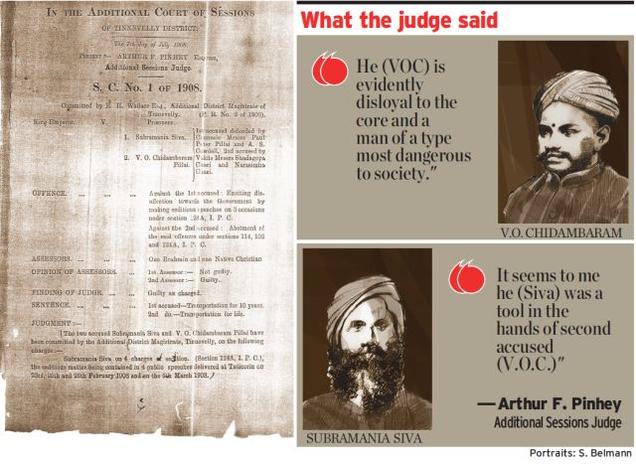
A copy of his judgement available with The Hindu, reads: “It seems to me that sedition at any time is a most serious offence. It is true that the case is the first of its kind in the Presidency, but the present condition of other Presidencies where the crime seems to have secured a foothold, would seem to indicate that light sentences of imprisonment of a few months or may be a year or two are instances of misplaced leniency.”

He goes on to state: “The first object of a sentence is that it shall be deterrent not to the criminal alone but to others who feel any inclination to follow his example. Here we have to deal with a campaign of sedition which nearly ended in revolt. The accused are morally responsible for all the lives lost in quelling the riots that ensued on their arrest.”

Though Siva was the prime accused in the case and his mentor V.O. Chidambaram, popularly known as ‘Kappalottia Tamilan’ for having started a shipping company to compete with the British in 1906, was only the second accused, the judge had surprisingly ordered a comparatively lighter sentence of 10 years of transportation on Siva and that of transportation for life on V.O.C.

“The maximum penalty that the law permits would not seem to be too severe for such a case. I think however some discrimination may be made in favour of the first accused. It seems to me he was a tool in the hands of the second accused… Subramania Siva also had the grace not to make vile and baseless allegations against the district authorities.

“For the conduct of the second accused I can see no extenuation. He is evidently disloyal to the core and a man of a type most dangerous to society,” Mr. Pinhey said.

A careful reading of the judgement also exhibits how factors such as the social background, community and caste of the accused as well as those of the witnesses were taken into consideration by the judge while testing the genuineness of their statements.

The two accused were convicted under Section 124A (punishment for sedition), a provision which continues to be in the statute book even in independent India, of the Indian Penal Code in connection with four public speeches delivered by Siva at Tuticorin on February 23, 25 and 26 and March 5 in 1908. V.O.C. was accused of organising those meets though he did not participate in all of them.

Describing the background of Siva, the judge says: “The first accused whose original name was Subramania Iyer, is a relation of the Palayamcottah Inspector of Police, P.W.7 (Viraragava Iyer) and a native of Batlagundu in the Madura district.

“In 1902, he seems to have obtained temporarily the appointment of Mochi in the office of the Special Assistant Superintendent of Police, Sivakasi. Later, it would seem he went to Travancore, and after completing his education there, assumed the garb of a Sannyasi, called himself Subramania Siva and started to tramp the country as an itinerant preacher.”

In the later part of the judgement, while speaking about the most important prosecution witness, Jaffir Hussain Sahib, Tuticorin Police Inspector who reportedly took notes of the Tamil speeches in English, Mr. Pinhey says: “He was a fine specimen of a Mohamedan gentleman.

“His demeanour in the witness box was perfect and he was unshaken by cross examination and I have no doubt he spoke the truth throughout… His notes are in English as he thinks in that language in preference to Tamil, though thoroughly conversant with the latter, and writes English with greater facility.”

On the other hand, rejecting the evidence adduced by Head Constable Kaliyugarama Pillai, the judge says:

“He is certainly the least satisfactory of the police witnesses and it has to be borne in mind that he is a Vellala like the second accused. It seems he was transferred soon after that note was taken.

“The circumstance that he broke his pencil directly the second accused began to speak and consequently lost that speech is I think significant. It possibly explains his transfer.”

The fact that the judgement, penned by a British national, consciously identified every other individual in India by their caste and community is also evident from its following lines: “When it was suggested to the witness that an Iyengar, like the Sub-Inspector and a Smartha Brahmin like the first accused, would not have taken food together at the same hotel… and the circumstantial facts on which the prosecution rely is that Subramania Siva though a Brahmin lived with the second accused at Tuticorin.”

The judgement known as ‘King Emperor versus Subramania Siva and V.O. Chidambaram Pillai’ is a classic piece of document that gives a fair idea of social conditions that prevailed in the country a century ago.

And it is a matter of history that though the conviction imposed on the two great freedom fighters were confirmed by the appellate courts of those days, the punishment was reduced considerably.

source: http://www.thehindu.com / The Hindu / Home> News> Cities> Madurai / by Mohamed Imranullah S. / Madurai – July 07th, 2014
Heaven in a mouthful of channa

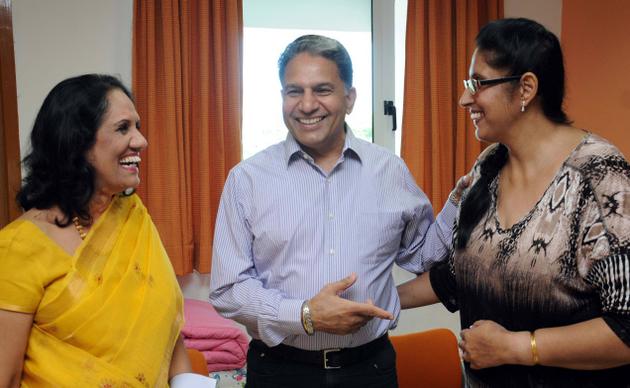
Jasbir Kaur Chahal from London underwent a rare surgery at MIOT Hospitals seen with her husband and Mallika Mohandas,Chairman,MIOT Hospital . / Photo: K. Pichumani / The Hindu

Londoner cured of acute spine condition after stint in MIOT hospitals

Jasbir Kaur Chahal had just gotten off the phone with her mother back in England. “Mum, do you know what I had to eat now?” she had asked her, full of beans. “What’s the worst thing for me? Channa! Yes, I ate channa!” she answered, in raptures over the chickpeas she had eaten for lunch.

Jasbir waits warily for her system to react violently to the chickpeas, but the good doctors here have told the 51-year-old from London that all will be well.

Jasbir had come to MIOT International Hospitals nearly doubled up in pain. She had a history of prolonged use of non-steroidal anti-inflammatory drugs (painkillers) for a serious condition that affects the spine — ankylosing spondylitis. But that was not her only problem. It was suspected that drug-induced diaphragm disease was keeping her from putting her favourite food into her mouth. She’d been on a liquid and low roughage diet for several months.

While she was careful avoiding food she thought was not good for her, after a point of time, nearly every time she ate, she’d feel ill, have bouts of diarrhoea, vomiting, and a stomach that bloated after a meal. And then there was the crippling pain that made her prone and put her in hospital often. After three years of waiting for a diagnosis through a double-balloon enteroscopy, a fed-up Jasbir made for India, and MIOT.

“You should have taken a picture of her when we came here first. She was bent over, clutching her stomach in pain and was diagnosed with depression,” her husband Joginder Singh explains. The couple came here expecting to wait a fair bit, but within a week, the diagnosis had been made, and the surgery completed, to provide relief.

‘Unprecedented’

Doctors found multiple strictures, nine places where the small intestine had narrowed to the point that food would get blocked and then build up, causing the symptoms. “We’ve looked at the literature and it certainly seems the first such case reported in India,” says George M. Chandy, director, MIOT Advanced Centre for Gastrointestinal and Liver diseases.

He goes on to explain what they did medically: S. Arulprakash, the team’s therapeutic endoscopist, performed a double-balloon enteroscopy to study the bowel; the strictures were located, after which the surgeon — V.Baskaran, director, Minimal Access Surgery — took over, removed two feet of the small intestine which had nine narrowed ring-like structures.

After having her bowel reduced by two feet, Jasbir chirps excitedly: “I feel three feet taller already.”

She is thrilled the doctors rallied around her and treated her as a person, rather than a statistic. Her natural jolly self is back after years, so much so her husband says, “I came with one wife, and it looks like I’m leaving with another!”

source: http://www.thehindu.com / The Hindu / Home> News> Cities> Chennai / by Ramya Kannan / Chennai – July 05th, 2014

Khan Academy to say ‘vanakkam Tamil Nadu’

Chennai :

Massive Open Online Courses (MOOCs) are all about accessibility, and this group of youngsters is taking it closer to learners. Cloud Vidyashram, an initiative by data analytics firm Report Bee and the non-profit AMM Foundation, has taken to translating the popular Khan Academy videos to Tamil.

“The idea is to help poor children study the same stuff that Bill Gates’ children study,” said Anant Mani, co-founder of Report Bee. Language was an initial barrier that had to be overcome. When Cloud Vidyashram wrote to Khan Academy about it they were more than happy to let them do the translation. “We experimented with radio artistes and translation professionals for the videos, but finally teachers were the ones who could pull it off,’ said Anant. The videos are 95% in Tamil and include English mathematical terms. Over three months, Cloud Vidyashram has translated 42 Khan Academy videos into conversational Tamil, the kind one hears in classroom across the state. The videos will explain basic concepts of the real number system, data handling and algebra. The project is being piloted in a Chennai Corporation school in Maduvankarai and a government aided school, Sir Ramaswamy Mudaliar Secondary School, in Ambattur.

“Khan Academy is a hit among children worldwide, and has helped children who found maths terrifying to start liking it. A lot of schools across the globe have started using them in classrooms. So we thought it was ideal for our classrooms as well,” said Bharath. Indian classrooms face the ignominy of a high pupil-teacher ratio, and teacher training is nothing to write home about.

Sharanya said Class 11 students were chosen for the pilot as they were a little more relaxed after completing a board exam, and needed a refresher in the basic concepts that they will need to brush up for higher maths. A baseline study of how many Class 11 students could read a bar diagram, pie chart and other basic applications of the three concepts, taught from Class 6 onwards, showed that only around half the students had passable knowledge of it. At the end of three months an endline study will be conducted to see if there has been any impact, and if the effect has percolated to other subjects.

source: http://www.timesofindia.indiatimes.com / The Times of India / Home> City> Chennai / by M Ramya, TNN / July 05th, 2014

99 going on 100: Women’s Christian College sets off celebrations

Chennai :

A drone, a float, more than a hundred voices joined in song at the stroke of midnight will kick-off the year-long centenary celebrations of Women’s Christian College, the first private women’s college in the city. At the stroke of midnight on July 6, which marks the moment WCC will enter its centenary year, staff, students and alumni of WCC will gather at the campus to sing songs of praise by candle light and take a pledge to commemorate the historic moment.

“We want to celebrate stepping into the 100th year,” says WCC principal Dr Ridling Margeret Waller, who adds that the college has plans for celebrations all through the year.

One of the first events planned for the day – and Waller and her planning committee are keeping their fingers crossed on this one – is a little celebratory cake-cutting with Anna Jacob, who at 100 years, is the oldest living alumnus of the college. “Anna Jacob will celebrate her 100th birthday this July, as her alma mater steps into its 100th year, and that is a cause for celebration. So we want to make it one of the first events,” says Waller.

Events planned for July 6 and 7 include a 100-voice choir of students and alumni, women ranging in age from 19 to 90, celebrating the college and its commitment to the empowerment of women. “The college was set up by women who belonged to Christian missionary societies in Canada, the US and the UK. They left everything they knew to come to an unknown land and liberate women from the shackles of poverty and to empower them with higher education. The motto of the college is ‘Lighted to Lighten’, and as part of that vision started by these missionaries, last year, WCC has adopted a village near Red Hills, where literacy programmes are conducted on a regular basis,” says Waller. “WCC was built on a vision and we need to grow it.”

After the midnight thanksgiving, students will take out a parade on College Road. “We have two floats – the first will feature the seven teachers who were here when the College began, and the second will feature the first batch of 41 students, complete with period costumes,” says Waller. The float will be designed in the facade of Doveton House, one of the oldest and most treasured buildings on the 19-acre campus. The college had moved to the campus in 1916, after functioning for a year in a rented building named Hyde Park. Among the live ‘statues’ of students on the float will be Rukmini Lakshmipathy, a history student here, who went on to join the Indian National Congress and later became the first woman to serve as a minister in the Madras Presidency. Among the teacher statues will be WCC’s founder-principal Dr Miss Eleanor McDougall, who headed the institution till 1935.

Leading the parade will be 30 women bikers from the college, while a hired drone will capture the proceedings from the sky, to be later telecast for alumni who missed the event.

As part of the celebrations, a centenary flag will be hoisted for two days, after which it will be lowered and sent on a journey around the world to cities where WCC alumni reside.

As for Anna Jacob, who lives in Vellore, she has already arrived in Chennai well in time for the celebrations. “Whenever I think of my college, I think of the chapel and the beautiful evening services we used to have there,” says Jacob. Jacob, who belongs to the batch of 1946, completed her intermediate course and missionary training course in WCC, was present at the college alumni homecoming in January this year, which was a curtain-raiser to the centenary celebrations. “It is good to see that some of the buildings that were there when I was – the Clock Tower and Science Block for instance – are still intact.”

source: http://www.timesofindia.indiatimes.com / The Times of India / Home> City> Chennai / by Kamini Mathai ,  TNN / July 05th, 2014

Keeper of yore with a keen eye for talent

He was not only effective behind the stumps but also had the knack of spotting and nurturing talent.

Bharath Reddy, who donned the gloves for India in 4 Tests and 3 ODIs and was a mainstay in the TN line-up for long, was instrumental in young L Sivaramakrishnan making his Ranji debut in the quarterfinals against Delhi at Chepauk in 1981-82. “Siva was just 16 when he made his (Ranji) debut. I had a lot of faith in his abilities, and had asked our skipper S Venkatraghavan to give Siva a chance, and it was granted,” recalls the man with 95 first-class appearances for TN. He took 171 catches and effected 50 stumpings playing for TN.

Reddy first came to notice with an unbeaten 101 against Midlands School during the Indian Schools team tour of England in 1973. “Studying at the Madras Christian College Higher Secondary School was a big plus since they backed me to the hilt. I was allowed to concentrate fully on my game.

I developed a liking for keeping since it provided the best view of the proceedings in a match. One could see how a batsman was planning to take on a bowler, the changes he was making to his stance,” says the Pachaiyappa’s College alumnus.

Having had the fortune of keeping wickets to the likes of Venkatraghavan and Bishen Singh Bedi, Reddy considers Prasanna the toughest to read. “While Venkat, V V Kumar, Bedi and B S Chandrasekhar were all great, Prasanna stood out for the ability to fox a batsman with his loop.”

He has no regrets in life but the 59-year-old believes he could have played more matches for India. “Players of our era were happy with whatever we achieved. Maybe, we lacked the drive that cricketers of the subsequent generations had.”

After retirement, Reddy has been involved in spotting and nurturing talent at Chemplast. “You may be blessed with talent, but if you don’t have the platform to showcase it, what’s the use? When I was Tamil Nadu captain, I ensured players who had the spark made it to the team. W V Raman was a classic case. He had the talent and temperament, and I ensured he made his Ranji debut for the state.

Chemplast has given chances to the likes of L Balaji, Murali Vijay and many others over the years. My chairman has been very supportive and has backed my choices all the time. There have been many who have asked him (our chairman) how he has put up with me for so long,” says Reddy .

(A column on famous sports personalities whose first playing field was Chennai)

source: http://www.timesofindia.indiatimes.com / The Times of India / Home> City> Chennai / by Prasad Ramasubramanian, TNN / July 05th, 2014

Emerald Jewel Industry MD bags entrepreneurship award

From left to right: M M Murugappan, Vice Chairman, Murugappa Group, Chennai, with T Sathish Kumar, MD, Milky Mist Dairy Foods Pvt Ltd, Chittode, Erode district, and K. Srinivasan , Managing Director of Emerald Jewel Industry India Ltd., Coimbatore. Photo: Special Arrangement

Coimbatore :   

K Srinivasan, Managing Director of Emerald Jewel Industry India Ltd, Coimbatore, has been awarded the ‘EO- Entrepreneur of the year 2014’ by the Entrepreneurs’ Organisation (EO), Coimbatore.

T Sathish Kumar, Managing Director, Milky Mist Dairy Foods Private Ltd, Chittode in Erode District, was chosen for the ‘Emerging Entrepreneur of the year 2014’ award.

The awards, given to young entrepreneurs from the western region of Tamil Nadu comprising Coimbatore, Tirupur, the Nilgiris, Erode, Namakkal and Salem districts, was presented by M M Murugappan, Vice Chairman of Murugappa Group, Chennai, at a function held here on Friday.

The organisation said that the award was given in recognition of entrepreneurs for their contribution in stimulating economic growth, in employment generation and for fulfilling their social responsibilities etc. Deloitte had collaborated with EO Coimbatore in this regard.

Karthikeyan Palanisamy, President, Coimbatore chapter, said that EO is a network of business owners in over 40 countries that facilitated small and large business owners to network and help each other to grow.

source: http://www.thehindubusinessline.com / Business Line / Home> Companies / by R. Yegya Narayanan / Coimbatore – June 30th, 2014

Every home should have a library: Kalam

Bangalore :

Former President APJ  Abdul Kalam on Sunday asked parents to have a small library at home to encourage their children to read books.

“Every home should have a small library with a minimum of 10 books to inculcate the reading habit in children,” Kalam said at a function to mark the sesquicentennial (150 years) of Bishop Cotton Boys’ School here.

Citing the importance of education, he said parents should take sincere steps to increase the collection of books every now and then. “And they should make their wards refer to the books at least an hour a day,” he added.

Paying a tribute to his science teacher Siva Subramaniam Iyer, Kalam said he was inspired by him to become a rocket scientist. “When we were in Class 5, he took us to Rameswaram beach to show students the birds’ flying pattern. He also had a model aircraft to show us the similarity. This eventually inspired me to become a rocket scientist,” he added

Hailing the significance of the Bishop Cotton Schools, the former president said: “One hundred and fifty years is a long time for a school. In astronomy, it’s equal to the number of time taken by the Earth to orbit around the Sun. But most importantly in its every orbit, a star is born.”

Earlier in the day, Bishop Cottons Girls’ School, founded in 1865, celebrated a Holy Communion service on St Peter’s Day at its Bishop George Edward Lynch Cotton auditorium. Archbishop of Dublin Dr Michael Geoffrey Jackson, Bishop Cotton Boys’ School principal John K Zachariah and Bishop Cotton Girls’ School principal Princess Franklyn presided over the service. The day was named after the school’s patron saint and inspiring role model.

source: http://www.timesofindia.indiatimes.com / The Times of India / Home> /City> Bangalore> Namma Metro / TNN / June 30th, 2014

An arterial road named after eminent politician during the British period

Madurai :

Panagal Road – the arterial road connecting Goripalayam with Sivaganga Road is named after Panagal Raja, eminent politician of the state from erstwhile Justice Party who was chief minister of Madras Presidency from 1921 to 1926. The road got its name during British rule.

Sir Panaganti Ramarayaningar (1866 – 1928) known as Panagal Raja was a noted politician in British India instrumental in starting Justice Party and raising the issue of caste based reservations. He was also the man behind educational reforms and municipal development of then Madras. As tribute to his reforms, there is a park in T Nagar, Chennai and the road in Madurai was also apparently named after him, says residents.

Colonial rulers who were living inside old Madurai city till Sepoy Mutiny in 1857 started shifting their establishments and residences in Northern Bank. Though Rajaji Hospital was established by theBritish way back in 1842, it was taken over by Madurai municipality in 1872 and the hospital came under state administration by 1918. Sir Arthur Hope, Governor of Madras inaugurated the full-fledged facility as seen today, in 1940 as per the stone tablet found in GRH.

Former Madurai East MLA, N Nanmaran said that Panagal Road could have been named after popular Justice Party leader since the Dravidian movement and parties evolved from it had its roots from that party. Government Rajaji Hospital earlier known as Erskine Hospital was very significant landmark since it was one of the biggest government hospitals for entire southern districts even today, he said. However N Pandurangan (74) an elderly Congress party man residing in the area says that the road was christened after Panagal Raja even during British days. Madurai city ended with South Bank and entire northern part was villages. The present day Panagal Road and Shenoy Nagar were Mathichiyam village, he recalled.

“In those days entire area was mostly wilderness and few houses situated here and there. But Panagal Road was still an important road with Rajaji Hospital and Collector office established in colonial rule”, he said.

source: http://www.timesofindia.indiatimes.com / The Times of India / Home> City> Madurai / by J. Arockiaraj, TNN / June 29th, 2014