Heritage lovers have reason to cheer as the world-famous and renovated Amaravati gallery and four other galleries of the Chennai Government Museum have been thrown open to the public. Renovation work went on for about 10 years at a cost of Rs.62.5 lakh at the Amaravati gallery, which has a number of precious sculptures, belonging to the period between the 2 Century B.C. and the 2 Century A.D.
Several sculptures, embedded on the walls of the gallery, were removed and have now been kept for display on the lines of the British Museum, a senior official said.
In the last few years, the renovation of the Ayaka pillar, an important symbol of the Buddhist stupa of the Andhra region, was taken up and was completed only recently. The gallery remained closed during renovation.
On Friday, Chief Minister Jayalalithaa inaugurated, via video-conferencing, the gallery along with the galleries for the Hindu pantheon of gods; Jain sculptures; anthropology and copper plates. Apart from declaring open a gallery on textiles and dyes, she commissioned a 3-D auditorium at the Children’s Museum. A facility for the virtual tour of the museum and a museum bus for the benefit of school students was also commissioned. These facilities have been set up at a cost of about Rs. 3 crore.
Another important landmark of the city – Gandhi Mandapam in Guindy – got a makeover, for which the government had set apart Rs. 12 crore.
Spread over 18.42 acres, the Mandapam complex has, among others, memorials for leaders of yesteryear — Rajaji K. Kamaraj, M. Bakthavatsalam and Rettaimalai Srinivasan.
The renovation work included the laying of footpaths and roads besides gardening, all of which cost Rs. 7.2 crore. Old copies of photographs kept at several memorials on the Mandapam complex were also replaced with the fresh ones.
The Chief Minister also laid the foundation stone for the sports fishing-cum-eco park in and around the Chetpet lake as part of the eco-restoration of the lake. Estimated to cost Rs. 42 crore, the project is expected to be completed by March, said an official in the Fisheries Department.
Facilities for boating will be offered. A multi-level car parking facility will also be provided.
source: http://www.thehindu.com / The Hindu / Home> News> Cities> Chennai / by T. Ramkrishnan / Chennai – June 29th, 2014
Doctors at Chennai GH prevent limb loss in patients through needle hole procedure
Chennai :
Anbazhagan, a chain smoker and diabetic, was admitted to Government General Hospital in Chennai recently with severe gangrene on his left toes.
Even after three of his toes were removed at a private hospital, tests at GH showed that he had a major block on his left leg which was interrupting blood flow.
Instead of performing a major surgery which would have required cutting his thigh open, doctors performed an endovascular procedure which requires only a needle-sized puncture and removed the block.
Along with Anbazhagan, 11 other patients benefited from a similar procedure at the hospital which is painless and leaves no scar.
Endovascular therapy is an offshoot of the developments that have happened in the field of cardiology. “Occlusive diseases of the arteries in any part of the body can be subjected to either balloon angioplasty or stenting as the situation demands. Compared to conventional open surgeries, this procedure is very minimally invasive and there is no need for extended hospital stay,” said Dr M Rajkumar, director, Institute of Vascular Surgery.
He pointed out that through this procedure, apart from preventing limb loss, lives of critically ill patients can also be saved.
Though the procedure costs several lakhs rupees in private hospitals, the patients were treated for free under the chief minister’s health insurance scheme.
source: http://www.timesofindia.indiatimes.com / The Times of India / Home> City> Chennai / by Janani Sampath, TNN / July 01st, 2014
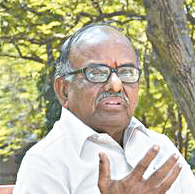
Considered the Father of Geriatrics in India, he provides holistic medical and psychological cures for the elderly. Interestingly, his foray into medicine was not a long-cherished dream.
Graduated: 1964, Tanjore Medical College
First Call
Medicine was never a childhood ambition for me. I had perfect scores in my PUC and naturally got an admission into a good college. It became an ambition since then.
Looking Back
I have never once felt bored about working around the elderly. They need extra support and care, medically and psychologically. I want my patients to be cured as early as possible.
Turning Point
It’s a wonderful feeling to know that I have given back to my society. Once when I visited my village, the people recognised me as one of their own who is doing well in medicine. Since I was the first doctor in my family, the recognition and love I received will be cherished forever.
Obstetrician and Gynecologist Dr Kamala Selvaraj
Ever since she commissioned the first test tube baby in 1990, Kamala Selvaraj has been in the limelight for her contribution to gynaecology.
Graduated: 1969, Kasturba Medical College
First Call
When I finished school, my father asked me if I wanted to get married or study further. I chose to study and become a doctor and since then, there was no looking back.
Looking Back
I have earned enough to can sit back and enjoy life, if I choose to. But when I look at the pain writ on every patient’s face, it is heart wrenching.I feel they need me and with all my experience, I can treat them like no one else.
Turning Point
Something that keeps striking me is that I have never faltered in my profession, nor have I advertised myself. The fact that the junior gynaecologists idolise me and consider me their role model is a testimony to my work.
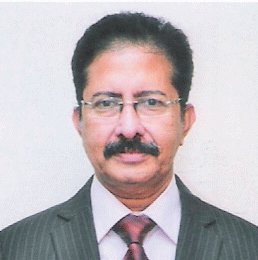
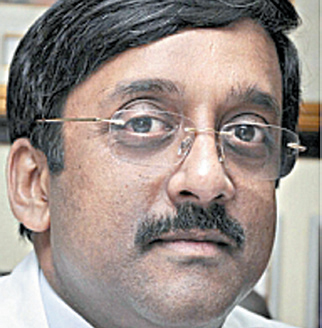
Admin Acolyte Dr V Kanagasab
The ever-present Dean of the Madras Medical College till he retired recently and the Director of Medical Education for a brief period, he has spent his life teaching and practising in government hospitals across Tamil Nadu. He is one of the people who contributed to putting MMC on the map during his tenure here.
Batch: 1980/ MMC and Stanley
Origin Story
It was a two way thing. I wanted to be a doctor and my parents were quite happy with my decision. My father tried to become a doctor in his day, but he wasn’t able to get in and settled for the agriculture department — so I still have the tag of being a first-generation doctor in my family.
Service Trip
Every single day, it was a lesson to go to whichever college I was at and not only serve people, but also spread knowledge to students. It is a great boon to be able to serve people who are oppressed, poor and often without education. That is a lesson that I had been trying to impart to my students in the 31 years of service that I’ve put in – to teach and serve people who require it. I gave up a lot of monetary benefits when I quit private practice and entered hospital administration, but I have no regrets today.
High Point
It was in 2010, when the MCI and the Government of India delayed the permits for the Dharmapuri Medical College, that we prepared a case and went to fight it out in Supreme Court. It was tough and we had doubts, but we had already admitted 100 students and their futures depended on it. Winning that case and laying those students fears’ to rest, is something that stays with me.
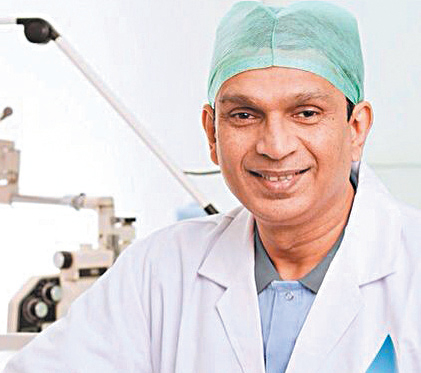
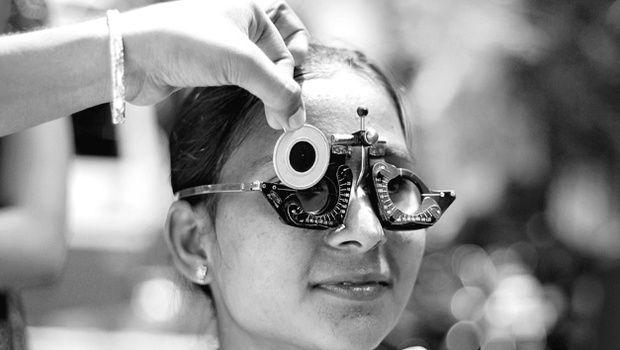
Eye Enigma Dr Amar Agarwal
Chairman and chief surgeon at Dr Agarwal’s Group of Eye Hospitals. He has been responsible for taking the group global and providing affordable and high quality eye care for people of all economic strata. His life is an eye-opener.
Graduated: 1983, Madras Medical College
First Call
I always knew that I wanted to be a doctor. When I was nine, my parents, who were eye surgeons themselves, would make me practice how to do sutures on the leaves of an onion, because it was very close to a human eye. I loved it then and knew that this is what I wanted to do.
Looking Back
At any point of time, I am in my scrubs and I’m always thinking of ophthalmology. I have never wanted to do anything else. You see, when you live and breathe and love what you do, it is not work. That way I can proudly say that I’ve never ‘worked’ a day in my life!
Turning Point
One thing that stands firmly implanted in my mind is the day my parents died. Three hours after I grieved, I took their eyes and transplanted them myself into a poor patient who had been blind for ages. When he opened his eyes and looked at the world with my dad’s eyes, I looked at his wife’s face — the happiness I saw there, will stay with me as a reminder of why I do this every single day
Diabetologist Dr Vijay Viswanathan
Dr Vijay,carrying on the family lineage, is a diabetologist at the M V Hospital, Royapuram. Becoming a doctor was an ambition instilled into him since the age of 11.
Graduated: 1982, Stanley Medical College
First Call
My father was a doctor – a diabetologist. I was inspired by him and since I was a student of class six, I wanted to follow his footsteps
Looking Back
I’ve been a doctor for 24 years, and I have been living my dream ever since I graduated. I am completely content with whatever I do and never have I stopped to think of options.
Turning Point
Patients from far flung areas such as Arunachal Pradesh come here to get treated for diabetes. It is a huge responsibility on me and my hospital. To know that I have to do my best to treat them is something that I cherish and this makes me feel content. The knowledge that patients can bank on me, and that I can do justice to it, makes me feel I am doing the right thing.
source: http://www.newindianexpress.com / The New Indian Express / Home> Chennai / by Daniel Thimmayya & Aparna Deiskan / July 02nd, 2014
Memorial tablets and gravestones, which mark the end of a life actually go way back to its early days. Except, back then only the valiant and deserving were immortalized in stone – usually with a spot of art to mark them apart. These prototype memorials were called hero stones and they were typically reserved for heroes or those who served their community. A 2-day national seminar held last week in Hosur, titled The Days of Heroes, uncovered new facts about these stones and pointed to their prevalence in the south.
Sugavana Murugan, a hero stone expert and convener of the seminar pointed out that Dharmapuri and Krishnagiri districts are known as the land of hero stones. “Multi-lingual people lived here in harmony and
their hero stones bear inscriptions in Tamil, Telugu and Kannada. These stones range from the 5th to 18th century AD. “Inscriptions on hero stones usually describe the political, social and cultural history of the region. These stones commemorate people for their valour in a cattle raid, for the retrieval of captured cattle, fighting and killing wild animals, death in battle, sati or heroic death for a public cause,” he says, adding that fertility and ritual stones have also been identified there.
This was the first time since 1974 that a national seminar on hero stones was conducted in south India. Organised by the Krishnagiri District Historical Research Centre, the conference drew together scholars from 15 universities across the country, who presented papers on various aspects of hero stones. One of these was also from Pakistan, describing hero stones in the Sindh region.
Professor V Selvakumar of Tamil University, Thanjavur presented his paper titled ‘Hero stone worship and its significance in Tamil Nadu’. Although hero stones have been discovered in many parts of Tamil Nadu, particularly near its borders with Karnataka and Andhra Pradesh, no detailed study has been conducted on the subject so far. According to Selvakumar these stones are referred to in Tamil as planted stones or natukal and in Kannada as virakkal (stone of valour).
“The concept of hero stone or hero worship evolved from the megalithic burial tradition,” he said, “The worship of heroes could have begun in the Iron Age when megalithic monuments were erected for the dead.
While we do find different types of burial sites in the Iron Age, some of them, especially menhirs (standing stone), appear to have been erected for heroes. They used different surface markers to convey the status of the dead and they were probably erected only for certain individuals, as we do not find them in large numbers, like burial urns.”
From Pakistan came a paper by Zulfiqar Ali Kalhoro on ‘Memorial Stones of Sindh, Pakistan’. “This practice was widespread in the early medieval period in Sindh,” he said. Like Krishnagiri and Dharmapuri, many of the hero stones in Sindh were erected in memory of heroes who died at the hands of cattle-lifters, Kalhoro said. “In other districts of Sindh are memorial towers erected in the memory of cattle retrievers. They are found in the hilly regions of Karachi, Thatta, Jamshoro and Dadu districts, which relied heavily on cattle.”
V Ramabrahmam, assistant professor at Yogi Vemana University, Kadapa, said the practice of erecting hero stones in India was recorded in Vedic texts. “The erection of a monument in memory of the dead and the practice of forming a mound with an attached post is described in the Satapatha Brahmana (9th- 8th century BC),” he said, “During the days of King Asoka (3rd century BC) hero stones were erected on wooden, and subsequently, stone posts. The origin of memorial stones of the later periods originates from here.”
What’s the difference between a memorial stone and hero stone? “Memorial stones contain funeral remains, whereas hero stones are only plaques commemorating a death, without any funeral remains. Incidentally, sculptures on hero stones not only convey the art of the times, but also a social and cultural commentary on the region in that time,” he explained.
More than 2,500 hero stones have so far been excavated from the state. Devarakonda Reddy, president of the Karnataka Itihasa Academy, said this may have something to do with the frequent fights between local kings and chieftains. It’s where the area’s history is set indelibly in stone. An imminent book titled ‘The Days of Heroes’ will incorporate the research papers presented at the seminar.
source: http://www.timesofindia.indiatimes.com / The Times of India / Home> City> Coimbatore / by M. T. Saju, TNN / June 30th, 2014
It was T Govindan, a professor and avid lover of ancient history, who established the Krishnagiri District Historical Research Centre (KDHRC) in Hosur in 2009. Even though it almost immediately began conducting one-day seminars and talks, KDHRC became defunct in 2010 due to lack of public support, but it was revived by a few committed individuals, following Govindan’s death in 2012. The centre aimed to preserve the culture of the region, mainly Krishnagiri and Dharmapuri, where a number of hero stones and inscriptions lay unattended, some even ruined. With more than 40 members, the KDHRC is today a strong promoter of ancient history in the region. It has published five books and conducted a number of seminars and talks, including the two-day seminar on hero stones held on July 21 and 22.
It has now also started publishing ‘Nalli’, a quarterly. “Nalli will cover new excavations and discoveries in the region. It will also create awareness among people about our rich culture and heritage,” says Sugavana Murugan, editor of Nalli and member of KDHRC. “KDHRC is planning to also document all the hero stones and inscriptions in the region, many of which were destroyed by vandals.
Lack of funds, however, poses problems. “We function with the help of donations made by people,” says Murugan. He hopes they continue to receive the resources needed to conduct seminars and talks, and organize events like the recently concluded seminar.
source: http://www.timesofindia.indiatimes.com / The Times of India / Home> City> Coimbatore / TNN / June 30th, 2014
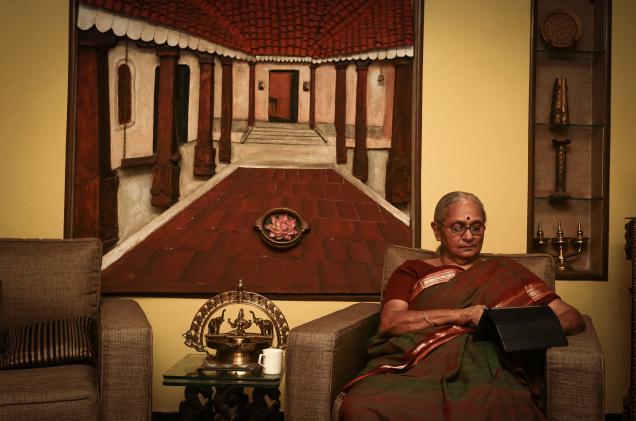
Chithra Viswanathan is 75 and lives alone in Mylapore but this overtly confident use of technology, which you’d normally associate with youngsters, has helped her showcase her passion, cooking, on a global platform. / Photo: Ram Keshav / The Hindu
Seventy-five-year-old Mylapore homemaker, Chitra Viswananthan tells Srinivasa Ramanujam how cooking meets technology through her mobile app
These days, when 75-year-old Chithra Viswanathan goes to Marina Beach for a walk, people stop her. They pause and look at her like they’ve seen her somewhere. And then, they recognise her as the ‘Internet maami’, a sobriquet she’s quite at ease with now.
A few of these co-walkers — regulars at the beach — are friends now. But that’s just a handful. When she logs on to Facebook, she has more than 1,200 friends. “I do not usually accept anyone as a friend unless we have many mutual friends,” she says, adjusting her glasses and skilfully sifting through the numerous windows on her iPad.
She’s 75 and lives alone in Mylapore but this overtly confident use of technology, which you’d normally associate with youngsters, has helped her showcase her passion, cooking, on a global platform.
If Meenakshi Ammal brought out the revolutionary Samaithu Par, a cookbook in Tamil, more than half a century ago, Chithra uses technology to help people all over the world. Her mobile phone application, called AskChitVish Premium, which was launched a few years ago, already has 2,300 recipes and 200 more waiting to be uploaded.
She always had a passion for dishing out new stuff from the kitchen for her grandchildren. But it was about a decade ago when, the Internet boom had just started and she was getting familiar with the computer, that she noticed a query on a website for the recipe of ‘poosanika kootu’. “It was unanswered for three days,” she recalls, “I just took it upon myself to answer it and give her the right recipe.”
There was no looking back after that — she started writing a cookery column for Indusladies.com that had a huge traction among Indians settled abroad. She cooked, she blogged, she wrote and she shared her experience online.
‘Chitvish’ soon became a hit. So much so that she had ‘fans’ across the world. One of them — a 45-year-old woman from Atlanta — actually came down to Chennai just to meet her. “She had been following my recipes,” says Chithra, “When she came to India, she made it a point to come to Chennai especially to see me. I was a little hesitant and clearly told her that I was no fancy chef but just a housewife. It was special to have someone come all the way just for me.”
Her everyday routine begins quite early, just like any other homemaker, but there’s a key difference. When she enters the kitchen, she’s armed with an iPad and her Samsung Galaxy — to take notes and pictures of what she does. “If I see something different on TV, I immediately try it out,” she says, “I never post any recipe online without trying it.”
Baking is very close to her heart as well. “I’m very passionate and experiment more with breads than cakes,” she says. It’s not a new-found passion but one that she started indulging in quite a while ago. “It was in 1967,” she says, “I saw an ad for a baking course in the Polytechnic Institute, Taramani, and immediately went for it with a few friends. It was perhaps the first course for baking in the city. The instructors taught us well and we were fascinated by the concept.”
Another concept that’s caught her attention of late is fusion cooking. She’s tried out Au gratin dosa and Punjabi pesto pizza, besides others. “It helps people try out new things,” she says, “The most exciting part is to add your own touch to a tried and tested recipe. For instance, in dishes that need eggs and ingredients that aren’t available here, I look for an alternative.”
Chithra doesn’t eat out, but doesn’t mind heading out once a while to check out what’s new and in. “Why do we like eating out?” she asks, “Not just for the taste but also the way the food is presented. I believe that we eat with our eyes — it’s important to dress up what you’ve made.”
When a friend or neighbour makes a sarcastic comment about cooking, it upsets her. “It (cooking) is very creative,” says Chitra, who credits her late husband, Viswanathan for encouraging her a lot, “That’s not all… there’s a science behind it. Cooking is about how much you add and in what quantities. A little more or a little less makes all the difference.”
A few years down the line, she hopes to come up with more innovative recipes. But not all of them are saved on her computer and iPad. “They keep crashing…can’t trust them too much,” she says nonchalantly, “I prefer storing them all on Cloud.” For this 75-year-old, the sky’s the limit.
source: http://www.thehindu.com / The Hindu / Home> Features> MetroPlus / by Srinivasa Ramanujam / Chennai – June 30th, 2014
An eye donation camp held here on Friday in connection with the birth anniversary of Helen Keller, has reportedly entered the Assist World Record with nearly a lakh pledging to donate their eyes.
Lions Club International, which organised the eye donation awareness camp at Quaid-E-Millath Government College for Women, claimed that about a lakh people undertook the pledge during the day, making it the biggest such programme ever.
“The last record was 22,000, and we created history today to emerge on top according to Assist World Record,” said a proud G Manilal, Governor, Lions Club district 324-A8.
Most of the volunteers were students from institutions in the city like Stella Maris and MGR University among others.
“We have circulated forms to college students of whom many have registered. The rest are waiting for their parents’ approval. We are expecting the registration to cross one lakh,” added Manilal.
Each person who registered was given a smart card, which had important medical data about him/her, including the consent to donate eyes.
Justice P Jyotimani, member, National Green Tribunal, New Delhi, distributed the eye donation smart card, which was received by popular director-actor Thangar Bachan.
Dr KS Seetha Lakshmi, principal, Quaid-E- Millath Government College, and many eminent eye surgeons attended the camp.
source: http://www.newindianexpress.com / The New Indian Express / Home> Cities> Chennai / by Express News Service / June 30th, 2014
Madurai Trees 25’ being released in Madurai on Sunday. Author D. Stephen, left, Assistant Professor in Botany, The American College, is seen. / Photo: R. Ashok / The Hindu
Lists 25 species that are common in Madurai with details of origin and uses
‘Madurai Trees 25,’ a book on trees in Madurai was released by Madurai Green, a non-governmental environmental organisation, here on Sunday.
The book authored in Tamil by D. Stephen, Assistant Professor in Botany, The American College, has a list of 25 species that are common in Madurai, with elaborate details of the origin and uses of the trees. The book was released by P. Saravanan, managing director of Saravana Multispeciality Hospital, at Gandhi Memorial Museum where the 25 Green Walk of Madurai Green was organised on Sunday.
Speaking on the occasion, N. Chidambaram, coordinator of Madurai Green, said the organisation, established 22 years ago, had conducted 25 Green Walks in the past two years. “Involvement of people in green walks has given us fresh hope that the environment of Madurai can be conserved in a better way in the coming years. The participation of youth is laudable,” he said.
“One of the major environmental issues Madurai faces is improper disposal of garbage. Sewage and garbage disposal should be done properly by the public,” Mr. Chidambaram added.
Mr. Stephen said the book would serve as guide to people on the different trees in Madurai. Purasu, nuna, athandai, vattakanni, oduvan, banyan, peepal, palm, neem and coconut were some of the trees mentioned in the book.
M.P. Vasimalai, executive director of Dhan Foundation, emphasised that the city’s green cover should be improved. “We should start planting saplings of rare and traditional trees,” he said.
President of Madurai Green D. Raghavan pointed out that the city’s temperature had rapidly increased in the three decades because of felling of trees. “In 1982, the maximum temperature here was 27 degree Celsius, whereas it was 32 degree Celsius in 1990 and now it is 39 degree Celsius,” he noted.
Members of Nanal Nanbargal and other youth organisations that took part in the green walks regularly also shared their experiences.
A.K. Xavier, Principal of St. Joseph ITI, Edwin Rajkumar, Professor of CSI Jayaraj Annapackiam College of Nursing, Ranjitham, Principal of St. Teresa Teacher’s Training Institute, and several others spoke. Free saplings of trees were distributed to those who attended the programme.
source: http://www.thehindu.com / The Hindu / Home> News> Cities> Madurai / by Staff Reporter / Madurai – June 30th, 2014
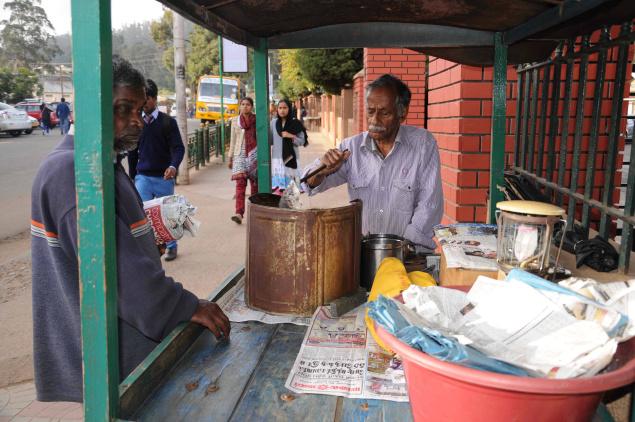
Peanut vendor P.S. Gopalakrishnan on the Government Botanical Garden Road in Udhagamandalam. / Photo:M.Sathyamoorthy / The Hindu
His presence is not as conspicuous as his absence. That is Trichur Kilimangalam P.S. Gopalakrishnan, a septuagenarian, who along with his pushcart equipped with a stove, a hurricane lamp, a ladle, a pan and a stainless steel container is a familiar sight on the Government Botanical Garden road here.
Though his presence is taken for granted and people from all sections of the society here and many regular visitors are aware of the fact that he has been around for long, only a few know that it is now 50 years since he started wheeling a push cart with pea nuts. Though landmarks are aplenty in this vacation destination many tend to agree that the best known is Mr .Gopalakrishnan’s pushcart.
The landmark makes its appearance near the out gate of the Lawley Institute, a heritage club on Government Botanical Garden road everyday around 2 p.m. and remains there till late in the night monsoon rain or winter chillness notwithstanding.
Mr. Gopalakrishnan who is now about 72 has been pushing it between that place and his house or some place nearby almost everyday since 1964 selling roasted pea nuts. Ever since he started the business, he has stuck to the spot near the Lawley Institute. In the process very few among the large number of people who use the road fail to stop or slow down to exchange pleasantries with him or buy a packet of his peanuts.
The taste of his uniformly roasted (in hot sand) peanuts sold earlier in ‘potlams’ and now in packets has remained the same but the price has gone up over the years. Speaking to The Hindu the ‘kadalaikaran’ as he is popularly known said that a small ‘potlam’ which he had in the early days sold for ten paise started fetching fifteen paise in the early 1970s. A few years later 25 paise and 50 paise potlams were offered.
With coins becoming increasingly scarce he started selling Rs. 1 potlams. For sometime now small packets are being sold for Rs. 5 and slightly larger ones for Rs. 10. In a reminiscent mood he says that he dropped out of school after doing his Class V due to personal reasons and when he was around 20 years moved to Ooty in search of a livelihood.
Finding a ramshackle cart he had started selling peanuts. With perseverance enabling him to make ends meet, he got married in 1970.The couple has a daughter and two sons and all are married.
Stating “my worst experience was when I was attacked by a few stray ponies and my cart caught fire in 1972”, he said that he escaped with minor injuries. Regretting that with age catching up he is finding it increasingly difficult to stick to his routine.
“The strain of standing in a single spot for 50 years is beginning to tell”. He added that he would be happy if his health permits him to continue his trade for at least another couple of years.
Having endeared himself to people of all ages by patiently answering questions about himself and his trade and listening to the personal problems of his customers, many treat him as, ‘part of the family’. He cherishes a scarf thoughtfully bought for him from New York by a girl from the Lawrence School in Lovedale who has been eating his peanuts since the late 1980s. Many tourists particularly foreigners are intrigued and excited at the manner in which he roasts the peanuts and see in him a fine photo opportunity.
source: http://www.thehindu.com / The Hindu / Home> News> Cities> Coimbatore / by D. Radhakrishnan / Udhagamandalam – June 30th, 2014
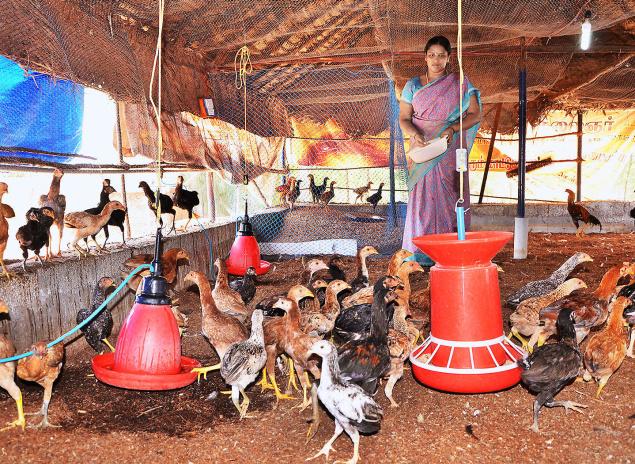
Country chicken farm at Keeranur in Sivaganga district. / Photo: L. Balachandar / The Hindu
Animal Husbandry Department plans to provide poultry sheds for free
As the country chicken (native breed or nattu kozhi) commands a niche market and prime rate compared to broiler chicken, the Department of Animal Husbandry has decided to encourage successful country chicken breeders by providing them additional sheds free of cost.
For the first time in Sivaganga district, those who had taken up country chicken breeding as an additional income generating source and bred three batches of birds, would be provided with an additional shed, costing about Rs. 1.25 lakh free of cost this year. The sheds measuring 331 square feet, would be built by involving the workers employed under the Mahatma Gandhi National Rural Employment Guarantee Scheme (MGNREGS), said T.Nagarajan, Joint Director of Animal Husbandry and B.Manivannan, Nodal officer, poultry scheme during a field visit.
The department has launched the process of short listing existing breeders to extend the benefit, they said. Besides, 160 new beneficiaries would be given front ended subsidy of Rs. 29,250 each to set up poultry farms during the current year under the State Poultry development scheme, they added.
The beneficiaries would also be entitled for back ended subsidy of an equivalent amount by the National Bank for Rural Development (NABARD) if they set up the farms, costing Rs. 1.25 lakh by availing loans from public sector banks. However, not many could get bank loans last year, they said. “We proposed 90 out of 240 beneficiaries for bank loans last year, but only 22 were given,” they said.
When contacted, sources in the lead bank said the banks could not concentrate on the loan applications last year when the model code of conduct for the elections was in force. This year public sector banks would be instructed to examine all applications and provide loans to eligible breeders, the sources said.
S. Kaleeswaran and his wife K. Sathya, practicing integrated livestock farming at their farm in Keeranur, have set up a country chicken poultry farm and had made a profit of Rs. 25,000 when they sold the batch of 220 birds. They, however, lost the second batch of 250 birds following diseases.
Veterinary Assistant Surgeon K.Suganya who periodically visited the farm said the birds had died of Raniket and Coccidiosis diseases, which affect the birds due to poor maintenance of litter. The farmers were advised to follow guidelines to avoid mortality, she said.
source: http://www.thehindu.com / The Hindu / Home> News> National / by D. J. Walter Scott / Kalayarkoil (Sivaganga) – June 29th, 2014