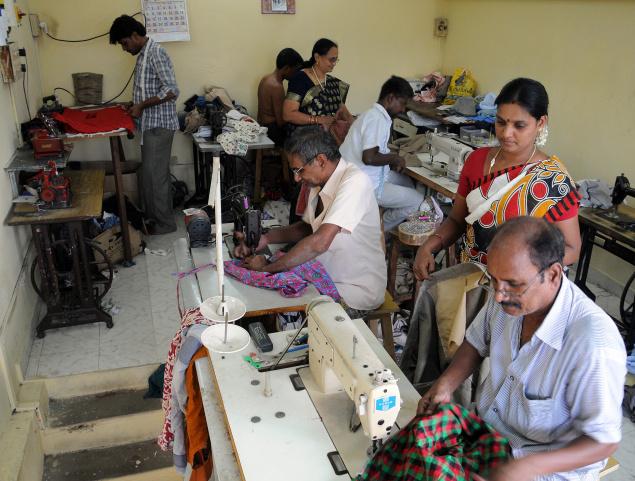
Giving clothes a second innings: Employees of Re-Stitch Point./ Photo: K. Pichumani / The Hindu
For 25 years, this small establishment in Mylapore has made a business out of a need to alter clothes, reports Liffy Thomas
Finding a tailor who specialises in altering stitched clothes is a challenge. More likely than not, your regular tailor is not keen on alteration work. If he accepts such work, he is likely to sit on it for a few weeks. And then, you don’t always trust the road-side tailor with an expensive dress.
For 25 years now, this shop specialises only in alteration of clothes for men and women. Re-Stitch Point at Mylapore does not take up stitching jobs. It does not have to. It has a huge number of customers giving it re-stitching jobs.
Not many tailors are keen on taking up such work, so that makes us different from most tailors, says M. Sashikala, who owns the shop.
Five tailors and two front-office staff take care of the day-to-day activities: taking measurement of customers and altering clothes.
From patchwork on an old and torn jeans to re-sizing a salwar kameez , the shop does it all, except for altering blouses.
A good number of customers want clothes altered for sentimental reasons.
For instance, a lady customer wanted a pair of trousers worn by her brother, who passed away, altered to fit her so that she could continue to wear it.
“It was a low-waist trouser and we had to add extra material to make it her fit,” said a staff that altering was more challenging that stitching.
Amjad Khan, who has been working in the shop for the last two decades, says the most difficult task is increasing the waist. “Unlike other parts that have extra stitches, here we have to get almost matching material to increase the waist,” he says.
Re-Stitch is keen on expanding, provided it gets more employees.
The shop is open from 10 a.m. to 1 p.m. and 4 p.m. to 8.30 p.m.
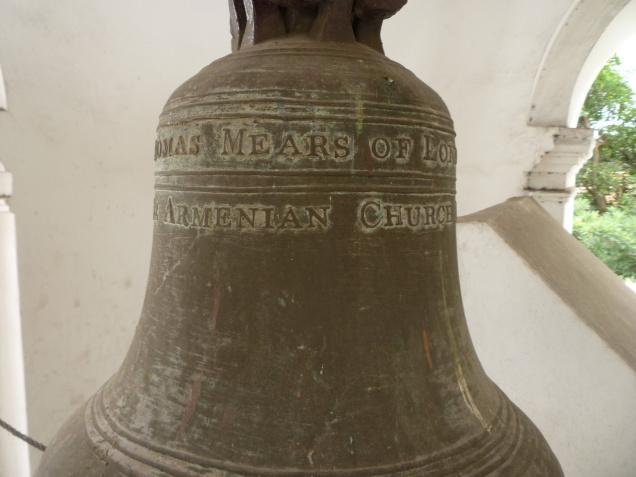
All the bells in the Armenian Church bear the stamp of Thomas Mears, which indicates that they were all cast between 1787 and 1844. / Special Arrangement / The Hindu
The Armenian Church standing on the eponymous street is one of my favourite locations in the city. Its solidly-built walls, quiet nooks and stately interiors fill me with a sense of peace that cannot be matched. Lovingly tended by the Armenian community in Calcutta and by the local caretaker Mr Alexander, it ought to be on every resident and tourist’s visit itinerary.
Leaving that aside, it was while walking around it with a group of Americans last week that I recalled that the heritage structure has its (albeit tenuous) links with the US of A. This concerns the bells of the church, which are housed in an independent three-storied tower, on the southern side of the yard. They are accessed via a three-century-old staircase by the more physically fit and brave. The church authorities restrict entry to the tower – a sensible precaution given the age of the staircase. The ground floor of the tower has three tombs all with the same carvings on the headstone. The inscriptions are in Armenian but they probably were members of the family that funded the tower. The belief is strengthened by the fact that the same motif as the headstones – winged angels, is repeated on all floors of the belfry.
The bells are rung every Sunday at 9.30 am. Said to be the largest in the city, there are six of them, donated at different times to the church, each weighing around 25 kgs. All of them were cast at the Whitechapel Bell Foundry of London. The company, founded in 1570, moved into its present premises in 1739 and continues in the same business. Talk about focus!
Given that all the bells in the Armenian Church bear the stamp of Thomas Mears, it indicates that they were all cast between 1787 and 1844, when two men of that name, probably father and son, were master founders with the company. It is of interest to note that the same company cast the bells for St Pauls Cathedral and Westminster Abbey in London, besides several other churches in England and the Big Ben in the Houses of Parliament in London.
Now for the American connect. The Liberty bell of Pennsylvania is one of the treasured heritage possessions of the USA. Commissioned in 1751, it was cast at the same Whitechapel Foundry and shipped to Philadelphia where it hung in the steeple of the Pennsylvania State House. It cracked even during its first ring and had to be recast twice locally before it could be used properly. A second and more lasting crack in 1835 ended its career as a ringing bell but it has remained a tourist attraction. Scaled down models of it, crack and all, remain popular souvenirs across the country. Our own ‘Belfry Six’ as the set of bells in the Armenian Church are referred to, have thankfully remained crack-free.
I wonder if any other church in our city has bells cast by the same company.
source: http://www.thehindu.com / The Hindu / Home> Features> MetroPlus> Society / by Sriram V / Chennai – June 27th, 2014
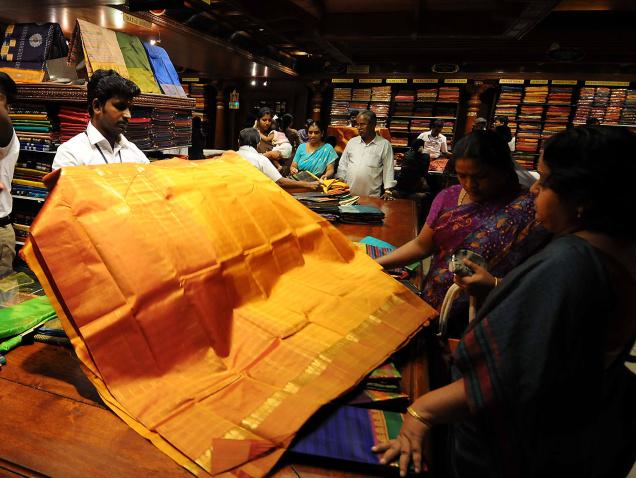
Chennai, well-known for its rich Kanjeevaram saris, can undoubtedly be called India’s Mecca of silk./ Photo: K.V. Srinivasan / The Hindu
In the age of social media, the traditional garment is unfurling itself in more ways than you can imagine. Pragya Priyadarshini traverses the lanes of T. Nagar to tell you why
If you think tradition and technology make for an incongruous marriage, think again. ‘Sari’, an app, can teach you how to drape your six unstitched yards like a professional, while your mother’s trusted silk-store is now creating Style Boards on Pinterest. The age-old sari has unfurled itself in more dimensions than our minds ever imagined.
Whether it is granting the wishes of its young connoisseurs or wooing the larger audience through the Internet, Sari like a mythological goddess with a hundred hands, is managing the incredible feat of pleasing women of all age-groups and how!
“Everything is quick now, the customers send us the designs of their choice through WhatsApp and we get them manufactured at our factory,” says A.B. Sidiq of Madeena Kalanther, a store in T. Nagar. “The designs are mostly from films, and television, especially Bollywood,” he says, as he turns the pages of the latest sari design catalogue, frequently pausing to point out the “filmi-saris” to me.
At a time when older generations are concerned about the increasing loss of tradition, the World Wide Web has made sure that the sari retains its magical charm in an ever-changing scenario. “With close to six lakh followers on Facebook, Twitter and Pinterest accounts, we are ahead of our competitors on social media,” beams Priyadarshini Ramesh of Pothy Silks. At 23, Priyadarshini, just out of college, is all set to bring in a fresh perspective to the business that her great-grandfather set up almost a century ago.
Chennai, well-known for its rich Kanjeevaram saris, can undoubtedly be called India’s Mecca of silk. The city exports saris to Germany, Russia and France where they have graced numerous red carpets. As I walk through the bustling streets of T. Nagar, making my way through the evening crowds with the aroma of lip-smacking street food hanging heavily in the air, each sari shop appears to be more lavish than the other. Some shops are spread across multiple floors, dressed in carved wood and glass-chandeliers, while others have an army of salesmen in matching uniforms to assist you, their lips curved in welcoming smiles, their hands joined in a vanakkam. Some of these shops have been here for more than half a century while the others, relatively new, are quickly catching up in terms of variety.
There was a time when saris from Chennai meant being exuberant Kanjeevarams with gold borders and temple prints, gracefully ending in pallavs with tassels. Snap out of that dream! Far from the Ramakathas and Dasavatara tales from olden times spun on them in conventional reds, blues and greens, saris today are inspired by every colour and theme under the sun. Saris are not confined anymore to Kanjeevarams and Pochampallis. From Kollywood designs to prints of auto-rickshaws, you’ll find symbols of namma Chennai ooru in a variety of saris.
“I have never seen my mother in anything else than a sari, she loves her silks,” says Amrutheshwari V., 23. When asked if she would wear one herself, she giggles, saying, “Yes, I would, but something more stylish you know, something modern.”
As I wander on my sari-quest through the city, at several places I am greeted with the new-age kitschy palm prints and Madhubani-inspired saris in bright colours. “You can’t wear heavy silks for occasions such as ethnic day in college or the valedictory function. Silks are okay for weddings, but for other occasions I would love to go for some funky kitsch designs on chiffons or crepes,” says 21-year-old Karthika Suresh, who speaks for girls of her generation. With street style trickling in, these new age saris also jostle for space alongside silks in many of the stores. “Saris in kitschy colours and prints are fashionable and fun, and they have been in demand, especially with youngsters, for three years now. Earlier, for all the wedding events, we wore just silks, but girls now want to wear something other than silk at receptions. That is where kitsch comes in, there’s nothing wrong with it,” says Priyadarshini. “Personally I would like to wear the designs and the silk that my grandmother wore 50 years ago. Fashion always gets back to its roots.”
Another store stocks a collection of beautiful half-saris called ‘Kochadaiiyaan’, named after the latest Rajinikanth flick. “There are always some customers who come looking for film names, every shop has them these days. Anything worn by Deepika (Padukone) or Sonam (Kapoor) becomes a hit, we have to meet the demand,” the manager says.
When some 150 years ago, Raja Ravi Verma, through his paintings, popularised the nivi drape as the Indian way of wearing a sari (with the pleats in front and the loose end draped across the shoulder), would he have ever imagined that this elaborate process of placing, pleating and pinning would turn into a quick-fix “tuck-and-go” affair. Gone are the days when grandmothers and mothers would spend their evenings carefully sewing gold borders onto their daughter’s trousseau, and chiffons and georgettes were ordered from abroad.
A lady’s silks were a symbol of prestige. While some lament the loss of hand-woven saris that lasted decades and were passed on as heirlooms, light and convenient machine-made saris have come as a whiff of fresh air to others. Either way, each strand of this six-yard- long canvas still has a story to tell. It is the story of a tradition, which has gracefully made its way from the treasure chests of our grandmothers to the aisles of modern-day boutiques. One that has synchronised its rhythm with our fast-paced times. Like a perpetually flowing river it can never go out of fashion. A celebration of our culture, our history and who we are, the sari is here to stay.
source: http://www.thehindu.com / The Hindu / Home> Features> MetroPlus / by Pragya Priyadarshini / Chennai – June 27th, 2014
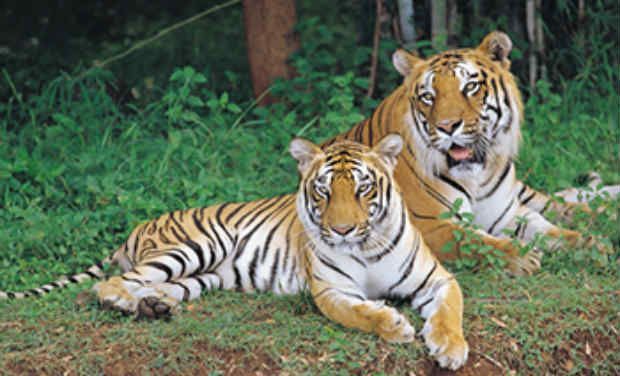
Picture for representational purpose (Photo: DC archives)
Erode:
The newly-declared Sathyamangalam tiger sanctuary has emerged the largest tiger country in Tamil Nadu, with at least 60 tigers stalking the sprawling jungles. According to the latest official count, the population of the big cats has more than doubled and about 60 tigers have been captured on the hidden cameras in just four blocks of the 1405 sq.km Sathyamangalam jungles in Erode district, which was once an infamous haunt of bandit Veerappan.
“We have visual evidence of a vibrant tiger population with an attractive prey base in the Sathyamanglam jungles. The camera trappings have spotted between 50 and 60 tigers. However, the sprawling forest has the capacity to carry at least 100 tigers,” the Erode Conservator of Forests, I. Anwardeen told DC.
Interestingly, the tally of tigresses spotted in the four blocks surveyed by the Word Wildlife Fund (WWF) in Sathyamangalam unfolds a tale of huge hope for the big cats.
source: http://www.deccanchronicle.com / Deccan Chronicle / Home> Nation> Current Affairs / DC / by H. Zakeer Hussain / June 28th, 2014
A miniature model of World Cup and a lively football match made out of gold (Photo: DC)
Coimbatore:
Here is shining example of what the football World Cup frenzy can do to a fan. G. Venkatesh, a goldsmith by profession and belonging to Vellalore, has crafted a beautiful miniature model of the World Cup using 130 milligram of gold.
Venkatesh, who has been making miniature objects using gold since 2009 hoping to create a Guinness record, has fashioned the football World Cup, all of 0.7 millimetres, with just 130 milligrams of gold.
Along with it, he has also crafted a replica of a lively football match with a team of miniature players, all made of gold, running around a ball. “I used to play football during my school days. Nowadays, I get to watch matches on television despite my painstaking and demanding job schedule,” he said. It took nearly 12 long hours for him to craft the World Cup and recreate the match scene.
Claiming to have dropped out of school after class 7, Venkatesh said his dream is to become a record-holder – like the achievers he sees on TV. Venkatesh is now busy crafting a miniature car, whose doors could be opened and wheels move.
“I had participated in few exhibitions and showcased my works and won appreciation. Some even came forward to buy my models for a good price, but I do not want to sell them,” he said. He hails from a poor family as his father T. Ganesh is a painter, mother G. Rajeswari is a homemaker and brother G. Manikandan is into crafting furniture.
source: http://www.deccanchronicle.com / Deccan Chronicle / Home> Nation> Current Affairs / DC / by V. Ashok Kumar / June 25th, 2014
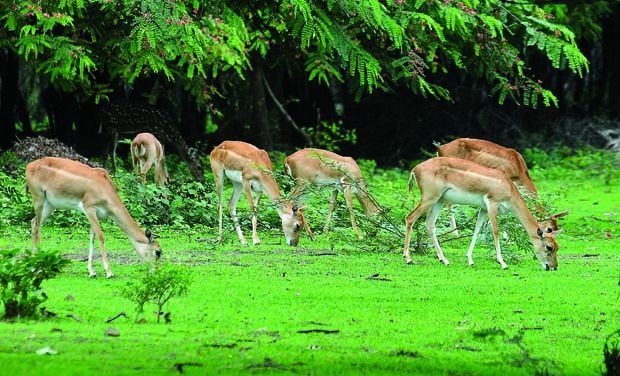
Its not all about technology at the IIT-M. Showing concern for the blackbuck population on its campus, which has increased from 13 in 2007 to 34 this year and other deer roaming its grounds, the institute has decided to create deer corridors with adequate space between buildings to allow the animals free movement.
“The architects drawing up a master plan for the institute have recommended that we demolish the old buildings and construct six storey ones with space in between for the deer to roam the grounds. We have decided to go along with this,” said IIT-M director, Prof. Bhaskar Ramamurthi.
Noting that the institute had always given priority to conserving nature and animals on campus, he explained that the idea was to create more open space as several old buildings had hardly any distance between them. “We have several buildings like these at Triplicane and Mylapore, which we will now replace with taller more widely spaced constructions,” he added.
The institute has also identified a couple of houses near the lake for demolition to preserve its natural surroundings.
“As it is a low-lying area the houses are often flooded. Whenever these houses get condemned we will demolish them and their occupants shifted to multi-storey buildings that will be constructed in areas where they are permitted,” he assured, adding that the new area identified by the architects was less than three per cent of the cap placed by the institute.
Prof. Bhaskar Ramamurthi has been associated with the institute for over three decades as student ,faculty and director.
The IIT-M’s annual animal census last year found 34 blackbucks, 238 bonnet macaque and 403 chital deer on campus.
Wildlife conservationist R.J. Ranjith Daniels said the increase in number of blackbucks on IIT-Madras campus could be termed a success story in conservation and planning.
“We recommended to the institute to identify critical habitat, identify territories and the area of herds to preserve them, which the institute did and the number of blackbucks increased. With equal number of male and female population we now have good scope for breeding,” he said.
source: http://www.deccanchronicle.com / Deccan Chronicle / Home> Nation> Current Affairs / by N. Arun Kumar / June 15th, 2014
Singeetam Srinivasa Rao remembers Dikkatra Parvathi, his first film in Tamil, based on Rajaji’s story
Singeetam Srinivasa Rao’s first film was in Telugu, a 1972 comedy named Neeti Nijayiti. It flopped. For his second film, he wanted to do something different. “At that time, there was this big art-cinema movement,” he told me last week. “We were very inspired by the neorealistic films, and by Satyajit Ray. That’s how Dikkatra Parvathi happened.”
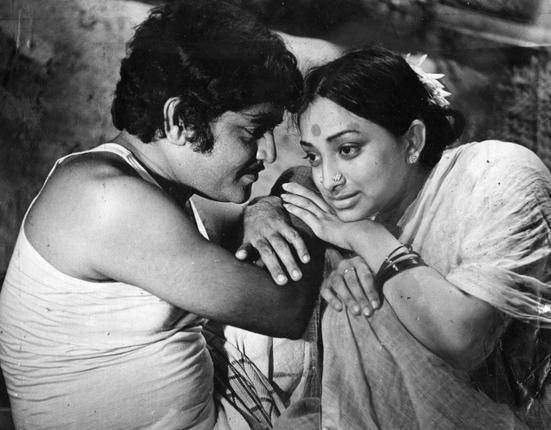
A still from Dikkatra Parvathi / by Special Arrangement / The Hindu
Ray’s Pather Panchali had become the touchstone for young filmmakers, and Rao followed its lessons scrupulously. Because Ray’s film was scored by a classical musician (Ravi Shankar), Rao brought in the veena maestro Chitti Babu to compose the soundtrack for his film, which turned 40 this month. And because Ray’s film was based on a classic work of literature (by Bibhutibhushan Bandopadhyay), Rao too decided that his film would be based on a literary story that had fascinated him: Fatal Cart.
That was the English translation of C Rajagopalachari’s Dikkatra Parvathi. “Those days,” Rao told me, “it was easier to get funds from the Film Finance Corporation [the earlier avatar of the National Film Development Corporation] if your film was based on a classic.” He put in fifty thousand of his money, and the rest of the two-lakh budget came from FFC – Dikkatra Parvathi was the first Tamil film financed by the organisation.
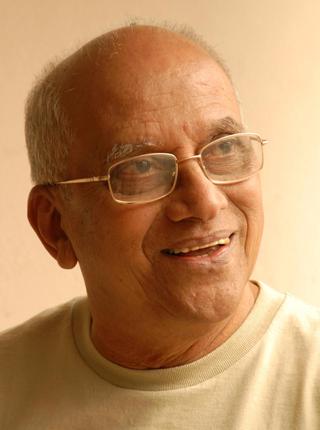
Filmmaker Singeetam Srinivasa Rao / by Special Arrangement / The Hindu
Seeking further financial assistance, Rao decided to shoot the film someplace a little beyond the Tamil Nadu-Karnataka border, because the Karnataka government was offering subsidies (up to fifty thousand rupees) for films shot in the state. But when they discovered that Rajaji’s birthplace, Thorapalli, was just seven kilometres from Hosur, where the unit was camped, Rao’s wife convinced him that the film had to be shot there. “The village looked exactly like the one described in the story,” Rao said. “Plus, we got the satisfaction of shooting Rajaji’s story in Rajaji’s birthplace.”
Rao was hesitant, at first, to approach the 94-year-old Rajaji and take permission to film his story. “He hated films,” Rao said. “I wanted to make a film from a story of a man who hated films.” Later, Rajaji assured him that he only hated bad films. Rao remembers the day he met Rajaji: 7 December, 1972. “December 10 was his birthday and there would be a constant stream of visitors. So I went earlier.” Rajaji died soon after, on Christmas day, and the permission letter he gave Rao contained his last signature in an official capacity. More than a year later, his children attended the preview of Dikkatra Parvathi, which was “dedicated to the memory of Rajaji.”
The story is about newlyweds Parvathi (Lakshmi) and Karuppan (Srikanth), whose happy – if impoverished – life is ruined when he becomes an alcoholic and is unable to repay his loans. Two stretches stand out. The first occurs when Karuppan, goaded by a cohort, begins to drink. This is his first time. He asks, almost innocently, if drinking isn’t wrong and if you begin to smell if you drink. He takes his first sip and spits out the cheap liquor. The people around him laugh – we don’t see them (the camera stays focused on Karuppan), but we hear their mockery. And as if to prove a point to them, Karuppan drains the bottle.
This self-destructive male behaviour is balanced, towards the end, by self-destructive female behaviour. Parvathi is constantly hounded by a moneylender’s son (YG Mahendra) who is panting after her, and at one point, he enters her home when Karuppan is away. What happens next? We are kept in suspense, as the film cuts away to the aftermath: a court case. (Rao shot these scenes in a courthouse in Hosur, corralling local lawyers into the cast.) Over the song Enna kuttram seidheno, we get incremental flashbacks that lead us to the climax, where we learn what really occurred that night. It’s one of the rare times a Tamil-film heroine has been allowed to remain human.
Lakshmi was cast because Rao was impressed by the mobility in her face. “She was acting in a lot of ‘glamour roles’ then,” Rao said. “I saw her without makeup one day, and knew she was right for the role.” As for Srikanth, he was cast because he was not “the regular hero.” Dikkatra Parvathi was shot in 22 days by the cinematographer Ravi Varma, who had just finished work on a Malayalam film namedSwayamvaram, made by a first-time filmmaker named Adoor Gopalakrishnan. Rao said, “Adoor used to come by for the rerecording sessions of Dikkatra Parvathi.” The score, though, hasn’t aged well. Over the opening credits alone, we hear the veena, mridangam, morsing, tabla, shehnai, sarangi, flute – the resulting symphony, today, sounds too ostentatious for such a small, intimate film.
Dikkatra Parvathi was censored on December 31, 1973, but the film couldn’t be released due to an impasse. The FFC demanded repayment of their loan before they would issue the release letter, and the distributors insisted on the release letter before they coughed up the funds that would allow Rao to repay his loan to the FFC. When the director ran into MG Ramachandran, the Chief Minister, and spoke about his predicament, the latter instructed his secretary to buy the film.
This was the first time in the Indian film industry that a film was procured by a state – though MGR wasn’t exactly looking at it as a work of art. He had in mind other, more practical uses – as a propaganda film to further the cause of prohibition. Still, Dikkatra Parvathi was back in Rao’s hands. It was released in one theatre in Chennai, Little Anand. It would be almost a decade before he made his next Tamil feature, Rajapaarvai.
source: http://www.thehindu.com / The Hindu / Home> Features> MetroPlus / by Baradwaj Rangan / June 28th, 2014
Taking the recently constructed fish landing centre at Nagore to a higher degree of functionality, a new project of building breakwaters (bulkheads) to prevent siltation of the bar mouth at Vettar in Nagore has been launched here.
The project envisages setting up of breakwaters of up to 330 metres long, with an underwater depth of 4.3 metres and above water height of four metres.
The proposal envisions providing a secure harbour in the fish landing centre for the fishing boats that were hampered by intense and frequent siltation resulting from long-shore drift.
An official source told The Hindu that the heightened siltation and sedimentation is caused by similar bulkheads built by the Marg Port in Vanjoor in the vicinity of Nagore.
The fish landing centre was recently made operational at a cost of Rs. 6 crore.
However, the fishing boats faced difficulties in passing through Vettar bar mouth because of siltation, posing the need for frequent dredging.
The breakwater project under the Modernisation of Coastal Inlet of the Vettar and funded by NABARD under its Rural Infrastructure Development Scheme envisages an estimated cost of Rs. 11 crore.
For NABARD, it is the 19th scheme under RIDS for the district.
The project implemented by the Fisheries Department has been awarded to Erode-based Sripathi Associates with a completion period of 12 months.
Consultations for the project has been provided by IIT Madras.
According to the official, the project is proposed to be completed within nine months, with a three-month buffer period in the event of monsoon hurdles.
Earlier, the foundation stone for the project was laid by Minister for Fisheries K.A. Jayapal here.
source: http://www.thehindu.com / The Hindu / Home> News> Cities> Tiruchirapalli / by Staff Reporter / Nagapattinam – June 24th, 2014
United India Insurance wins contract for pensioners’ health insurance scheme in Tamil Nadu
Chennai :
The Tamil Nadu government has chosen United India Insurance, the public sector insurance company, for implementing the health insurance scheme for pensioners and family pensioners.
The company was chosen in an open bid and contract had been awarded for four years, said a government order issued by the finance department on Thursday.
The scheme pertains to provision of medical insurance to pensioners and family pensioners. The state government will pay the insurance premium along with the service tax to the insurance company on behalf of all the pensioners and family pensioners.
Finance minister O Panneerselvam made an announcement in the budget speech about the scheme and the finance department fixed the quantum of assistance at Rs 2 lakh to the pensioner and his or her spouse as well as family pensioners.
The pensioners and family pensioners will have to contribute an amount as subscription and the rest will be contributed by the government.
If the spouse is also a pensioner, the subscription would be collected from one person only, based on the option exercised by them, said a finance department official.
The amount of the pensioners’ contribution to the scheme would be decided after the selection of the insurance company and finalisation of the costs, said the order.
The scheme for pensioners and family pensioners is different from the general free insurance scheme which is for people whose income is below Rs 72,000 per annum.
source: http://www.timesofindia.indiatimes.com / The Times of India / Home> City> Chennai / by B. Sivakumar, TNN / June 27th, 2014
When a transplant team from Apollo Hospitals walked into Sri Ramachandra Hospital in the early hours of Friday to harvest three abdominal organs — liver, pancreas and small intestine — for transplant, they had little medical literature on what was a complex transplant within the country. But they seemed confident.
Although the surgeons have carried out complex liver transplants, they have done just one pancreatic transplant in the past, and no intestinal transplant. “Transplanting pancreas and intestines is very rare, and the combination makes it more complex . Intestine transplant has high failure rates. One surgery in Chennai had failed,” said a transplant surgeon. The surgeons could not speak in detail after the 12-hour transplant, but said they used refined techniques, effective immunosuppressive drugs and had better quality donor organs this time.
In the 2000s, transplant surgeon Dr Shanmugha Bhaskar performed a bowel transplant at Madras Medical Mission with organs harvested from a brain-dead patient at Government General Hospital, but the patient died. There were no attempts at bowel transplant in the state after that. In November 2012, Delhi-based Medanta Hospital did a small intestine transplant on a 30-year-old patient. “This is the first time we are doing a small intestine transplant, and we have combined it with two other organs,” the surgeon said.
Patients with intestinal failure, on most occasions, develop nutrition-related complications. But doctors say they have ensured the patient at Apollo Hospital was fit for surgery. While a team of surgeons were preparing the patient, another team retrieved the abdominal organs and rushed them to the transplant hospital. In the next 12 hours, doctors transplanted the three organs into the patient who had suffered multiple organ failure. The patient, who is in an isolated room of the ICU, is recovering well, doctors said.
However, doctors warn that it’s too early to call the transplant a success. “Post-operative care is the most difficult part in a cluster organ transplant. The recipient’s system may reject the organs or the patient may develop infection,” said liver transplant surgeon Dr R Surendran of MIOT Hospitals. The patient will be kept on high doses of immunesuppressive drugs to ensure that his body does not reject the new organs. This in turn increases chances of infection. “A sterile environment in post transplant medication and round-the-clock care is needed,” he added.
About 70 such transplants occur worldwide every year and the survival rate is about 65% to 70% in the first year.
source: http://www.timesofindia.indiatimes.com / The Times of India / Home> City> Chennai / by Pushpa Narayan & Janani Sampath, TNN / June 27th, 2014