Doctors cure toothache that was almost fatal

Chennai :

When 59-year-old V Srinivasan fixed a dentist appointment for a toothache, little did he know that two weeks later he would end up in an operation theatre with life-threatening complications.

By the time the bank employee was admitted to a city hospital, he had a huge swelling in his neck, slipped in and out of consciousness and suffered from breathlessness. A preliminary glimpse of his scan reports was sufficient for doctors to pinpoint the cause.

The tooth infection had spread to his carotid artery – the vessel that supplies blood to the brain – causing severe swelling that constricted his wind pipe and limited blood supply to his brain. “The fact that he was diabetic added to the complication,” said neurosurgeon Dr K Sridhar. He led three surgeons and a dozen others to conduct a 12-hour surgery removing about 9cm of the diseased portion of the artery and creating a bypass to resume blood supply to the brain. At every stage of planning, doctors had to monitor Srinivasan’s sugar levels. “He had undergone an amputation of a few toes after they developed gangrene. First, we thought the infection was from his foot, later we realised the infection had spread from his tooth,” said Dr Sridhar.

The scan reports revealed three aneurysms (blood-filled balloon-like bulge on the wall of a blood vessel) in the carotid artery. “One had already burst, if the other two also ruptured, we knew we would lose the patient,” said neuro interventionist Dr Joy Varghese

Before the surgery, an infectious diseases specialist was roped in to help control the diabetes and infection in the body. “The surgery was complex as we had to be wary of the two aneurysms which could rupture at any point,” said Dr Varghese.

Two weeks after the surgery, Srinivasan was out of the intensive care unit and presented before the media on Thursday. Tubes still ran along his frail body as he was wheeled into the room, but his family vouched that he looked much healthier than a month ago, when they thought they had almost lost him. “When doctors at the hospital explained his condition, I had a sinking feeling. They told me the risks involved, but I decided to take the chance,” said Surya S, his wife. Doctors say he will be discharged in a week.

source: http://www.timesofindia.indiatimes.com / The Times of India / Home> City> Chennai /  TNN / June 27th, 2014

With trophies from past, he travels for an informed future

Hosur :

A wide range of ancient terracotta vessels, pieces of smoke pipes, roof tiles and tools that belong to pre-historic period are spread on the table. C Veeraragavan’s love for ancient pieces began 25 years ago when he first found a three-legged terracotta jar near his home in Villupuram. Today, with more than 40 rare pieces, this 66-year-old conducts exhibition in various parts of Tamil Nadu to create awareness among youngsters about our history and arts.

The retired school teacher, who travels across the state showcasing his rare collection, says: “It’s not for money, it’s my passion. I spend from my pocket most of the time, as transporting these ancient pieces is not easy. They require proper care. But, I love doing it. I want children to know about our history.” Veeraragavan had exhibited his pieces as part of a two-day national seminar on ‘Hero Stones’ held in Hosur recently.

Veeraragavan also maintains a collection of 60 estampages of hero stones and inscriptions from various parts of Tamil Nadu. Hero stones are a type of memorial stones erected for the dead, who did exemplary work for the benefit of a society or community. “Taking the estampages of hero stones is not easy. I would go to the spot early in the morning, and start my work. It would take many days to get a perfect copy. Many hero stones faced vandalism in the later years, but I am happy that I have at least the copies of those rare pieces,” he says.

Veeraragavan’s collection has stone tools dating back to paleolithic and neolithic periods. He will even tell you about the minute differences in the tools from the two different pre-historic era. The terracotta vessels dated back to 2nd century BC to 2nd century AD. Although he is happy to conduct exhibitions, he is a bit worried about the pieces that were stolen from his collection during exhibitions. “Someone stole a beautiful chariot from my collection two years ago. Recently, someone stole a precious bronze jar,” he says.

But, these problems apart, Veeraragavan says he will continue his exhibition across TN. “I know the importance of this job. I have collected all these ancient pieces from the surface of the earth. Nobody is allowed to do excavation without permission. I am preserving it for the future generation,” he says.

source: http://www.timesofindia.indiatimes.com / The Times of India / Home> City> Chennai / by M. T. Saju ,  TNN / June 25th, 2014

Watts of energy from sugarcane, soon

Sugarcane Breeding Institute develops varieties that can be alternative energy source

Coimbatore : 

The Sugarcane Breeding Institute in Coimbatore has developed two types “energy canes” – one which can provide sugar and energy and the other which can be a feedstock for ethanol.

The canes are being field tested, according to institute Director N Vijayan Nair said.

He told Business Line on the sidelines of a National Symposium on “Bio-energy for sustainable development – the Potential Role of Sugar crops” that a few clones of energy canes are being tested at Samalkot in Andhra Pradesh.

The institute has registered the clones with the National Bureau of Plant Registry.

Stating that the energy canes were only at the testing stage, he said that the can which can produce sugar and energy can be processed in the existing sugar factories.

The second type, which can be handy for generating energy, has high fibre and biomass yield. It has been developed with an eye on the future. “This can be used for production of cellulosic ethanol,” Nair said.

The Institute plans to promote cultivation of such canes in marginal lands, he said adding that the initial results have been positive.

Nair also said that the technology for cellulosic ethanol was changing rapidly. It nevertheless offers enough opportunity in the coming years.

The Institute, he said, was not a front-runner in this technology, but foreseeing the requirement of feedstock for ethanol, developed bio-energy canes.

“While the development this far has been appreciable, the issue is, we are not integrated on feedstock development or integrating other technologies or in development of research labs that work on process optimisation and other related technologies. Each exist in silos,” he said.

source: http://www.thehindubusinessline.com / Business Line / Home> Markets> Commodities / by L N Revathy / Coimbatore – June 25th, 2014

Language of preservation

Sandwiched between the stark walls of two-storied concrete buildings is a small tiled-roof structure with wooden beams and trellis work painted green. The 100-year-old building in which the Madras Sanskrit College began stands dwarfed by newer structures that have come up around it to accommodate the 80 students that the college teaches today.

“Though other structures have come up around it, we have kept the original building intact as we are proud of being a 100-year-old institution. We wanted to keep it while expanding the college to meet modern needs. Classes are still conducted here,” said college manager H Subramanian, showing the staircase to the first floor, which has railings made of Burma teak.

Constructed in 1910 by jurist and philanthropist V Krishnaswami Iyer, who contributed a fair share to the growth of Mylapore, it was the only building on campus when the college — established in 1906 with about 500 students — moved from nearby Pellathope. It was constructed on 5,000sqft with a single floor. The building looks more like a house with a small verandah and plants curling across the windows and red roof tiles. The building cannot be classified into a particular style or type but follows the style of construction adopted in the early 1900s for office buildings. “You’ll find many collector’s offices and other government buildings in this style in the districts. There were many of them in Mylapore too. This was the style of office buildings in the early 20th century with high ceilings and large windows that practically touched the ground,” said Intach convener S Suresh.

The college was set up by Krishnaswami with two others, who formed a committee to prevent the loss of Sanskrit. Back then, as now, students studied the basics of the language and its grammar and get a ‘Visarada’ in Veda and Vedanta certificate at the end of five years.

The building is supported by iron and wooden beams with high ceiling which makes it well ventilated. Similar structures surrounded it for many years, and the campus had a lot of trees. “Classes used to be conducted under the trees for many years,” said Subramanian.

Over the years with the expansion of the college, trees gave way to buildings and the house-like structures on either side of the heritage building had to accommodate a hostel and a research institute, said Subramanian. A few trees are still left on the front and rear side of the main heritage structure.

“The main building was whitewashed in January. The old tiles and wooden beams were carefully removed, painted and replaced during the renovation. As the tiles were in good condition we did not change them,” said Subramanian. The building houses the college office and lecture hall on the ground floor and examination hall and mini hostel for students on the first floor. “Despite having new buildings, the principal conducts lectures and holds discussions on the first floor. It is so well ventilated that we don’t have an airconditioner though a proposal is pending,” said Subramanian. On the first floor are wooden cupboards from the old days.

Over the years, the building has had many famous visitors. On April 28, 1915, Mahatma Gandhi visited the college. A few years later on October 9, 1922, Rabindranath Tagore visited the college and said he was pleased with the teaching of Advaita philosophy.

source: http://www.timesofindia.indiatimes.com / The Times of India / Home> City> Chennai / by B. Sivakumar, TNN / June 27th, 2014

3,000-year-old paintings found near Palani

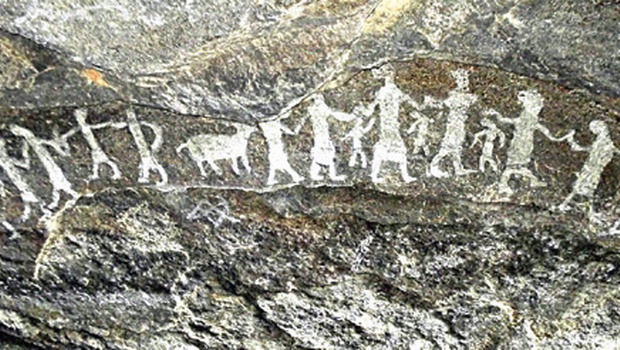
This cave painting depicts men, women and children dancing during a festival | Express

Paintings that are over 3,000 years old, belonging to the Sangam period, showcasing the love and valour of Tamils, were discovered in the Andipatti hills near here on Sunday.

V Narayanamorthy, Secretary of the Tamil Nadu Archaeological Research Institute, and his team came upon the paintings when they were inspecting some caves, west of Andipatti hills.

He said, “The faded paintings have been found in over 10 places in the cave and were painted in white colour using a mixture of limestone, natural gums and herbal extracts.”

One of the paintings shows a group of women carrying pots of water on their heads, while another shows men, women and children dancing together at a festival, holding hands. What’s interesting is that this kind of dance can still be seen in the Paliyar and Puliyar tribal communities, the archaeologists said.

Another picture shows people getting ready to sacrifice a goat for a festival.

The paintings also tell stories—one of an elephant captured and trained, on which the king goes for a ride surrounded by guards. Several scattered paintings depict men, women and tigers and hunts undertaken.

The caves were in frequent use about 2,000 to 3,000 years ago.

source: http://www.newindianexpress.com / The New Indian Express / Home> Sates> TamilNadu / by Express News Service – Palani / March 04th, 2014

New stapler method to treat constipation

Chennai :

Malar, 49, was suffering from a problem she thought was unspeakable and untreatable. She had been suffering from chronic constipation for 15 years and no amount of laxatives or fibre-rich food helped.

Malar’s is not a stray case. Doctors say many people suffer from this and nearly 70% of them are women who have given birth. Most of them suffer from a condition called obstructive defecation syndrome (ODS). In this, the lining of the rectum juts out every time the patient strains and obstructs motion, thereby making it impossible for the person to pass motion regularly. ODS causes severe headache, depression and decreased self-esteem. Dr Rajkumar of Rigid Lifeline Hospitals said that it is also one of the common causes of colorectal cancer.

“Since the surface of the bowel is in constant contact with toxic body waste and carcinogens, it puts such people at a cancer risk,” he said. The doctor pointed out that many people who suffer from ODS are not aware of it and suffer in silence. “Till very recently, there was no cure for this. But now we have a new method called stapled ano-rectal resection which is a safe and cost effective method involving minimal pain and hospital stay,” he said.

source: http://www.timesofindia.indiatimes.com / The Times of India / Home> City> Chennai / TNN / June 27th, 2014
Celebrating the act of goodness

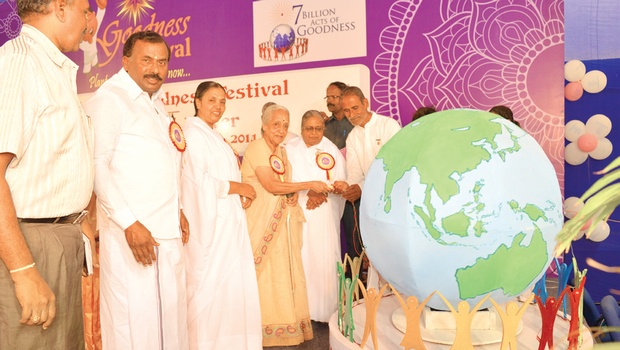
Dr V Shantha, chairman, Cancer Institute, Adyar, inaugurating the emblem of the global project ‘7 billion acts of goodness’. Mayor Saidai Duraisamy is also seen

Chennai :

The Prajapita Brahma Kumaris Ishwariya Vishwa Vidyalaya, an organisation that imparts teaching and education on spiritual and moral values, launched ‘The Goodness Festival’ at Besant Nagar in the city on Friday. The festival is a three-day programme that aims at creating awareness about the values of self, god and acts of goodness through several lectures, seminars and workshops.

The launch ceremony had an introduction to the global project undertaken by Brahma Kumaris titled ‘7 billion acts if goodness’, which was intended to encourage everyone to perform at least one act of goodness a day.

Mayor Saidai Duraisamy, who inaugurated the event, said that the primary concern in life was good health, and that one must inculcate good eating habits to enjoy a healthy life. “A healthy person is capable of performing good actions. Only a person who eats healthy can think healthy and consequently perform good actions,” he said.

T S Krishnamurthy, former Chief Election Commissioner of India, complemented the efforts taken by Brahma Kumaris in the field of improving the quality of lives. “I sincerely hope that festivals such as these contribute to the welfare of humanity,” he said.

The investiture was followed by a lecture on the topic, ‘Women – The ICON of power’. Speaking on the topic, Dr V Shantha, Magsaysay awardee and chairman of the Cancer Institute said, “We have been talking about empowerment of women with reference to the lawful dues a woman must acquire. However, empowerment comes from what a woman is capable of. Every right has its responsibility and therefore, education and awareness are extremely important for one to understand what women empowerment is all about.”

“India is ranked 118 among 177 nations, as far as women emancipation is concerned. That’s the reason we are still unable to say confidently that we have empowered the women.” She also added that female infanticide continued to be a problem in North India, and that the lack of independence for women, zero decision making power in the family and the traditional patriarchal mindset posed serious threats to the idea of women empowerment.

Padma Venkataraman, vice president of Women’s Indian Association, said that the concept of empowering women should not be construed as a war between men and women, but a movement that aimed at gender equality.  Nanditha Krishna, director, the CP Ramaswami Aiyar Foundation, said that first step in being good could be by uttering good and kind words.  The second day of the event, which will be held on Saturday, will see competitions among school students on various topics and a session for school teachers and college professors.

The third and final day of the event will provide special attention to senior citizens, who reside at old age homes, accompanied by lectures by renowned personalities.

source: http://www.newindianexpress.com / The New Indian Express / Home> Cities> Chennai  / by Express News Service  / June 28th, 2014

After 10-yr Lull, FRCS Exam Stages a Comeback in India

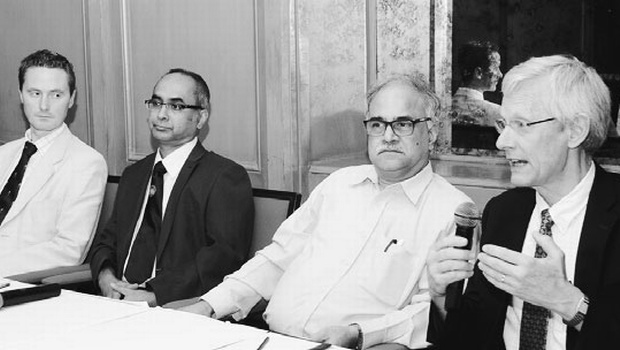
Dr Robert Murray, FRCS chief examiner, Dr Simon Madge and Dr Chakraborty, FRCS examiners, and T S Surendran, vice-chairman Sankara Nethralaya in Chennai on Thursday | A s Ganesh

Chennai :

After a decade, Britain’s prestigious FRCS examination made a comeback in India, when candidates from across six Asian countries appeared for the second segment of the three-part Ophthalmology tests conducted at Sankara Nethralaya in Chennai.

Briefing the media here on Thursday, an examiners’ team, led by Dr Robert Murray, from the Royal College of Surgeons of Edinburg (RCSEd) that conducts the examination, said a total of 39 candidates from India, Pakistan, Singapore, Myanmar, Indonesia and Sri Lanka took the FRCS (Part B) examination in Ophthalmology at the leading eye care hospital in the city. The examination was an exhaustive evaluation of the clinical expertise of the candidates, who had qualified Part A (theoretical). The final part included four years of training, the examiners said.

Stating that the Asian system of education seemed to be on the right path, Dr P Chakraborty, a JIPMER graduate and FRCSEd examiner, said the objective was to promote educational research and training exchanges between the institutions in the UK and India.

“We are here because of the demand,” Dr Murray said, adding that the last two parts of the FRCS examination revolved around good medical practices, including ethics. Candidates must answer questions related to interactions with patients, colleagues and drug companies. “Ethics is covered in both parts, but in greater detail in Part C,” he said.

On the quality of the Part B candidates, another examiner, Dr Simon Madge, said, while some were outstanding, others needed more training.

Dr T S Surendran, vice-chairman, Medical Research Foundation, Sankara Nethralaya, said the FRCS examination was seeing a revival at the hospital after a break of 10 years.

source: http://www.newindianexpress.com / The New Indian Express / Home> Cities> Chennai  / by Express News Service  / June 27th, 2014

Govt’s fruit farm in Salem gets 3-star rating for big yield

Salem :
The government’s fruit farm in Karumandurai in Salem district has received three stars in the agriculture ministry’s five-star rating system. Spread over 1,050 acres, the farm produces varieties of mango and other fruits.The National Horticulture Board, part of the agriculture ministry, gave the Karumandurai Tamil Nadu Government Fruit Farm the rating for its nursery maintenance and plant and fruit production.”This rating would be applicable for two years. We are growing more than two lakh saplings of alphonso, neelam, malgova and imam pasanth mangoes every year. We also raise one lakh guava plants, 20,000 sapota and 10,000 pomegranate plants. Apart from these, we grow other fruits such as banana and jackfruit. Every year, we grow more than 6 lakh fruit plants and made a profit of 17 lakh in the last financial year,” said A Mohan, horticulture officer at the farm.He said a farm should have consistently produced good quality fruit plants for at least three years before it is eligible for the rating. The volume of production should increase every year.

The horticulture department has 66 fruit farms across the state, of which Karumandurai farm is the biggest. The farm, started in 1981, is one of the largest in south Asia.

He said TNGFF has insect-proof screen houses, soil sterilisation yards and indexing against viral and virus-like diseases. Nursery plants are reared under the care of pathologists, entomologists and horticulturists.

The horticulture officer said this year they have planned to sell more than 6 lakh fruit plants to growers and nursery owners and that targets for coming years were also being fixed. The nursery plants of sound health ensure better life expectancy and performance in the orchards, he added.

(AM Shudhagar will send fruit farm photos)

source: http://www.timesofindia.indiatimes.com / The Times of India / Home> City> Chennai / by B. Senthil Kumaran , TNN / June 25th, 2014 

Gung ho about Tamil Nadu buses, blog offers need-to-know info

Chennai :

‘Atomic Express’ is neither a new train nor the title of a film. The state government bus gets its name because it plies between Kalpakkam, home to Madras Atomic Power Station, and Bangalore. ‘Triseas’ are buses that buses that originate from Kanyakumari, where the Arabian Sea, Bay of Bengal and Indian Ocean meet. And ‘Anandha Paravai’ (Happy Bird) flies from Kuttam to Chennai and to Coimbatore.

These quirky names are a rage in the interior districts of Tamil Nadu. They may be largely lost on the urban crowd, but not for much longer.

Five young bloggers provide information on buses operated by Tamil Nadu State Transport Corporation. They announce new routes and timings, put up photographs of TNSTC buses and meticulously send mails to subscribers. The blog, tnstc.wordpress.com, is viewed around 2,500 views a day, has 500 subscribers and has had 10 million visitors since it started two years ago.

Preetham Sri Krishna Vignesh, who works in an automobile company in Coimbatore, says he and his friends in Coimbatore, Chennai, Hosur and Tuticorin started the blog in 2012.

“We wanted the world to know that these buses do a great job,” Vignesh said. “Back then the only way to get information about timings was to ask your friends or the depot time keeper. We decided a blog would be a good platform to provide information.”

Another of the bloggers, K Dhandapani, says private buses are getting more fancy all the time – some of them offer WiFi, TV, comfortable seats and even toilets – but government buses do not get any publicity.

“They connect some of the most remote routes in state, like Kodaikanal to Pallangi, but few know this apart from people who commute on the route,” Dhandapani said. “Government buses should be promoted. There are so many positives about them.”

The bloggers source information from newspapers (often translated from Tamil), personal experience and fellow bus enthusiasts. “Twenty people collect details from local bus stands and update the blog,” Dhandapani said. “We’ve even started to use RTI petitions to see how the corporation decides the fares.”

The government got into the act long after portals like Redbus and Ticketgoose. The state started online booking in late 2011 and, a year later, netted more than Rs 1 crore through online booking on a single day.

But users say the government’s website is slow. “It’s not user-friendly like other portals,” said Arun Kumar, who books tickets frequently through tnstc.in.

source: http://www.timesofindia.indiatimes.com / The Times of India / Home> City> Chennai / by Karthikeyan Hemalatha, TNN / June 23rd, 2014