Water, water everywhere …

Hydro-geologist A. Gnanasekaran demonstrates the resistivity meter used to detect water sources below the ground. / Photo: Nahla Nainar / The  Hindu
Hydro-geologist A. Gnanasekaran demonstrates the resistivity meter used to detect water sources below the ground. / Photo: Nahla Nainar / The Hindu

Old-school diviners and certified hydro-geologists are busy identifying sub-surface water zones in Tiruchi

So, you are among those who think that water comes from a tap? Spare a thought for the people who make a living scouting for aquifers below the ground – and have to get it right before the drilling equipment hits earth.

“Most builders don’t plan for long-term water usage or rainwater harvesting in Tiruchi,” says A. Thangavel, 59.

A seasoned ‘water diviner’ of the old school, Thangavel is a native of the nearby Kambarasanpettai village and claims to have “100% success” in finding water in and around Tiruchi since he started out in 1975.
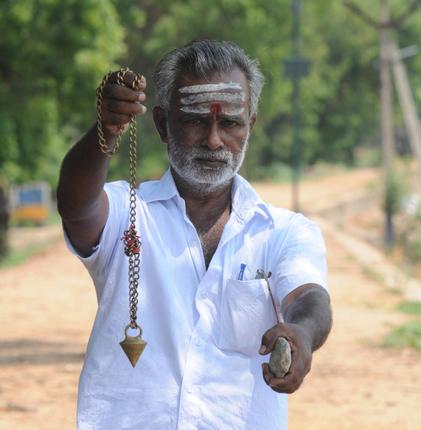
Water diviner Thangavel with some of the traditional implements in his water dowsing toolkit. / Photo: A. Muralitharan / The Hindu

His toolkit (in a hard-backed suitcase) has an impressive collection of implements: pendulums of iron, copper, bronze and brass, a glass bottle, 20 types of rocks and a watch.

The armoury includes a copper dowsing ‘radar’ built along the lines of the old neem-wood witching stick (which Thangavel carries around separately). The coconut is missing, because it broke on his last assignment.

“I wait for people to call me for my services. Up to 2000, I was dowsing water using just a watch, for free,” says Thangavel. What follows next is an explanation based on iffy science: “There is an electrical charge in the flow of water that seems to react to certain groups of blood, but not to those who are overweight, non-vegetarian or diabetic,” he says. A positive blood group and ‘pure lifestyle’ are essential to becoming a water diviner, he insists.

Thangavel starts out with a copper wire, which indicates the presence of water, but not its depth. “I make a marking after studying the lie of the land and aquifer’s location. For this, I start with the copper wire, and then use these tools one by one – I note how activated each element is in that spot, and then finalise my marking,” he says, adding a survey could take anywhere between three to five hours, or more than a day for trickier calculations.

“These days I don’t answer so many questions because the customer doesn’t want to pay me for my trouble,” Thangavel says. So he has narrowed down his findings to just three issues: the availability of water, its depth and the long-term yield. His fees hover in the range of Rs.3000-5000.

Claiming to have boned up on his technique by reading ancient literature on water dowsing, Thangavel says that the construction boom in Tiruchi has led to an increase in the need for water diviners. “But most of them are doing stuff blindly,” he says dismissively. “Water dowsing has been in existence for many centuries throughout the world, but in India it has no official certification.”

Traditional diviners and qualified hydro-geologists have little choice but to co-exist in the crowded marketplace, says A. Gnanasekaran, who has been marking groundwater spots for over 24 years now.

Gnanasekaran decided to specialise in hydro-geology after working on his 1990 Anna University post-graduate project that surveyed geophysical methods to explore groundwater supply and using that technology to help farmers.

While he dabbled with commercial work for a while, Gnanasekaran says he works for the government as well – he is in fact certified by the authorities to scout for water in the districts of Tiruchirappalli, Dindigul and Tiruvallur.

Tiruchi is a winner in the rock formation stakes, says Gnanasekaran, as its alluvium, the fertile layer of soil and sediments deposited by the Cauvery river, is an excellent source of water zones within 30 to 40 feet and is regularly recharged.

“The further you move away from the river banks, to Musiri, Uppiliyapuram and so on, you will find hard rock formation,” he says.

Gnanasekaran and his team of four geologists use the resistivity meter, approved by the National Geophysical Research Institute (NGRI) and the ‘Schlumberger method’ to test for the presence of potable water and that for irrigation. “We work on plots between three to 40 acres,” he says. “We start by studying the local geology and bore-well locations, and calculate our costs based on the extent of land and time required for the calculations. The government has stipulated Rs. 1800 as the charge per water marking. This is what I charge the farmers too,” he says. The rates are higher for institutions or industries.

“Very often customers come to us after they have become confused by traditional water diviners’ markings. Actually we are testing for the conductivity (power to transmit heat, electricity or sound) of the soil rather than for water,” says Gnanasekaran. “The higher the resistivity (the power of resistance to an electrical charge), the lesser the chance of water being there.”

But broadly, Gnansekaran tries to coincide his findings with the calculations of the old-school diviners, to keep everyone happy. “I interpret the result based on my experience, and pinpoint the area personally first. The exact calculations on water depth in relation to its resistivity will be available next day in the form of a computer-generated graph,” he says.

The shallow water layer is almost dry in Tiruchi, says Gnanasekaran. “Around 95% of well irrigation systems, which use water from within 100 feet depth, have died out. In recent years, we have been going for water within 200-300 feet, but even this is drying up slowly. Now the government recommends deep wells of 600-800 feet,” he adds.

Though new software has made it easier to calculate resistivity levels, it is costlier, and therefore less viable for small projects, says Gnanasekaran, who also runs the Annai Trust, an NGO that works with socially and financially disadvantaged people.

A spell of rainy days can deprive water diviners of their livelihood, but Thangavel is confident of training others to take it up.

Gnanasekaran is concerned about the over-exploitation of water resources, but says he steps back once the aquifer has been identified. “I don’t have a role to play in what happens to the water after this,” he concludes.

source: http://www.thehindu.com / The Hindu / Home> Features> MetroPlus / by Nahla Nainar / Tiruchirapalli – May 30th, 2014
Stamped with quality

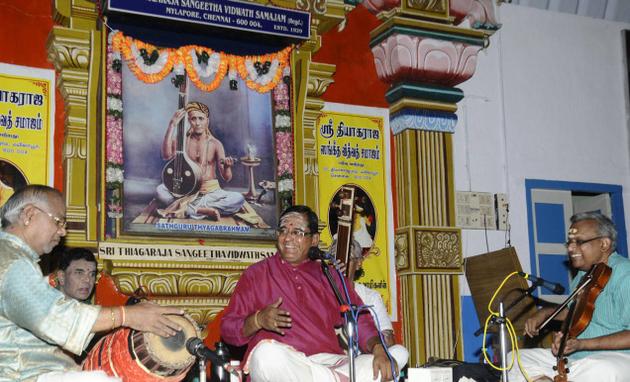
Showed his class : A.V.K. Rajasimhan. / Photo: M. SRINATH / The Hindu

A.V.K. Rajasimhan’s vocals had a vintage touch.

Reaching Sri Thyagaraja Sangeetha Vidvat Samajam in Mylapore and finding a safe parking space for the car was an ordeal. But the stress vanished once you entered the Samajam because of the divine vibrations prevalent there. Adding to the ambience was the imposing statue of the Saint poet, which gave you the much needed serenity as his kritis have done for centuries.

A.V.K. Rajasimhan, son of A.L. Krishnamurthy Bhagavatar (popular for his abhinayam-based sampradaya bhajans) was featured by the Samajam in its annual Tyagaraja Jayanthy Utsavam exactly five days after the his Jayanthy.

Tyagaraja was born in the Tamil month Chiththirai with Poosam as his star and this year it fell on May 6.

Like his father, Rajasimhan, who trained under O.V. Subramaniam, shines in samparadaya bhajan. His foray into Carnatic music is a recent phenomenon. The grooming in nama sankirtanam has really worked well for him. Here is a voice that has a vintage touch endowed with sweetness and the concert too bore that stamp.

However, the same could not be said of his selections that evening. While one expected him to delve into the ocean of the Saint’s kritis, that he included other composers was a mild aberration taking into account the occasion. Two such songs were Dikshitar’s ‘Sri Mooladhaara’ ( Sri) for the beginning and the other, Thanjavur Sankara Iyer’s ‘Ranajana mala,’ for the end.

Strangely, he left out the numerous utsava sampradaya kritis of Tyagaraja that one yearned to listen to. Despite the shortcomings, the evening’s fare showed his class. One was the alapana of Chandrajyothi, a real challenge, given the fact that there aren’t many kritis in this raga. Rajasimhan completed the essay with aplomb. And for veteran violinist M.A.Sundareswaran (M.A.S), it gave him ample scope to reiterate why he is a highly rated accompanist. That evening, his father and veteran violinist Parur M.S. Ananatharaman and flute vidwan N. Ramani were both present at the concert, which might have been an added inspiration for M.A.S.

A fast-paced thathva meruga tarama set the tone for the evening’s main Todi. He was able to paint a multi-coloured portrait of the raga with all its hues. M.A.S’s reply further enhanced the mood already created by the singer. Tyagaraja’s ‘Karuna Joodavamma’ was sung with devotional fervour that Sathguru had perceived.

Srimushnam Raja Rao, who has completed 50 years of service to classical music, was in his elements. His sollus bore the stamp of a maestro embellishing the concert. In the company of E.M. Subramaniam (ghatam), his tani was gripping.

source: http://www.thehindu.com / The Hindu /  Home> Features> Friday Review> Music / by V. Balasubramaniam / Chennai – May 22nd, 2014

Biryani under a hundred bucks

Chennai has a variety of options for biryani. / by Special Arrangement / The Hindu

Akshatha Iyer picks some of the city’s favourite biryani joints that serve the dish for Rs. 100 or less

Chennai’s biryani obsession has nurtured a wide range of cooks, styles and spaces — from the fancy five-star spreadto the delicious plate of the greasy variety served from a hole-in-the-wall down the road.

Real Kalyana Biryani

Hanging out in Nungambakkam? If you want a traditional meal, head to the blandly-titled Real Kalyana Biryani restaurant. Walking down the stairs to their basement dining hall, you can soak up the aroma of freshly-ground spices blended with well-cooked meat. As the name suggests, this place specialises in traditional Muslim biryani served at weddings.

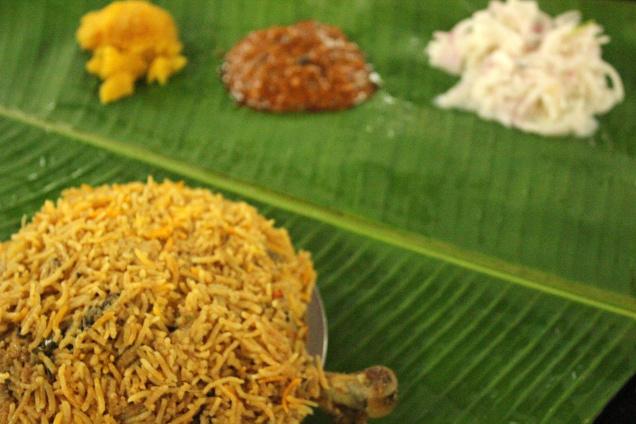
Customers eat off freshly washed banana leaves, which are quickly filled with biryani, followed by a onion raita, brinjal gravy and a sweet, which changes every day. On the day we visit it’s a cheerful yellow kesari. Busy through the day, the restaurant draws about 150 customers for dinner alone. “Our biryani is authentic and tastes of home. We use pure ingredients and hygiene is our prime concern,” says Yasar, manager of the restaurant. Apart from this they cater for parties and family get-togethers. They are particularly popular with the offices in the vicinity, and are busy through lunch sending out parcels. “I come here because I feel the food is tastier than at any other biryani restaurant. I also like the fact that they have good quality as well as quantity. So it is value for money,” says Anand, who eats here at least three times a week.

Where: Nungambakkam High Road

How much: Rs.75 (for one)

When: Noon-4 p.m, 6 p.m.–10 p.m.

Tel: 9840480435/4282 21128

Bismi Biryani

The appealing yellow and red board of Bismi Biryani on Thiruvanmiyur main road is difficult to miss. Bismi Biryani has made its mark for over 10 years. Most of the customers we met are loyalists and say they have been eating at this joint for more than two years at least.

S.J. Hussain the owner of this branch (there are a number of restaurants bearing the Bismi name across the city — though we’re cautioned that only some are ‘original’) tells us, “Before starting this biryani centre I was poor and found it difficult to provide for my family. The restaurants have brought me wealth and laurels. Today I am well-settled and a very happy man.”

Customers particularly relish his chicken fry and mutton biryani, which are served as a combination meal. There is a crowd of almost 300 people at lunchtime, many of whom stand and eat outside, or order parcels due to the lack of space. Chef Ummar Ali, also known as ‘Master’ is a big draw for his chicken biryani. Between spooning out the dish, he says that customers come looking for him. “I am happy that my food makes them happy.”

Where: Thiruvanmiyur Main Road near bus depot

How much: Rs. 60 (for one)

When: 11 a.m.-10.30 p.m.

Tel: 99412 70613, 99411 87572

Al Taj Biryani

Triplicane is a tough area to function in when you are in the business of biryani. “There are around 40 shops in and around this area, and we still manage to stand out,” says Hussain, the owner of Al Taj Biryani. Claiming that they are one of the oldest biryani restaurants in the locality, and are still leading the pack thanks to their special ‘Vaniyambadi style of biryani,’ he says “we have almost 350 customers on regular days and around 600 customers on Sundays”.

Al Taj Biryani’s advantage is the freshly-made biryani, made with their trademark blend of spices sourced from Vaniyambadi. (A small town near Vellore, Vaniyambadi is famous for its Mughal-style biryani, influenced by the Nawabs of Arcot. In a nod to the origin perhaps, this restaurant features Mughal paintings on its walls.)

They are particularly popular because they were the first ones to introduce ‘combo meals’ among the small biryani centres in the area. Their combo consists of finely roasted chicken 65, steaming hot biryani with chicken or mutton along with an aerated drink. The combo made the restaurant hugely successful, drawing in many customers and party orders. They have branches in Mylapore and Royapettah as well. Mohammed Yasar, a regular customer, who reluctantly pauses mid-way through a bowl of bread-halwa (their speciality dessert) says that he likes eating here because the food not just tasty, but also hygienic.

Where: Triplicane

How much: Rs. 100 (for one)

When: 10 a.m.-11p.m.

Tel: 98400 74038

Chennai Rowther Biryani Centre

Rowther Biryani is best known for its huge dining hall which includes both AC and Non-AC seating, looking into an open kitchen. Airy and spacious, it accommodates around 100 customers at one go. Mohammed, who owns the restaurant, tells us how he, along with three waiters handle the service. “Two in the AC section. Two in the non-AC section. Work is tiring but interesting.”

He adds, “We use only the best quality rice and 100 per cent halal meat for our customers.” His customers include office-goers, college students and families. The open kitchen is the main attraction — you can see the cooks doing everything from cutting vegetables to tossing up plates of hot biryani. They also offer a range of other dishes, from tandoori to Chinese. However biryani is clearly the star here. “I am not from Chennai, I just came here for work. I live alone, and I don’t have time to cook. Rowther Biryani centre is a big help,” says Akhilesh, between bites of chicken biryani. “Service is fast and friendly. It is like a home away from home.”

Where: K.B. Dasan Road, Alwarpet

How much: Rs. 70 – Rs.100 (for one)

When: 11.30 a.m.- 4.30 p.m., 6 p.m. -11 p.m.

Tel: 93804 50979, 4323 0636

source: http://www.thehindu.com / The Hindu / Home> Features> MetroPlus / by Akshatha Iyer / Chennai –

Chennai salutes martyred officer

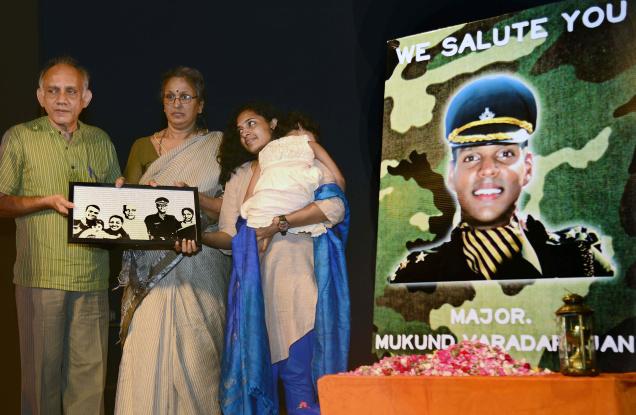
Family members of Major Mukund Varadharajan at the function on Wednesday./ Photo: R Ravindran / The Hindu

At a function, a host of distinguished personalities paid their respects to Major Mukund Varadharajan

The Tapovan Hall at the Chinmaya heritage centre on Tuesday evening witnessed the city paying respects to a son who sacrificed his life safeguarding the boundaries of India.

Major Mukund Varadharajan (32) of the 44 Rashtriya Rifles was killed in an encounter with terrorists in Shopian district, South Kashmir, on April 25. Mukund, who hailed from Chennai, was cremated with full state honours.

A large section of people including former civil servants, military personnel, judges and other noted personalities gathered in the evening to commemorate the brave soldier from the city and honour his contributions to the country. Also present were his family members, including his young daughter.

Gita Menon of Chinmaya Mission began the tribute, saying “We bow to the proud son of India.” She went on to add that soldiers provide a sense of security to every citizen in the country.

Nonagenarian V. Kalyanam, who was the personal secretary of Mahatma Gandhi, was also present during the evening. In his brief words to the Major’s family, who were in the front row, he said the officer was a brave man and wished the family well.

“Brave men like Mukund give their today for our tomorrow,” stated retired Colonel David Devasahayam from the Indian Army, to the applause of those gathered in the auditorium. Retired IAS officers M G Devasahayam and Naresh Gupta also paid tributes.

Swami Mitrananda, acharya of Chinmaya Mission, Chennai, honoured the late Major’s family members with a memento towards the end of the evening which concluded with a mime titled Paapa by theatre artist Krishna Ganapathi. A video recording of tributes by personalities who couldn’t attend was also screened.

source: http://www.thehindu.com / The Hindu / Home> News> Cities> Chennai> Events / by Staff Reporter / Chennai – May 21st, 2014

Thanjavur Paintings of Later Maratha Period Discovered in Abandoned Temple

Pudukkottai :

An array of age-old Thanjavur paintings was found at an abandoned Ettukal Mandapam near Gandharvakkottai in the district by members of the District Science Forum.

According to Manikandan, a teacher at the Government Boys Higher Secondary School, Gandarvakkottai, and member of Tamil Nadu Science Forum, the paintings were found on the roof top of the Ettukal Mandapam located in the banks of Chettiyurani, a small irrigation tank, in Gandharvakkottai. He said the paintings were lying in a dilapidated state.

After finding the paintings, the team called on a famous artist S Kaliyaperumal here, to know its details. Kaliyaperumal told them that the paintings were of the later Maratha period. Artists had used bio-chemicals to give colour and shade to the paintings.

The members of the Science Forum urged the district administration to take decisive steps to protect the painting before it gets completely destroyed.

source: http://www.newindianexpress.com / The New Indian Express / Home> States> Tamil Nadu / by Express News Service / June 03rd, 2014

TIRUCHI: 10TH ANNVERSARY ISSUE – Cycling, samosas, Maaza… Anu Hasan’s memories of Tiruchi


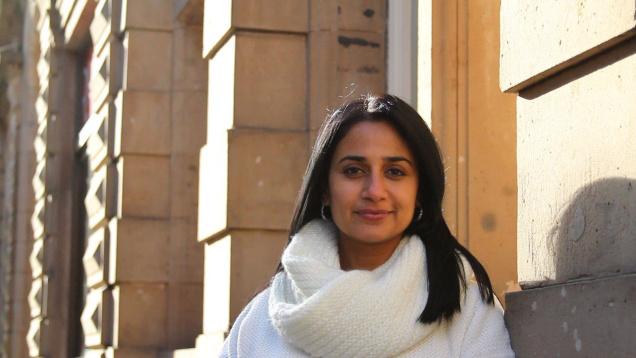
Anu Hasan feels a part of her will always belong to her home city Tiruchi. / by Special Arrangement / The Hindu

 My memories of Tiruchi are a stream of pleasantly vague incidents interspersed with events of stark clarity.

I remember walking to Aruna Nagar to get the bus to school and stopping to catch butterflies on the way. My brother and I used to go to the same school for a very brief period. And I remember him walking too fast for me to keep up with him. But I was too proud to ask him to slow down and I would half run half walk behind him.

After a few years, I went back to studying at my old school – St Joseph’s Anglo Indian Girls Higher Secondary school…or convent as it was called then. I loved being back there.

I got my first cycle when I was in the 6th standard and my mother was upset that Visu maama who had gone with me to help choose the cycle had allowed me to buy one that was much too high for me. She later took back her words as my height shot up to 5 ft 7 inches.

I would cycle to school from Kumaran Nagar, past Bishop Heber College and Hostel, studiously ignoring the jeering calls from the boys. The climb up the bridge over Uyyakondaan Vaaykaal would get me out of breath but I would die before I admitted any such thing.

And then we would cross court and then cycle past Campion – another attempt at studiously ignoring the boys who stood outside the school while being acutely conscious of the fact that the July wind could whip my uniform skirt embarrassingly high at any moment if I weren’t careful enough. Half the time I cycled with one hand holding my skirt in place. It’s a wonder I didn’t fall off!

My days were filled with basketball and dance classes and samosas and Maaza (mango drink).

I remember practising basketball in YMCA and my parents coming to watch me. I remember my mother’s shock when some guy yelled out my name as we went past Bishop Heber. She looked at me in askance and I shrugged.

My school teachers who loved me and disciplined me and guided me and encouraged me … what would I have become without them … or should I say how much worse would I have been without their influence in my school life.

When I look back at those years gone by, I wish I could remember more but then I realise I remember that I was happy and that I had a great childhood…and after all that is all that matters isn’t it?

And now even though I live in the United Kingdom and have been to many parts of the world, in my heart, I am still the same small town girl.

I am from Tiruchi and a part of me will always belong there.

Tamil actress and TV anchor Anu Hasan (born Anuradha Chandrahasan) is currently based in the UK.

source: http://www.thehindu.com / The Hindu / Home> Features> MetroPlus / by Anu Hasan / Tiruchirapalli – may 20th, 2014

Shooting inside a Shaolin temple

Director Haricharan./ by Special Arrangement / The Hindu

Director S. Haricharan is in China to film the life of Bodhidharma, said to be a Tamil prince

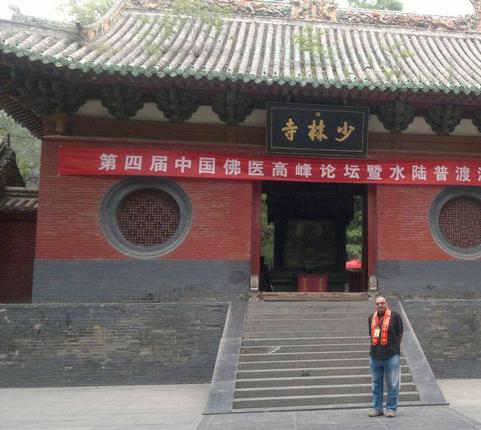
“Is the blue-eyed barbarian, as he is referred to in Chinese texts, a myth or real?” asks film director S. Haricharan (Thoovaanam), who is in China on invitation to shoot a film on the life of Bodhidharma, the 28th Patriarch of Buddhism. “I consider this a rare privilege and an even greater honour that I have been given access to shoot inside the Shaolin temple at Mount Song in the Henan Province of China. It is probably the first time that a film director from Tamil Nadu will have access to shoot inside the Shaolin temple. It is even more gratifying that I will be shooting a film on the life of the great Bodhidharma who, according to many available records, was a Pallava prince born in Kanchipuram!” says Haricharan.

Haricharan in front of the Shaolin temple./ by Special Arrangement / The Hindu

Prior to his visit to China, Haricharan went on a recce to Vaiyalur (Kanchipuram) to check out a culvert inscription available with A.S.I Chennai (provided by Dr. Maheshwari) that one Bodhivarman (a Pallava prince) did exist around the same period that Bodhidharma surfaced in China. “Did Bodhivarman, on embracing Buddhism and fearing persecution, flee from Kanchi via the Palar river to Mammalapuram and then board a ship to China? Did his father, the king, aid him in his efforts to leave Kanchi in search of a forefather who was already in China spreading Buddhism? There are many such unanswered questions. With hope in my heart and filled with pride and enthusiasm, I am on the way to China in an effort to try and unravel the mystery surrounding Bodhidharma,” says an excited Haricharan.

The director is accompanied by cinematographer Sharon and will be assisted by a Chinese crew while shooting at the Shaolin temple.

source: http://www.thehindu.com / The Hindu / Home> Features> Cinema Plus / by Nikhil Raghavan / Chennai – May 31st, 2014

Carnatic singer dead in Chennai

Jayalakshmi of the Radha-Jayalakshmi duo, whose timbre and ‘briga’-laden voice stood out in the worlds of Carnatic and film music, died on Monday. She was 82.

The Radha-Jayalakshmi duo came from the G.N. Balasubramaniam (G.N.B.) school of music and were trendsetters in the Carnatic music world after Brinda-Mukta of the Veena Dhanammal school of music.

Like the Alathur Brothers, Radha and Jayalakshmi were cousins. Jayalakshmi had her roots in Srirangam while Radha’s family hails from Chengalpattu. But they were born in Chennai and both of them grew up together in the city. They started giving performances from the age of 14.

T.R. Balasubramaniam, one of the primary disciples of G.N.B., was their teacher.

“But they would often visit G.N.B. and get their lessons corrected by him,” said Jayalakshmi’s sister Champakalakshmi.

After listening to them singing for All India Radio (AIR), recording companies made a beeline to release their songs rendered in a unique style, but immersed deeply in the classical tradition.

A listener of Carnatic music of the bygone era could clearly notice the perceptible difference in the singing style of the duo, in all popular songs.

Jayalakshmi rendered a lot of semi-classical songs in films, for music directors including S.V. Venkatraman, K.V. Mahadevan, S.M. Subbaiah Naidu and Kunnakudi Vaidhyanathan. Her solo song, ‘Manamey Muruganin Mayilvahanam’, and the duet with Radha, ‘Thiruchenduril Porpurinthu’, continue to enthral lovers of semi-classical songs.

source: http://www.thehindu.com / The Hindu / Home> News> Cities / by Special Correspondent / Chennai – May 28th, 2014

J Jayalalithaa’s victory in Tamil Nadu finds resonance in Mumbai

In Goregaon’s Aarey colony there were firecracker showers and arrack being served all night after J Jayalalithaa swept Tamil Nadu with 37 seats

Tamil Nadu Chief Minister and All India Anna Dravida Munnetra Kazhagam (AIADMK) General Secretary J. Jayalalithaa, greets supporters as she arrives for a political rally in Madras, India, Tuesday, March 9, 2004. Indian general elections, which will determine India's leadership for the next five years, will be held in four rounds, beginning April 20 and ending May 10, 2004. (AP Photo/M.Lakshman)
Tamil Nadu Chief Minister and All India Anna Dravida Munnetra Kazhagam (AIADMK) General Secretary J. Jayalalithaa, greets supporters as she arrives for a political rally in Madras, India, Tuesday, March 9, 2004. Indian general elections, which will determine India’s leadership for the next five years, will be held in four rounds, beginning April 20 and ending May 10, 2004. (AP Photo/M.Lakshman)

AIADMK’s celebratory cheer has touched the 8,000 plus Tamil settlement inside Aarey colony in Goregaon.

Most here are AIADMK supporters, who celebrated with crackers when they heard J Jayalalitha had swept 37 of the 39 seats. The arrack rounds which began in the evening went on till morning. Arun Shanmugan, 70, who had a bit himself, said, “It was available free. Of course we are very happy that our Puratchi Thalaivi Amma has won.” Then, we don’t know whether it was the emotions or the effects of arrack as he suddenly broke into tears. “We should have won all the 39 seats.”

Shanmugan’s neighbour, Rajendran Appadurai, 34, a local mason, hails from Elumalai in Madurai. “I was on the phone till afternoon when I heard that R Gopalakrishnan had won with a majority of 1,97,436,” he says and adds with the cockiness of a psephologist, “Then I knew AIADMK would sweep it. The one who wins Madurai wins the state.”

Though many here are daily wage earners they don’t mind going back home to vote. “Our voter cards are from there,” says Sunder Kaundar, 28. The women are more forthcoming. “There we get rice, pressure-cookers, TV sets and idli dough grinders to go vote. What’ll we get here?” laughs elderly matriarch Maniamma Nadar. But, the settlement is divided between Amma’s supporters and those who swear by the DMK. Shanmugan’s house with paintings of Jayalalitha demarcates the two groups.

Though DMK supporters are only around 2,000 their views aren’t any less fierce. Both K Rajendran and Magesh Selvam insist, “Annan is like God. He has done so much for the poor,” he says, referring to DMK patriarch Karunanidh’s son M K Alagiri. “Without him, how can there be a future for the party. I hope he’s brought back into the fold.”

They brush off all questions about DMK’s ministers being caught in corruption. “When you give things like rice, TVs and mixer-grinders there will be expenses. Now they can’t keep giving all this from their own pocket, can they?” asks Rajendran. Their neighbours Tyagarajan and wife Tilakavanti who had gone to Tirunalvelli to vote say, “Once the cases tighten the noose around Jayalalitha, AIADMK supporters will understand.”

Across the city in Bhandup, the largely Christian Tamil fishing community of Madraswadi feels the AIADMK’s performance is the outcome of the Jayalalithaa-government’s work. “Amma increased cash assistance during non-fishing season, set up fish-processing parks and seafood export processing zones in Nagapattinam and Karaikal,” said Mary Arul who has promised to offer a crochet veil to the Velankani shrine if AIADMK does well. “When my cousin and his neighbours were arrested by the Sri Lankan navy it was Amma who had them released.”

In Mumbai’s Iyer-Iyengar stronghold of Matunga Jayalalitha finds acceptance more because she is an Iyengar. “Just look at how poised she appears compared to Karunanidhi with his ridiculous dark glasses and the constant dribbling. Obviously anyone would choose her,” says Padmalaxmi Iyengar, 54.

source: http://www.dnaindia.com / DNA / Home> Mumbai / Place:Mumbai,  Agency:DNA  / by Yogesh Pawar / May 19th, 2014

MYLAPORE : Lessons in grit and focus

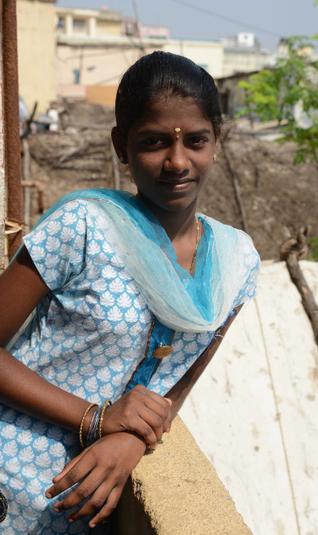
Sindhuja is the first Tamil medium student to top her school with 1,160 marks./  Photo: K.V. Srinivasan / The Hindu
Sindhuja is the first Tamil medium student to top her school with 1,160 marks./ Photo: K.V. Srinivasan / The Hindu

Girl from Dooming Kuppam is school topper at St. Raphael’s. Liffy Thomas on the super achiever

Six years ago, it was a difficult decision for N. Sinduja to take. She wanted to switch over to English medium like her other classmates, but stopped herself from doing so did not make the move.

“I did not want to burden my father with more fees to pay. Also, I was not confident if I would shine equally well in English medium,” explains Sinduja.

Today, whatever lingering regrets she had about not making the switch have disappeared.

The student of St. Raphael’s Girls Higher Secondary School, Santhome, is the first Tamil medium student to top her school with 1,160 marks.

In the Dooming Kuppam fishing hamlet at Santhome, where she lives, she is possibly the first student to rack up such a high total.

Her stock has gone up among her family, friends and neighbours.

“I got centum in business maths and commerce, 199 in accounts but lost most of my marks in English,” she says, talking to us from her single-room Housing Board quarters where she lives with her father, mother and grandmother.

Her father A. Nethyanandam is a coolie and her mother N. Mageshwari, a homemaker.

“There were many financial hurdles in educating our two daughters, but her father was always particular that he met their demands even if it meant sacrificing our comforts,” says Mageshwari, adding that Sinduja would walk from her home to school. She never had to be told to study.

According to Sr. Ranjitham, headmistress of the school, 285 students appeared for the Board examination and a majority of these students are from the fishing hamlets.

A class topper through her school days, Sinduja even taught her classmates.

“That helped me a lot,” says Sinduja, who wants to pursue CA and become an auditor. In class X, she scored 427 marks. Sinduja never took tuitions and was guided by her sister Sasi Rekha, who completed her BSc in maths and accounts.

On the one hand, Sinduja is happy about her marks, but unsure of how she will pursue CA. “I will have to go for coaching and I heard that the fee is a huge,” she concluded.

source: http://www.thehindu.com / The Hindu / Home> Features> DownTown> Mylapore / by Liffy Thomas / Chennai – May 19th, 2014