Hygiene Comes First on This Butcher’s Block

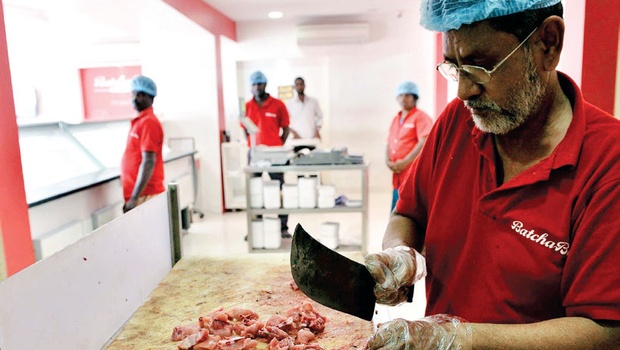
BatchaBai’s meat shop in T Nagar | P Jawahar

Sparkling white tiles, gleaming metal counters, spotlessly clean knives and the soft humming of refrigerators… This could be the sight that greets you when you walk into a run-of-the-mill meat shop on the streets of Chennai. Not in a few years or even a few months, but right now.

The Meat Sciences Department of the Tamil Nadu Veterinary and Animal Sciences University (TANUVAS), has been providing meat retailers free designs and consulting services to convert their shops into places where hygiene is the priority – and they have been doing it for the past five years.

“We have been giving out designs and consultation to any entrepreneur who wishes to start up or modernise his business,” says Robinson Abraham, Head of theMeat Services Department. “All they have to do is approach us.” Consulting at a private firm would be prohibitively expensive to the small businesses that most meat shops were, he pointed out.

But when asked about what these five years of free consulting has engendered, he points to just one operating shop in Chennai. The BatchaBai meat shop in Kilpauk stands as a silent testimony to what a few well-thought out improvements in slaughter house design can do.

There are counters made of stainless steel, teflon cutting boards, rounded edges to prevent wiping hands on tables and white tiles to make any spattered blood visible. Compared to the ill-lit, ill-washed rooms that most meat shops offer, the sight is almost unreal in its cleanliness. “These are very small but necessary design elements,” points out R Narendrababu, one of the three professors in the department. “They improve the hygiene of the shop tremendously.”

The reason why hygiene comes in a sad second in the owners’ list of priorities, he adds, is because consumers themselves have been desensitised to the dangers of bad hygiene. “Unless people refuse to buy meat from shops that don’t adhere to basic hygiene norms, retailers will never feel the need to implement these practices,” he says.

source: http://www.newindianexpress.com / The New Indian Express / Home> Cities> Chennai / by Jonahan Ananda – Chennai / January 29th, 2014

Training them to sew a new life

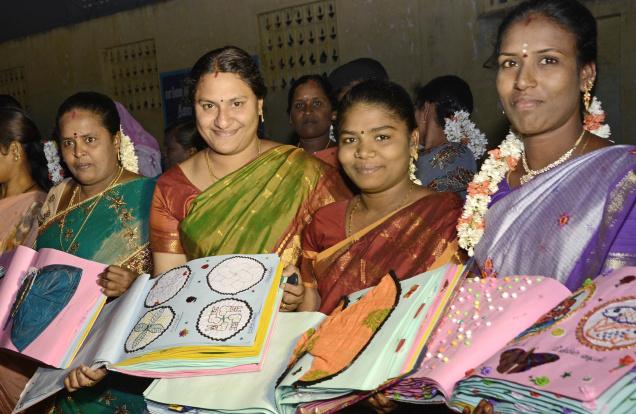
Tailoring trainees displaying miniature models of their creations in Tiruchi on Monday. / Photo: R.M. Rajarathinam / The Hindu

A total of 58 women received certificates at the valediction of the training programme organised by ROTECH Institute, a project started by Rotary Club in 1997 for providing tailoring and embroidery training to women of low income groups, at St.Mary’s Middle School, Mannarpuram, here on Monday.

The women had undergone six-month-long free training in embroidery and tailoring under trainer P.Amutha. “The institute aims at making poor women economically self sufficient,” said K.Natarajan, president, Rotary Club of Tiruchi.

“Every year, we target a different area so that we can ensure that a larger number of persons are benefitted form the initiative. Till date, over 2,000 persons have been trained by ROTECH,” he added.

The trainees displayed miniature models of their creations for everyone to witness the various patterns and techniques of design that they had learnt during the course. G.Selvanayagi, district employment officer, distributed certificates to the women and advised them to make best use of the skills acquired through the programme.

Two tailoring machines worth Rs.4,000 were given to two women from very poor families. “I need a livelihood to help me survive and support my two daughters, after the death of my husband two years ago. This training has proved to be very useful and the machine will help me earn a livelihood,” said A.Fathima, one of the recipients of the tailoring machine.

K.Sureshkumar, chairman, ROTECH Institute, Arockia Mary, correspondent, St. Mary’s Middle School, family members of the trainees and members of Rotary club were present.

source: http://www.thehindu.com / The Hindu / Home> News> Cities> Tiruchirapalli / by Staff Reporter / Tiruchi – January 28th, 2014

Greater flamingos found in Tenkasi tank

Tirunelveli :

The third leg of bird monitoring undertaken by the Tirunelveli forest circle spotted a good number of greater flamingos in the water bodies. Interestingly, some of them were spotted for the first time at the Sundarapandiayapuram tank near Tenkasi.

Tirunelveli forest circle consisting Tirunelveli, Tuticorin and Kanyakumari districts has undertaken six months’ aquatic bird monitoring in the water bodies. The third leg of bird monitoring took place on Saturday. According to forest officials, the monitoring was conducted in about 20 tanks across the three districts. Different species of birds, ranging from 10 to 40, were noted in each tank with numbers ranging from few hundreds to as high as 15,000. Important water birds noted were spot-billed pelicans, bar-headed geese, little grebe, Indian spot-billed duck, comb duck, Asian open-bill stork, painted stork, pheasant-tailed jacana, terns apart from egrets, herons, variety of ibis, cormorants and moorhens, forest officials said.

District forest officer C H Padma said a group of greater flamingos was noticed first time in Sunderpandiyapuram tank near Tenkasi. In many of the irrigational tanks, an increased water level is observed due to release of water from dams. “It is happy to note that local people were aware of these monitoring works going on around their villages. Local people were also involved in some of the tanks on Saturday,” she said.

Conservator of forests Tirunelveli, Rakesh Kumar Dogra also participated in the monitoring exercise in Kadambankulam and Tuthukuzham of Tuticorin district and spotted around 100 greater flamingos. Commenting on the greater flamingos spotted in Tenkasi region, he opined that they could have migrated from nearby tanks. “We have learnt from the local people that flamingos do visit different tanks but not regularly,” he said. Though the flamingos normally prefer tanks nearby seashore areas, they could have visited this Sunderapandiapuram tank in the interior area for food, said M Mathivanan, coordinator of Agasthiamalai based Conservation Centre of ATREE.

The bird-monitoring exercise is yielding positive results and helping in the conservation of the tanks and the winged visitors, Dogra said. “The monthly presence of the department around the water bodies improves conservation. Officials were also instructed to specifically look for any mortality of birds or abnormal behaviour. This activity has definitely improved the protection status of winter visitors to these bird habitats,” he said.

The next monitoring is on February 23.

source: http://www.articles.timesofindia.indiatimes.com / The Times of India / Home> City> Madurai / TNN / January 28th, 2014

History beckons GRH’s plastic surgery dept

Madurai :

It is celebration time for the department of plastic surgery at the Government Rajaji Hospital (GRH) here, as it enters its Golden Jubilee year. The department, then named ‘Plastic and Facio-Maxillary Surgery’ centre started functioning with 12 beds from January 26, 1964, thanks to the efforts of Dr Sam C Bose, one of the pioneers of plastic surgery in the country.

The centre was the second to be started in the state after the one in Government Kilpauk Medical College, Chennai. Now, it has become the only plastic surgery department across all government hospitals to provide comprehensive treatment for all kinds of problems including cleft lip and palette surgery, critical burns injury, hypospandias and other congenital disorders correction and facial ortho correction for accident victims.

To ensure that the standards are maintained high at the department, many retired heads of department and professors still contribute to help shape up the plastic surgeons. Every Saturday, about four retired professors and eight faculty members would teach the six postgraduate doctors. The special attention has helped the students of the department to excel in their field. PG students of the department consequently won gold medals at the Dr MGR Medical University for the year 2012 and 2013, said R M Raja Muthaiya, head of the department. The PG seats and two seats for MCH available in the department are much sought after by the students.

Best cosmetic, reconstructive and hand surgeons in the United Kingdom – Dr Mehboob Ali from Ilayankudi and Dr J Srinivasan from Rajapalayam are alumnus of the Madurai Medical College, said 84-year-old Dr Bose, who founded the department.

Within few months of its inception, the centre became famous for accurate surgeries. As many as 100 children with cleft lip problem were operated in just three months. The department was sought after so much that people from all parts of Tamil Nadu thronged the centre. The 2,600 cleft lip conducted by Dr Bose between 1964 and 1987 in his tenure was one of highest number of procedures in the world at that time.

The department was pioneer in all the developments in plastic surgery then. Specialists like Dr Harold Keith McComb from Australia along with a team visited the department and stayed here for three weeks in September, 1964. They were stunned by the department’s performance as it was advanced on a par with any hospital in the world, Bose said reminiscing the old days.

Now, the department treats around 600 critically-ill burn injury patients. However, cleft lip surgeries drastically reduced to just one or two in a month since Smile Train, an NGO, not only does it free but also provide monetary assistance to parents of the children.

source: http://www.articles.timesofindia.indiatimes.com / The Times of India / Home> City> Madurai> Plastic Surgery / by V. Devanathan, TNN / January 25th, 2014

Feel of the country in Yercaud

Rural beauty

It is hard to believe that a mere 22 kilometres from chaotic, noisy and lively Salem, at a height of 4,970 feet, lies Yercaud, a quaint hill station in the middle of Shevaroy Hills in the Eastern Ghats.
Yercaud, the “jewel of the south”, is not as well known as Ootacamund or Kodaikanal and therefore spared the ravages of droves of tourists, but it is a popular hill station because it is relatively less expensive and has comfortable weather conditions throughout the year. Tracing its etymology to the Tamil term yer meaning lake and kadu meaning forest, Yercaud, literally means the forest around the lake, and is believed to have been inhabited first by the tribes from Kanchipuram, when Tamil Nadu or Thondai, as it was then known, was invaded by Telugu rulers.

We know about Yercaud from the time Sir Thomas Munroe discovered it on 1842. Planters made a beeline after David Cockburn, the collector of Salem in the 1820s, facilitated the establishment of plantations with coffee, pepper, orange, apple and other citrus fruit plants imported from South Africa. Cockburn has since been known as the Father of Yercaud.A 45 minute drive from Salem on a fine ghat road is one of the USPs of Yercaud.

This drive is best done in the morning, so that you can admire the 20, scary hairpin bends, the beautiful scenery and the clusters of baby monkeys and their families. You know you have reached Yercaud when the lake appears. This is quite a sight — a serene body of water ringed in by mysterious beautiful hills and dotted with colourful boats. There are other sights too in Yercaud. The Lady’s Seat, perched up on a precipice gives a vantage view of the hills all around, the sunrise and the sunset.

It is named so because the women of the Raj would sit there and pass the time of the day soaking in the sun and the beauty with a pair of binoculars. At the Botanical gardens, you can see the diverse flora and fauna of the Shevaroy Hills right down to the insectivorous pitcher plant. The Killiyur Falls, into which the lake empties out, is another beautiful sight, if you can manage the trek. The Chennai Trekking Club organises some interesting treks. The view from Pagoda Point and the Karadiyur Point in Karadiyur village, 12 kilometres from Yercaud are worth a visit.

For those who swear off the traditional sightseeing spots, Yercaud offers many small streets and bylanes through which you can amble gently, soaking in the quaint colonial bungalows like

The Grange, which was built by the collector in the 1820s or the Fairholme Bungalow. Stop by and tease a butterfly and quaff a cup of tea from the chai kadai (shop) in the typical old world thick glass tumbler. Pick up some absolutely fresh green peppercorns, bite into soft avocados and taste some uncommon fruits right off the trees in the plantations. Or get into the car and drive around the 32 kilometre loop road, which starts at the lake and ends at it — a road straight out of the picture book complete with the canopy of trees.

source: http://www.deccanherald.com / Deccan Herald /Home> Supplements> Sunday Herald Travel / by Bhagyalakshmi – January 19th, 2014

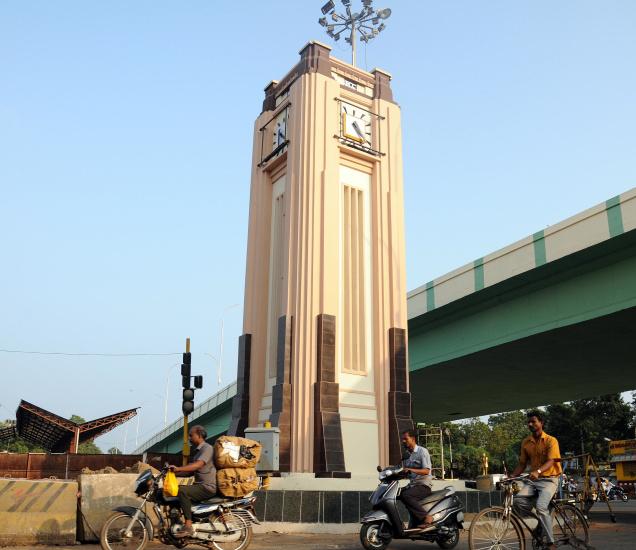
Clock tower at Mint ticks again

Last year, a team of Corporation officials involved in the construction of Mint flyover decided to give a fresh look to the clock tower./  Photo: K. Pichumani / The Hindu
Last year, a team of Corporation officials involved in the construction of Mint flyover decided to give a fresh look to the clock tower./ Photo: K. Pichumani / The Hindu

60-ft-tall structure became defunct decades ago

A century ago, British officers at Fort St. George used to fire cannonballs at 8 p.m. every day, it is said.

The practice stopped after the first standalone clock tower was built at Doveton junction in the early 1900s.

One such clock tower, at Mint Junction, that had been defunct for decades, got a lifeline on Friday when it was run on a trial basis following repairs.

The 60-feet-tall clock tower was revived by the Chennai Corporation and P. Orr & Sons. Each aluminium dial on the clock is four feet in diameter.

“Most of the mechanical iron equipment was rusted and jammed as lubricants had dried over the years. We repaired the clock completely free of cost,” said S. Vel Mani, senior manager, P. Orr & Sons.

At present, the city has only four standalone clock towers — at Mint, Royapettah, Doveton and Pulianthope.

It was last year, when a team of Corporation officials was involved in the construction of Mint flyover, they decided to give a fresh look to the clock tower and roped in experts from P. Orr & Sons.

Run on weight-driven mechanism, the clock has a pendulum, a swinging weight, as its time-keeping element.

Six iron plates have been tied to a metal rope and connected to a chain of wheels.

When the wheels rotate, the iron plates go down and the brass pointer on the dial of the clock moves.

Once the plates hit the floor, the clock stops working. Once a week, maintenance staff in charge of the clock will key it by lifting the plates to run the clock.

A classic example of art-deco architecture, the features of the clock tower include high use of cement concrete, linear model, thin lines, rich usage of colours and fewer floral engravings.

“The architectural style of the clock towers and cinema theatres built in the city in the 1900s were influenced by the industrial and French revolutions,” said historian Sriram V.

source: http://www.thehindu.com / The Hindu / Home> News> Cities> Chennai / by D. Madhavan / Chennai – January 19th, 2014

Kumbakonam Sri Mangalambika Vilas 100 and counting (Foodie Trail)

The small Sri Mangalambiga Vilas eatery could be easily missed as a non-descript joint in this temple-cum-business town but for a board reading “Since 1914” kept outside amidst the bustle on the lane leading to the Adi Kumbeswarar Temple.

It is not easy to remain in the restaurant business for over 100 years serving traditional South Indian dishes like idly, dosa and others. All the more in Kumbakonam, where almost every eatery serves tasty food and the famed degree coffee.

The success of Sri Mangalambiga Vilas becomes evident when one starts eating the sponge-like soft steaming idly or the crispy dosa (rice or rava) with sambar and coconut chutney.

A little girl who was troubling her mother by refusing to eat the idly on her banana leaf started gulping it down fast after the first bite.

The South Indian coffee – a mix of milk, coffee decoction and sugar – tasted great.

There was a Non-Resident Indian (NRI) family from the US enjoying their meal at the cramped eatery without making any fuss. The staff treated them like any other guests, a pointer that NRI guests are regulars there.

The lunch (rice, sambar, rasam, curd/buttermilk, vegetables) is also good – light on the purse and the stomach. It is a pleasant surprise to hear the staff enquiring from the guests if they wabt second or third helpings of vegetable curries, whereas in such places, you will only get a single small cup.

“The hotel must have been functioning even prior to 1914. But I do not have any record. Based on my father’s age at the time of his death and his age when he came to Kumbakonam I arrived at the year 1914. That is why I have used the words “Since 1914” and not “Established 1914,” proprietor H. Rajagopal told IANS.

He said his father V.G. Harihara Iyer came to Kumbakonam when he was 14 to work in the eatery, then owned by a named Thayu Patti.

“My father died in 1955 when he was 52 years old. By that time, he had bought the hotel from Thayu Patti, who decided to quit the business due to her old age,” Rajagopal said.

In those days the eatery was also called Sannadhi Kadai or Koil Kadai.

While there are outlets in Chennai proclaiming to sell Kumbakonam Degree Coffee, strangely no such boards were visible in Kumbakonam itself.

According to Rajagopal, coffee which is prepared with the first decoction and freshly boiled, pure cow’s milk, is called degree coffee.

“Coffee decoction is made pouring boiling water on coffee powder kept in a filter. The filtered decoction will be strong. It is called first decoction and coffee made with this is called degree coffee,” he said.

Rajagopal said another round of decoction can be obtained from the same coffee powder but it will be lighter.

“Degree coffee made with cow’s milk would taste better than the one made with buffalo milk. We used to roast coffee beans ourselves. The more the beans are roasted the decoction yield will be lower but the coffee would taste better,” he pointed out.

“Today, rich people come here. But the hotel is not for the rich class. People from all walks of lives frequent the hotel,” Rajagopal, also known as Ramani, remarked.

According to K. Hariharan, who manages the eatery, Tamil and Telugu movie actors have visited the place.

Rajagopal’s cousin Ambi Iyer has acted in Tamil movie “Nanban” made by director S. Shankar.

“Shankar, in his younger days, had bought tiffin from our hotel. At that time he had seen Ambi Iyer. And in “Nanban”, he had a role suitable for Ambi Iyer,” Hariharan told IANS.

However, business establishments too have to change with times and Sri Mangalambiga Vilas is no exception. In 2010 the 30-cover eatery was renovated and another round of renovation and expansion is in the offing.

“We are planning to expand by soon opening an air-conditioned dining hall which would increase the number of covers,” Hariharan said.

According to Rajagopal, there are several traditional South Indian dishes like sevvai and others that can be added to the menu so that the offering is not limited to items like idly, dosa, upma and pongal, among others.

Rajagopal does not have any plans of branching out on his own or on franchising the model.

“My elder daughter in the US wants to open an outlet there,” Rajagopal said.

On his plans for celebrating the centenary or say naming a dish with 100 as the suffix, Rajagopal said he had not thought about that.

(Venkatachari Jagannathan can be contacted at v.jagannathan@ians.in

source: http://ww.business-standard.com / Business Standard / Home> News-IANS> Features / IANS / Kumbakonam (TamilNadu) / January 21st, 2014
9,000% dividend! Record payout from TMB

Coimbatore :

Hold your breath shareholders! Tamilnad Mercantile Bank (TMB) has declared an interim dividend of 9,000 per cent. Yes, you read it right.

That’s actually Rs 900 per share of Rs 10 each, for the fiscal ending March 2014.

The board of this Tuticorin-headquartered bank took a decision to this effect at a meeting held on January 18.

Bank sources said this would translate into an outgo of Rs 25.6 crore (unchanged from last year).

Highest in the sector

The 9,000 per cent interim dividend is said to be the highest in the banking industry and this is the second year in a row that the bank has declared such a high dividend. It may be recalled that the bank’s board had approved a dividend of Rs 750 per share for 2008-09 and Rs 1,000 per share the following year, but could not make the payment as the annual general meetings for 2009-10 and 2010-11 were not held due to legal issues.

Legal tangles

The AGMs for the subsequent years have also not been held till date.

As a result of the legal tangles, the bank has been compelled to hold back some major decisions, including the plan to go for an initial public offering.

Bank sources said TMB’s shares continue to trade at between Rs 60,000 and Rs 65,000 a share in the informal market.

source: http://www.thehindubusinessline.com / Business Line / Home / by L. N. Revathy  revathy.lakshminarasimhan@thehindu.co.in / Coimbatore – January 21st, 2014

Farmers opt for mulch farming to battle odd seasons

Madurai :

Even as the climatic conditions are not favourable and drought-like condition appears imminent, a group of farmers from Kannanur village in Chellampatti Union are confident to tide over the crisis with the system of mulch farming. In mulch farming method, the root soil of the plant is covered with the plastic sheet or organic materials. The method is beneficial to save moisture on the earth, reduce weed growth and protect the soil fertility.

The farmers in the village were desperately looking out for some alternative since they were finding weeding laborious and finding workers for the task was even more troublesome.

P Kaniraja (37) from the village stumbled upon a news about mulch farming of using plastic sheets in Tharapuram and Thuraiyur in Trichy district. A school drop out; the progressive farmer keeps track of all new inventions in the field and wanted to try mulch farming in 2008. He attempted mulch farming on tuberose which turned out to be a huge success for him. “We chose tuberose since it is 1,000 day crop and the mulches can be used for long without replacing,” Kaniraja said. While in conventional farming he used to run around for agricultural labourers for weeding but along with his wife Sathya, he completes weeding work in just few hours once in a while.

“Weeds are real menace in tuberose and it will cause lot of damage if not removed on time. The soil will lose its fertility since weeds consume the nutrients and chemical fertilisers have to be used in that case. It bears lot of financial burden on the farmers. Mulch farming is really beneficial for the farmers since we are relieved of weeds and additional cost on fertilising the soil,” says M Selvam, another tuberose farmer from the village.

Another great benefit of mulch farming is that the plastic layers prevent moisture loss from the ground and the plants require lesser water. Sprinklers are ideal for irrigation. “In conventional irrigation method, water has to be pumped three to four hours continuously for an acre of cultivation but operating sprinklers for 15 minutes in a day is all sufficient for the plants. We can irrigate on alternate days also,” Kaniraja explained.

Some 10 farmers from the village are making use of mulch farming and they are actively promoting it among their friends. “Initially, five of us adopted mulch farming and many other farmers are showing interest due to its benefit. There are around 10 of us in the village and two more started it recently,” said Selvam.

“It will be beneficial to fight drought season also since it requires hardly 1/10{+t}{+h} of the water used in conventional methods,” said Kaniraja. Out of his interest, he had created a rose garden under mulch farming in nearby Arul Anandar College at Karumathur. College principal, Fr Xavier Vedham said that the model farm is attracting a lot of farmers. “We have kept it as demo model and many farmers are visiting to have a look of it,” he said.

source: http://www.articles.timesofindia.indiatimes.com / The Times of India / Home> City> Madurai> Soil / TNN / by J Arockiaraj, TNN / January 22nd, 2014

Madurai hosts world meet of eye hospitals

Madurai  :

About 100 delegates representing reputed eye hospitals from across the world have arrived in Madurai to participate in the first annual meeting of the World Association of Eye Hospitals (WAEH) in India. The five-day event commenced here on Tuesday with a board meeting of WAEH. The meet would be officially inaugurated on Wednesday.

Aravind Eye Care System, Madurai, is hosting the eighth edition of WAEH meet that commenced in 2007.

Ophthalmologists and eye surgeons will discuss various developments and problems in their field during the sessions. Representatives of hospitals, including some centuries-old eye hospitals, are attending the event, said Johannes Cornelis Adrianus, president of WAEH.

Various topics, including digital innovations in eye-care and extended roles of non-medical staff, apps in healthcare, current and future developments in the ambulatory care environment, future healthcare and technology to improve efficiency will be discussed elaborately, Adrianus said.

The meet is an opportunity for WAEH members to interact and exchange knowledge about professional topics.

R D Thulasiraj, executive director of Aravind Eye Care System, said latest technology available globally is available in India also. Medical tourism is picking up in India with several foreigners from small developing nations arriving. All new technologies and methods in the field would be shared during the gathering, said.

source: http://www.articles.timesofindia.indiatimes.com / The Times of India / Home> City> Madurai / TNN / January 22nd, 2014