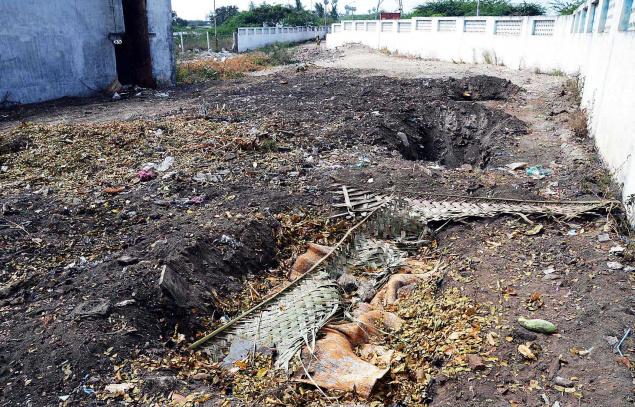
The pits, the Coimbatore Corporation has dug for processing wet waste at the Chokkampudur burial ground./ Photo: S. Siva Saravanan / The Hindu
Being done on experimental basis at Chokkampudur
Following the initiative to segregate waste at ward 23 in R.S. Puram, the Coimbatore Corporation has taken the next step by processing wet waste.
According to Corporation Commissioner G. Latha, the civic body had started the process a week ago, on an experimental basis, at the Chokkampudur crematorium, where the civic body had dug three pits to process the waste.
The area councillor S. Manimeghalai said that conservancy workers collected two small truck loads of wet waste, took it to the crematorium, where they dumped it in the first pit.
The workers then sprinkled effective micro-organism solution to hasten the process of composting.
They also topped it with dry waste and dried and powdered cow dung to complete the process.
Thereafter, every day, the workers would stir the waste till the 20 day.
They would then transfer the waste to the second pit.
Once the experiment was complete, the workers would dig a bigger pit to accommodate the entire ward’s wet waste. Ms. Manimeghalai said that the initiative had provided a solution in wet waste management, which became necessary after the Corporation and residents came together to segregate waste.
Every day, the workers in the ward collected six-and-half to seven tonnes of dry waste, which they sold to a private firm which paid the workers at Rs. 3 a kg.
Fuel
Ms. Latha said that the local processing of wet waste also helped the Corporation save on fuel in that the civic body need not transport the waste till the compost yard in Vellalore.
The motto was local solution for local problem.
If the civic body found the process successful, it could consider replicating it in other wards, starting with the four wards where it had begun waste segregation.
source: http://www.thehindu.com / The Hindu / Home> News> Cities> Coimbatore / by Staff Reporter / Coimbatore – January 22nd, 2014
As alternative methods of farming are tried to boost agricultural output, the state government is keen on promoting kitchen gardens to produce fresh fruits and vegetables. Arul Anandar College at Karumathur, 25 km from Madurai city, has been raising vegetables in sacks and that too with the least of water to counter water shortage in the region.
Though, sack cultivation is not novel, its irrigation method is rarely heard of, at least in the region. Discarded pet bottles of 2 to 3 litres are hung upside down from a pole attached to the sack. Intravenous tubes used to give saline to patients are used to regulate water flow to plants.
The college has been involved in several research work in agriculture under the Rural Development Science (RDS) programme. The RDS department has been testing sack cultivation for the last few years as it is ideal for raising vegetables especially creepers on terrace, said college sources. The practice involves filling discarded plastic sacks with enriched soil and composted coir so that the sack weighs light. After successfully growing creeper vegetables like ash guards, snake guards, bitter guard and pumpkin in this way, the college has started experimenting with intercrops like brinjal and ladies finger of late.
Second-year students of the RDS department water the plants once in two or three days. Guru Eswaran, one of them, said purpose of the saline tubes is to regulate water flow. “We fill bottles once in two or three days. In case of holidays, we can reduce the flow so that the water in the bottle lasts for a week’s time,” he explained. The students also add diluted vermicompost wash (the concentrated run-off water obtained from vermicompost fields) into the bottles as fertiliser.
Ambudoss Arvind, associate agriculture professor, said sack cultivation is ideal for roof-top gardens and kitchen gardens. Using this method, one can save space and water, besides adopt organic methods. It could be used even in dry areas not fit for conventional farming. “We are also trying poly-bags for kitchen gardens. Pesticide spraying is very intense in conventional method of farming. Vegetable crops can be raised organically too. A kitchen garden can serve the needs of an entire street,” he claimed.
Besides research, the college also demonstrates innovative farming practices to farmers. College principal Fr Xavier Vedham said the RDS department sensitises local farmers about its innovative methods.
source: http://www.articles.timesofindia.indiatimes.com / The Times of India / Home> City> Madurai> Vegetables / by J. Arockiaraj, TNN / January 19th, 2014
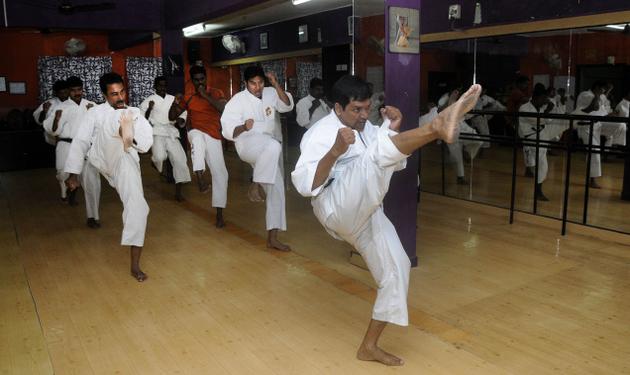
Maxwell Jude Anthony in action./ Photo: G. Krishnaswamy / The Hindu
Maxwell Jude Anthony teaches women easy defence techniques at his Shorinji Kempo classes. Vipasha Sinha reports
There is no need to kick and punch to escape assailants, all you need to do is to put little bit of pressure at the right spot. Maxwell Jude Anthony says this feature makes Shorinji Kempo one of the best self-defence arts for women.
“There is now a lot of talk about self-defence for women. They are being encouraged to learn physically demanding defence techniques. This approach may not be practical as assailants are well-prepared and attack after observing the victim. Often they work in pairs. Even if you hit them in the groin and put them down, they may return with more accomplices,” says Maxwell, who considers Shorinji Kempo effective in immobilisingthe attacker.
“All you have to do is apply pressure on certain points in the body and the recipient automatically reacts to it and loses the grip. For instance, there are around 180 points in the wrist, which can be worked upon to desensitise the attacker. It is a camouflage technique, where the attacker is caught off guard and before he comes to his senses, you have enough time to escape, ” he says.
Maxwell has been practising this art for 23 years. “Back in 1990, I saw a poster saying Shorinji Kempo, martial arts classes by Kirtie Kumar Futnani. Shorenji in Tamil means scratching, which piqued my curiosity and I went to the class. He invited me for a demonstration, where he was teaching kids. As past of the session, he asked me to grab his hand and the next thing I knew, I was flying mid-air to the other side of the room and the kids were clapping. I did know what had happened. The science of it got me intrigued and I practiced it regularly under my guru. I went on to be his successor and began practising as well as training,” says Maxwell, who also trains the visually impaired in foot reflexology.
Founded by Doshin So, Shorinji Kempo, translated as Fist Way of Shaolin Temple, was used as a healing technique in Japan post World War to help people in distress. It was used to cure people through acupuncture by activating various pressure points. Later it was developed into a self defence-technique, especially for women and children.
Maxwell organises Shorinji Kempo workshops on Mondays, Wednesdays and Fridays from 6 a.m. to 6.45 a.m. and 7 a.m. to 7.45 a.m. Venue: Russian Culture Centre, 27, Kasturi Ranga Road, Alwarpet, Kasthuri Ranga Rd, Parthasarathypuram, Teynampet.
For details, call 4352 9970, 90251 40051.
source: http://www.thehindu.com / The Hindu / Home> News> Cities> Chennai> DownTown / by Vipasha Sinha / Chennai – January 18, 2014
Malaysian Hindu devotee Karthi Gan grimaces while tapping his feet to the beat of ritual drums as two men plunge dozens of sharp hooks into his chest and back.
The painful ritual is Karthi’s way of giving thanks to the Hindu deity Muruga as part of the country’s colourful annual Thaipusam festival, one of the world’s most extreme displays of religious devotion.
Celebrated also in India and other areas with significant Tamil communities, the three-day festival that kicked off yesterday is marked with particular zest among Malaysian Indians.
Hordes of Hindus flock to temples across the country with offerings, many showing their fervour via extensive piercing or by bearing the elaborately decorated burdens called “kavadi” that are carried to religious sites.
“I got what I asked from Lord Muruga,” said Karthi, a 31-year-old engineer, who prayed during last year’s festival for “a good life”.
“I got a new-born baby. I got a new home,” he said late last night, when he and thousands of others began the slow and painful process of affixing their kavadi in the northern state of Penang.
His styrofoam kavadi structure — a frame attached to his hips and crowned by a peacock-eye design — was relatively light.
The piercing, however, had him feeling “a little nervous” ahead of the ritual just outside a Hindu temple, but he soon joined dozens of others who submitted to the ordeal.
Installing the kavadi, however, is merely the beginning.
In Penang, devotees then paraded barefoot for hours today through the streets of the state capital Georgetown, carrying kavadi that can weigh as much as 100 kilogrammes.
Participants swayed trance-like to drumbeats that had throbbed since yesterday.
Cheered on by friends and family who danced and chanted, the processions culminated in an 800-step climb to a hilltop temple for prayers.
Thaipusam commemorates the day when, according to Hindu mythology, the goddess Pavarthi gave her son Lord Muruga a lance to slay evil demons.
More than two million of racially diverse Malaysia’s 28 million people are ethnic Indian, mostly descendants of labourers brought in under British colonial rule. Most are Hindu.
source: http://www.business-standard.com / Business Standard / Home> PTI Stories> National> News / AFP / Georgetown (Malaysia) / January 17th, 2014
The event by Center for Tamil Culture is to be held from January 20 to 22
The Center for Tamil Culture will organise a three-day meeting of eminent Tamil writers and scholars across the globe in the city from January 20 to 22.
Titled ‘Thayagam Kadantha Tamil’, the international conference will see the participation of 35 experts from all over the world, said Nalla G. Palaniswami, founder-chairman of the Center, here on Friday.
The experts include R. Karthickesu from Malaysia, Cheran and A. Muthulingam from Canada, Nagarathnam Krishna from France, S. Ponnudurai from Australia, Shanmuga Siva and Muthu Nedumaran from Malaysia, Ulriche Nicholas from Germany, Kalaimagal from China, Seethalakshmi and Azhagiya Pandian from Singapore – all experts in their field, said senior journalist Maalan, who is the convener of the international conference.
Seven sessions
There would be seven sessions which will focus on literature, media, technology and education, for the four were important to take Tamil to the next generation.
Sirpi Balasubramaniam, one of the trustees of the Centre, said that there were writers, scholars and experts from 12 countries to talk about their experience.
They will elaborate on their understanding of language, how they viewed the Tamil publishing world, how technology had helped bridge the divide among Tamil writers and many more interesting topics.
This was not the first programme. The Centre for Tamil Culture had conducted such an event, he said. It had also organised events focussing on Tamil writers from the Kongu region and honouring writers, he added.
Improving quality
Later talking to The Hindu Mr. Maalan said that the main aim of involving writers from outside Tamil Nadu will help improve quality of works published here. In other words the participants would surely bring in variety and experience that would enhance quality to whatever was available locally.
It would also bring in new sections to Tamil literature just as there was American literature, African literature. He also hoped that in addition there would also be dialogue and synergy among the writers.
He said that it was wrong to say that the Tamil diaspora literature was dominated by those from Sri Lanka, though it was true that there were many from the island nation, who shared their experience of being away from homeland and the struggle they went through.
The Tamil diaspora literature included publications from people from Australia, Switzerland, Canada, the U.S., Malaysia and Singapore. And their experiences and works were as varied as any other. At the conference one could find feminist literature, post-modern literature and much more.
Mr. Maalan said that a concerted effort was needed to take the works of writers outside Tamil Nadu to readers across the world and suggested that e-publishing could be a way out.
e-publishing
Though a few publications in Tamil Nadu encouraged writers from abroad, the best way forward was e-publishing. But it was not uploading content that was converted into the printable document format.
It had to be e-publishing in the real sense, he said and added that efforts were also being made to take the works to the mobile platform. He also welcomed the government support to such endeavours.
source: http://www.thehindu.com / The Hindu / Home> News> Cities> Coimbatore / by Karthik Madhavan / Coimbatore – January 18th, 2014
The Welding Research Institute (WRI) has signed a protocol of intention with Leibniz University of Hannover, Germany for joint working in the area of power source evaluation facility.
The pact was signed at a function held at the WRI of Bharat Heavy Electricals Limited (BHEL) on Thursday in the presence of A V Krishnan, executive director, BHEL, Trichy and senior executives.
On behalf of Leibniz University, Prof Dr Ing D Rehfeldt exchanged the signed protocol with R Easwaran, general manager (WRI & Labs), BHEL, Trichy.
Krishnan said that WRI has taken the right initiative to become a world class institute and this research – academia partnership will augment its efforts to develop a centre for welding power source evaluation which would be helpful to the nation in a big way.
He also said that by bridging the technology gap, WRI can evaluate the current generation power sources, which have several advanced features and needed to be evaluated for their dynamic characteristics. Various manufacturing sectors in the country would benefit through the development.
Prof Rehfeldt said that Leibniz University is looking forward for the joint establishment of the power source evaluation facility at WRI.
It is not only the hardware and software of the equipment, but the human mind working on this, that would fully unleash the potential of the technologies, said Rehfeldt.
Easwaran said the modern inverter-based power sources have many added features for improving the depth of penetration of welds, making spatter-free welds, welding thin sheets, etc and understanding the dynamic characteristics of the power sources required a high power data acquisition system in tandem with a high speed visualization system as well as automation even manual welding, to avoid human hand unsteadiness.
source: http://www.articles.timesofindia.indiatimes.com / The Times of India / Home> City> Trichy> Bharat Heavy Electricals Limited / TNN / January 18th, 2014
Insights into bringing a story alive on stage, the power of imagination and words, reinventing mythology and the eternal intensity of compelling photographs mark Anusha Parthasarathy’s account of the Fest
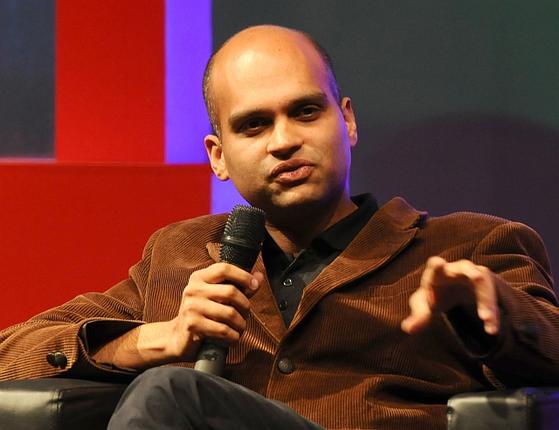
Aravind Adiga /. Photo: R. Ragu / The Hindu
Aravind Adiga
The evolution of a writer who was born in a hospital near Poonamallee High Road and grew up in a house nearby into a Man Booker prize-winning author is the story of Aravind Adiga. In his conversation with David Godwin at The Hindu Lit For Life 2014, Adiga talked much about the city of his childhood and the good memories of the train journeys from Mangalore to Chennai. “But my childhood was dominated by the Udupi hotels of Madras,” he said. “Especially Woodlands and Dasaprakash. For a long time, I looked for a Dasaprakash hotel wherever I went.
When David brought up The White Tiger and the story behind it, Aravind recollected seeing a magazine a driver of his colleague was reading in New Delhi once. “It was called Murder and this pulp fiction was a rage among the drivers of New Delhi. It had a collection of stories where the driver kills his owner,” he explained. “In India, the middle-class takes a lot for granted. The domestic help is privy to a lot of personal information. I wanted to ask the question, why is India safe? The core of the novel, of course, is about how a man becomes free.”
Aravind’s first novel was set in New Delhi and the second in Mumbai (Last Man In Tower). He is working on his third. “The Madras I grew up in is gone, and for a long time, I was looking for my childhood. I understand now that I must look at the future. I have now decided to learn Tamil,” he said. When asked if the function of literature was not to recover the past, he said, “In the book The Leopard, there is a line that goes ‘Everything must change so that everything can stay the same’, and I think Chennai has done just that. You don’t always have to write about a place you enjoy,” he said.
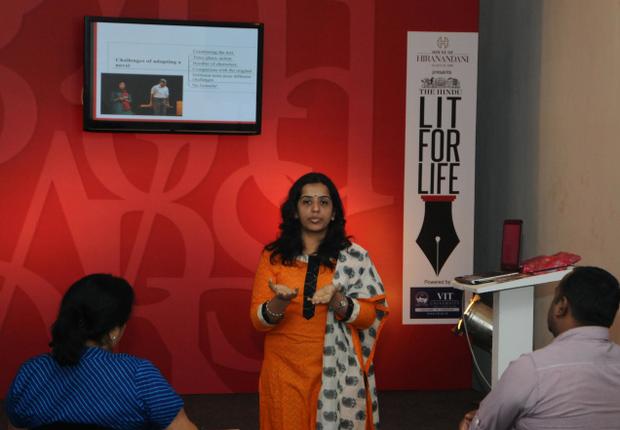
Nikhila Kesavan conducting a workshop / Photo: R. Ragu / The Hindu
From Page To Stage
Everyone sat in a huddle, eyes flitting between the screen and the speaker at the From Page To Stage: Bringing A Story Alive, a workshop by Nikhila Kesavan. The actor-director spoke in length about adapting short stories and works of fiction into stage productions or feature films.
The workshop dealt with two novels; one that had many characters and the other that was a monologue. “A novel rarely lends itself to stage. And there are so many places, a hostel, cafe or a terrace. How do you show so many things for a stage production? This is where the director decides which actors are most important and who can be avoided,” she said. And on the subject of the play or movie being compared to the book, she said, “There will always be comparisons when you have an adaption. But it’s best not to be too aware of it. I just evaluate the whole play as a piece of theatre.”
There is no one formula to successfully adapt a novel or a story, and everyone has to find their own way, the actor pointed out. “Sometimes, a book has so many incidents that if you take out even one, the story will fall apart. In other books, there is a lot of talking and only two or three incredibly dramatic scenes, but they are so good that you want to adapt the story. There are different ways of treating the stories — you have monologues or you could divide the passages among many voices so it’s not boring.”
Nikhila also added that it was easy to point out from the first reading if a play was meant for theatre. Sometimes, a play might make a great film but fail on stage. “There are many challenges to tackle in theatre. If you are making a movie, you think as a director, actor and writer, which is different from a playwright writing a script.” And on perspective in an adaptation, she said, “Many people have seen different versions of The Ramayan, but what do you see in the text? It’s how you portray and design the story. Your characters can be very radical and different from the original or it could be a good retelling,” she explained.
Kumar Shahani with Sadanand Menon (left) / Photo: R. Ragu / The Hindu
Evolution Of The Imaginary
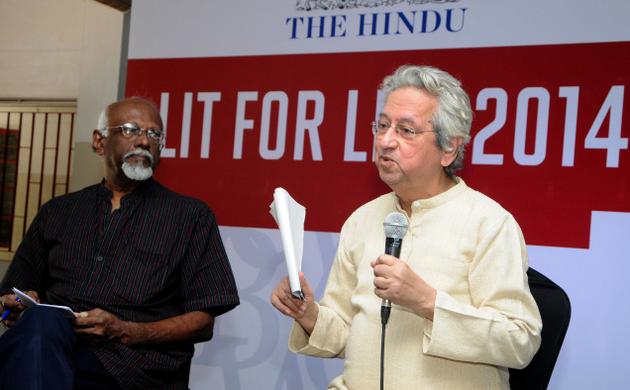
From the multiplicity of perspective to the loss of poetry and handling of colours on screen, noted filmmaker Kumar Shahani explained the concepts of the imaginary through his experiments in films, conversations with intellectuals all over the world and his views on the changing state of imagination in India and overseas. He was introduced by arts editor Sadanand Menon.
The session began with a frame that inspired a scene in his film Khayal Gaatha, which looked at the history of Khayal singing. He talked about the different perspectives that can be captured on one frame. “I worked with the idea of multiple duration — being present simultaneously and how the place around it gets changed. And how the resonance around an area changes,” he said. The painting was of a woman peeping out of the window, looking at a lover. At the far end, another conversation takes place.
Shahani spoke of the perils of fitting into a category. “When I presented this painting in Sydney, many didn’t understand what I had done with it. They have blocked out all other kinds of enunciation because they are so influenced by the revolutionary thinking of Da Vinci or other thinkers,” he said.
The filmmaker also spoke about the importance of colour, how to handle it and the role technology has played in changing perspectives. “I’m appalled by the attention span of the breaking-news genre or Hollywood, where you can’t really look at anything,” he explained. “I see a future where the less opportunities we are given to create, the more we use other people’s creations (which they created for their own purpose).” Sadanand added that image is a form of consciousness. “When you can imagine an image, it’s a whole new consciousness that is emerging depending on how the creator re-imagines it. The imaginary is not fiction, but a world in the process of becoming real.”
Making Waves
With two MBA graduates-turned-authors and a literary fiction writer on the panel, the discussion Making Waves: How To Create An Impact As A Writer dealt with many interesting issues such as how important marketing is to make a book sell in today’s scenario, how different is it for different genres of books, and how one views literary fiction or commercial fiction today. The lively discussion among Anita Nair, Ashwin Sanghi and Ravi Subramanian was moderated by Naresh Fernandes.
“It’s difficult to construct a Chinese wall between the two lives I lead — I use business tools in writing. The amount of time and energy one would devote to a business plan, I would dedicate to a plot,” said Ashwin Sanghi, known for best sellers such as Chanakya’s Chant and The Krishna Key. He believes the author’s work does not stop with writing.
Banker-author Ravi Subramanian agreed. “When you write a book, there are enough people to read it. But how do you reach the right audience? So I send out my manuscripts to a few trusted people I’ve interacted with. They are people with no connection to banking. I do this so that I can change the script in case there are parts of the book they don’t understand. It also helps improve the story.”
Anita Nair’s rule is to write books that she likes to read. “They seem to endure,” she added. “Writing, to me, is an intense and personal exercise. I don’t see the reader in my mind. I don’t believe marketing is important. The book has to be good, only then will it endure. You needn’t be aggressive. A book is not a product.” Ravi explained the need for an author to become the CEO of his book. “A lot of good books don’t make it because readers don’t know they exist. An author must take charge of everything from writing to marketing the book to make sure the reader sees it.”
Reinventing Mythology
Are mythological retellings relevant? How does inventing mythological texts help us contend with the present and the future? These important questions and more were discussed in Revinventing Mythology: The Art Of Rewriting Religious Narratives. The panel had Paul Zacharia, Veenapani Chawla and A.R. Venkatachalapathy, and was moderated by K. Satchidanandan.
The moderator began the session by pointing out that every field was in some way impacted by mythology and that they had become a part of everyday life. “Now Ekalavya is being seen as a big protagonist in Dalit literature. Shambuka is another figure who is gaining prominence; Rama is being questioned on killing him and Vaali. Rama is being questioned on ousting Sita from the kingdom. This is because myths are polyphonic and can be interpreted in many ways and contexts,” he said.
Paul, a short story writer and columnist, talked about confronting one’s religious beliefs through reinvention. “It was an attempt to reinvent myself spiritually so that I could enjoy inner freedom,” he said. Veena, an actor, director, choreographer and composer has done extensive work with mythology and talked about the importance of three characters in epics — Ardhanarishwar, Sabyasachi and Brihanalla. “They are concepts, ways of viewing humanity. Ardhanarishwar brings together two polarities in gender. Sabyasachi brings together the capacities for knowing in different ways. The middle ground or the third side to these two characters is Brihanalla, which not just combines two different genders but also the capacities.”
A.R. Venkatachalapathy brought up the issue of myths helping one contend with the past, present and future. “When a society is modernised, contending with myths is considered as a way of being modern,” he said. “There have been retellings with Ravana as the hero of the epic or with Hiranya Kashipu. Here the retellings don’t reject the myth, but rather rewrite it in a different way.”
Pablo Bartholomew./ Photo: R. Ragu / The Hindu
Remembering Bhopal
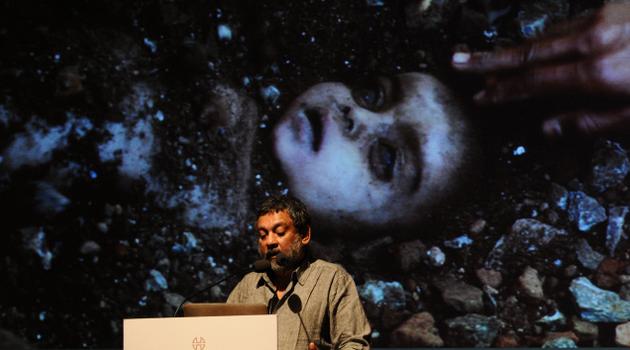
It has been 30 years, and yet, the images that Pablo Bartholomew shows on the screen continue to hurt as much as they did when they were first taken in 1984. Introduced by Rahul Pandita, the award-winning photographer narrated his experiences in Bhopal during the time of the gas tragedy through his unforgettable images.
Pablo began his photo presentation with pictures of himself as a child and a young man, talking about his father who introduced him to photography. He then showed snapshots from his early work, recording the hippy culture of students at that time. “Many of them are parents now and their children are unable to accept how hip their parents were back then,” he laughs. In the collection was a picture of the Rock Fest in St. Stephen’s College in 1974. There were also pictures of Satyajit Ray on the sets of Shatranj Ke Ki Khilari.
In 1983-1984, Pablo took to news photography and shot many images of Operation Blue Star and the riots that followed. When the Bhopal gas tragedy took place, he rushed there and landed three days later. The images of J.P. Nagar, men wearing scarves around their noses and mouths, people sporting glasses to shield their eyes, are haunting. There are more and more pictures of hospitals, doctors checking patients, dead livestock, mass burials and so on. The most haunting image, which won him the World Press Photo of the Year, is of an infant being buried and a hand reaching out to caress. Pablo visited Bhopal many times afterward, on the first, ninth, 10th and 20th anniversary to document whatever changes have happened. “Memorials have been erected for those who died and more people are agitated and getting on the streets,” he said. He promised to visit Bhopal again soon.
source: http://www.thehindu.com / The Hindu / Home> Features> MetroPlus / by Anusha Parthasarathy / Chennai – January 15th, 2014
The Indian Institute of Technology – Madras (IIT-M) has united with 5 universities belonging to different countries of the Globe – France, Canada, China, UK, and Israel to make a group effort in research area by bringing out joint Ph. D Programmes.
It took more than a year for Indian varsity to negotiate with Universite de Technologie de Troyes in France, Technion – Israel Institute of Technology, University of Waterloo in Canada, University of Liverpool in UK and National Tsing Hua University in China. Now, they all have joined hands with IIT-Madras to offer joint PhD programmes.
Lih J Chen, president of National Tsing Hua University stated the agreement with IIT-M as a watersShed moment for the Chinese varsity. He added that research of the highest quality need to be carried out and the work can no longer be only an ‘in-house’ affair.
R Nagarajan, IIT-M dean of international & alumni relations, told about their agenda, that a simple 4-stage process will be followed by IIT-M started with faculty collaboration, followed by student exchanges programmes which will lead to co-supervision and ultimately conclude in a joint degree programme.
Two teams of students from Belgaum and Vellore won the first prize of `40,000 at the third edition of the InoVIT 2014, organised by the VIT university recently.
Event organiser A Ruban Kumar said around 1,600 student-participants of classes 9 to 12, from the southern States had taken part. The events were categorised into working model, idea presentation, poster presentation and quiz in the preliminary and final rounds. The top two winners for the three prizes in each of these events, selected by a panel, were given a total cash prize of `3 lakh.
Elton John and team mates from St Paul’s High School from Belgaum, who developed a spy robot and a smart wheel chair developed by Karthik, Mukesh and Pranesh from Avinesh Infotech Robotic Academy, Vellore were the two teams that clinched the first prize for the Working Model Category.
In the idea presentation category, Anga Sasha from Little Angel School, Visakapatnam, Andhra Pradesh, and a team led by Visakan from Kalgi Ranganathan Montford School Chennai, jointly won the first prize of `35,000 for the idea of specially designed goggles for blind people to see using the principle of ‘echolocation,’ and ‘oceanic electromagnetic waves fencing,’ to help fishermen maintain maritime boundaries respectively.Misba Fathima and team from Islamiah Girls Higher Secondary School, Vaniyambadi, and Rishab Jain and his team from Maharishi International School, Chennai, jointly won the first prize of `35,000 in the poster presentation category.
Naveen Unnikrishnan and team from Bhavan’s Adarsh Vidyalaya, Kochi, and Vicknesh and his team from Bakthavachalam Vidyashram, Chennai, won the first prize of `20,000 each in the quiz group I (9 and 10 classes) and group II(11 and 12 classes) respectively.
source: http://www.newindianexpress.com / The New Indian Express / Home> States> Tamil Nadu / by Express News Service – Vellore / January 16, 2014
The Department of Medical Physics and Radiation Oncology attached to the Christian Medical College here is organizing a two-day national workshop on Radiotherapy Gel Dosimetry from Wednesday, at the MePhysics Block, Rehab Campus, Bagayam, Vellore.
According to Dr Paul Ravindran, vice principal of the college, the aim of the meet is to provide hands-on training on the application of three dimensional gel dosimetry in radiation therapy.
The workshop is being conducted in collaboration with the Union for International Cancer Control. Atomic Energy Regulatory Board, and the Board of Research in Nuclear Sciences have also financially supported the workshop.
source: http://www.newindianexpress.com / The New Indian Express / Home> States> Tamil Nadu / by Express News Service – Vellore / January 08th, 2014