Two significant records were created by the Coonoor Tea Trade Association in 2013, the turnover crossed Rs 500-crore mark and the average price topped Rs 100 a kg, reveals an analysis of market reports.
The average price was above Rs 80-a-kg mark for the second consecutive year. The volume sold continued to remain above 5-crore-kg level for the third consecutive year.
In all, 51 auctions were held last year with 5.95 crore kg being sold against 5.53 crore kg in 2012. A higher volume was sold despite average price rising to Rs 89.32 a kg from Rs 82.28 in 2012.
Consequently, the turnover rose to Rs 531.45 crore from Rs 455.01 crore. This increase of Rs 76.44 crore marked 16.80 per cent growth.
The increased turnover lay spread among factory owners, growers, traders, workers, auctioneers and warehouse keepers.
For the first time at the auctions, the average price crossed Rs 100/kg to touch Rs 104.11 on March 8. It remained above Rs 100 till April 26 peaking to a high of Rs 110.70 on March 21.
However, oversupply in global market reduced exports. Availability of low-priced tea in north Indian auctions reduced upcountry demand. Collectively, in the last quarter, CTTA auction average price crashed to Rs 72 – the least in the last two years. Otherwise, the year’s average price would have been much higher.
source: http://www.thehindubusinessline.com / Business Line / Home / by The Hindu Corrrespondent / Coonoor – January 07th, 2014
Tamil Nadu-based masala brand, Aachi Kitchen is planning to open a chain of Chettinad restaurants, the latest diversification of this nearly two-decade-old group inspired by the success of global chains such as KFC and McDonalds according to a report by Sanjay Vijayakumar and Sangeetha Kandavel in Economic Times.
Aachi Kitchen will start in the first quarter of this year in five locations. “First, I want to see whether I can sustain and then blow the trumpet,” said AD Padmasingh Isaac, Founder and Chairman, Aachi Kitchen, who refused to say how much he is investing in this venture.
Isaac, a first-generation entrepreneur who belongs to Nazareth in Tirunelveli district, started selling masala under the Aachi brand in 1995. This year, he expects to clock revenue of Rs 750 crore.
Holding a bachelor’s degree in business administration, he worked as area manager for Godrej’s personal care products unit for a decade before becoming an entrepreneur. Over the years, the Aachi group has extended to products such as herbal cosmetics, herbal cough syrup and even a matrimonial site. But the restaurant foray is likely to be the biggest-ever extension under the Aachi name.
Aachi’s decision comes at a time when a slew of South Indian players are upping the game in the food business. The likes of Hotel Saravana Bhavan and Adyar Ananda Bhavan have global ambitions in this space. More specifically, though, the quick service restaurant market where Aachi expects to play, is expected to swell in size in the years to come. A September 2013 report of Crisil said it expects this format to double in size to Rs 7,000 crore by 2015-16 from three years earlier.
source: http://www.hospitalitybizindia.com / HospitalityBizIndia.com / Home> F&B Overview> F&B / by HBI Staff, Mumbai / Wednesday – January 08th, 2014
SASTRA University here has come out with a novel method for treating effluents let out by Tirupur dyeing units.
Meera Parthasarathy, Senior Assistant Professor, Center for Nanotechnology and Advanced Biomaterials, School of Chemical and Biotechnology, and inventor of the novel method, explained it to the industrialists and technical persons of Veerapandi Common Effluent Treatment Plant at the university here on Tuesday. The method involves treating effluents with a special bacteria identified at SASTRA University named SASTRA bacteria for which patent had been filed and a powder in a two-step process instead of the seven-step process that was followed by dyeing units.
The untreated effluent undergoes bacterial treatment and powder treatment and becomes non-toxic.
Collecting untreated effluents from Tirupur, the SASTRA team conducted the experiments using bacteria and the powder prepared by them. Treated water was put to Zebra Fish Model (rearing fish in it) to find out whether it has been detoxified. Fish survived even after seven days and there is no toxicity in fish too, Meera Parthasarathy, said.
Following the court order, the dyeing units have been using a common effluent treatment plant.
K.K.Padmanabhan, Technical Director, Veerapandi Common Effluent Treatment Plant, said that as per the court order the units should follow zero liquid discharge and hence wastewater could not be let out.
When T.K.Rangarajan, CPI (M) MP, wanted to know about the usability of the treated water for drinking purposes, Mr.Padmanabhan replied in the negative.
source: http://www.thehindu.com / The Hindu / Home> News> Cities> Tiruchirapalli / by Special Correspondent / Thanjavur – January 08th, 2014
Along with Nammalvar, his brothers Balakrishnan, an engineer, and Ilangovan, a former MLA, practised organic farming.
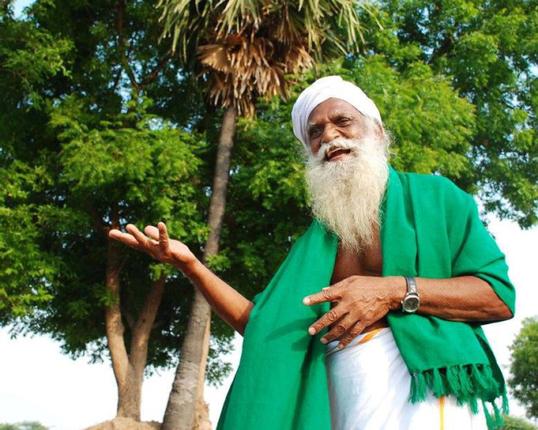
Chirping of birds rented the air. Gentle breeze from hundreds of trees blew across the farm. It was the farm maintained by the family of G. Nammalvar (75), organic farming scientist, who passed away on December 30, at Ilankadu, his native village near Thirukattupalli.
It was a hot summer in June 2004, when this reporter visited that place to see Nammalvar along with V.Palaniappan, Adviser to Thiruvaiyaru Knowledge Resource Centre of Dr. M. S. Swaminathan Foundation.
Rays of sun and summer heat could not enter the place as it was a mini woodland with all kinds of trees. Birds were in large numbers and went on chirping.
Nammalvar, with his green head gear and flowing beard, was sitting on a wooden coir mesh cot under a tree.
As he took us through the farm and explained the activities, we understood that Nammalvar not only preached organic farming but also practised it in his family farm.
Along with Nammalvar, his brothers Balakrishnan, an engineer, and Ilangovan, a former MLA, practised organic farming.
Nammalvar showed the variety of trees he and his brothers had planted in the farm.
He showed how the leaves that withered from trees and other biological waste were turned into compost.
He also demonstrated the ‘Pancha Kavyam’ was prepared using five products — cow’s urine, dung and milk, ghee and buttermilk. “Pancha Kavyam can be used as a growth regulator and pesticide repellent for crops,” he said.
It was Nammalvar’s padayatra for ‘reviving natural resources and fertility’ (Iyarkai Valam Meetpu Nadaipayanam) in 2004, organised by Centre for Ecology and Research, a voluntary organisation, that made people rally behind him.
The yatra which commenced on June 5, 2004 covered a distance of 550 km in 25 days from Poompuhar to Grand Anicut, passing via 344 villages in Cauvery delta districts.
The padayatra created public awareness of the importance of organic farming, sustainable agriculture and participatory development at Thirukattupalli, Thiruvaiyaru and Orathanadu.
His last campaign for nearly a month from December 1 in Cauvery delta districts was against the proposed methane extraction project.
He was planning to organise a rally at Mannargudi on January 25 to protest against the proposed project.
Hundreds of people, mostly farmers, paid homage to late Nammalvar whose body was kept at Bharath College of Science and Management here.
R.Vaithilingam, State Minister for Housing and Urban Development, paid homage to Nammalvar. The Minister placed a wreath on the body of Nammalvar on behalf of Tamil Nadu Government, said a press release issued here on Tuesday.
source: http://www.thehindu.com / The Hindu / Home> News> Cities> Tiruchirapalli / by G. Srinivasan / Thanjavur – January 01st, 2014
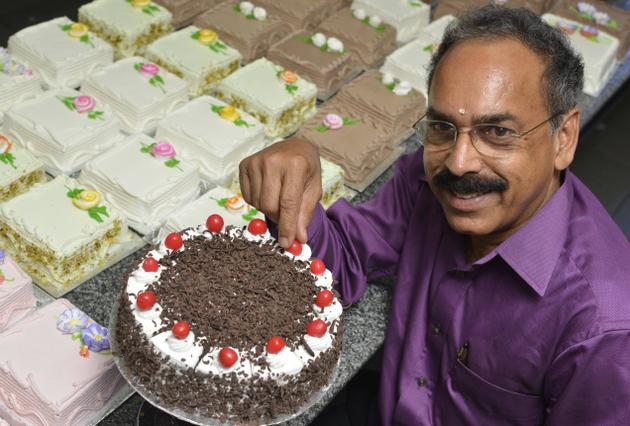
K.R. Balan once travelled on a rented bicycle to sell buns to petti kadais. Today he owns one of the biggest bakery chains in the state.
One morning in 1967, 14-year-old Balan from Kavumpuram boarded a train all alone to Coimbatore. He lied to his mother saying he was going to Calicut to visit his sister. He did that because he wanted to do something to save his poverty-stricken family. “We lived in olappuras – thatched huts. My mother was a daily wage labourer. Father did some small business and farming. I had no education. Life was my teacher,” says Balan who is 61-years-old now. Today he leans back on a plush armchair in his swanky air-conditioned office at Ganapathi, from where he controls K.R. Bakes, one of the biggest bakery chains in the state.
When he started out, Balan would cycle around Coimbatore in a bicycle that he would rent for 25 paise. He sold buns and barley biscuits to shops in the outskirts. In a year’s time, he along with his three friends set up a small shop in Idayarveedhi. “We had no man power or machines and we worked almost nonstop. We woke up as early as two in the morning to make the goodies.” While his friends handled the production side, Balan, who had a way with people, steered the marketing and delivery. “I spotted potential customers as I travelled around in my cycle. Soon, we started sourcing our snacks to almost all the village shops.” The buns were a great hit, recalls Balan. “Coimbatore had many mills. In the evenings, tired labourers would come to our outlet for chai and a coconut bun. Chai shops were considered beedi points and undignified places for women. People would disparagingly refer to us as ‘those chai wallahs’.” But, things changed. The cycle gave way to the scooter and then a Bullet bike. The demand for their buns and cakes rose. Balan zipped around his scooter across the Valayar border to supervise the K.R. outlets that mushroomed in many parts of Kerala.
While his friends decided to move on to other things, Balan stuck on. “I loved my job and had full faith in it.” The brand name KR came into being in the late 80s. “Our outlets had different names. A friend suggested I bring them all under one brand. I chose the name K.R. Bakes.” The two letters, which Balan later added before his name as initials, changed his destiny. From a small room that sold coconut buns, K.R bakes became the most popular bakery brand name. Now, there are 30 outlets in Coimbatore and many more in Erode, Cochin, Malappuram, Palakkad and Trichur. By early 2000, they even introduced a fast food section that sold North Indian items. “We introduced the idea of a coffee shop, way before any coffee outlet chains set up their shops here. But, we cater to the common man and do not compromise on quality. All our fast food are made right in front of the people and served hot.”
Balan and his sons never miss the IBA, an international trade fair for bakery, confectionery and snacks held once in three years in Germany. “It is a great platform where you are exposed to innovative ideas and developments in technology. Bakers from all over the world showcase their products and ideas. I realised my job was indeed honourable.” The Coimbatore production has the latest Italian cookie machine, icing machine, imported egg breakers and cake mixers. “It is not like the olden days. One cannot afford to be laid back. The competition is high now,” says Balan. Balan knows what it is like to be poor and uneducated and this is what has prompted him to help educating economically underprivileged children. “We also tell our labourers to educate their children and assist them financially. Education is important. I know its value as I was deprived of it,” he says. “We have doctors and lawyers in the family now,” he says with pride. His three sons help him in his business. So do his brothers who handle the outlets from different cities. Balan remembers making his sons work at their retail outlets, when they would come home on vacation. He would pay them too. “They never would spend that money. They would save each penny. I wanted them to know the value of hard earned money. I wanted them to know that the money left by ancestors is easily squandered, while the one earned through sweat stays forever.”
source: http://www.thehindu.com / The Hindu / Home> Features> MetroPlus> Food / by Parshathy J. Nath / Coimbatore – January 09th, 2014
Young women transforming small dots into beautiful ‘kolams’ was a common sight early in the morning, especially during ‘Margazhi’, till a few years back. Not any more. Busy with daily chores, the young have decided to outsource the work to elderly women, who have taken up ‘kolam’ drawing as a profession.
The Tamil month of Margazhi is considered auspicious for girls. It is believed they would get a good spouse if they draw beautiful ‘kolams’ at their doorsteps and visit temple. Times have changed. Girls busy with studies or jobs find it difficult to attend early morning poojas in temples. Similarly, drawing beautiful, intricate designs in front of the house braving the morning chill is an ordeal that many wish to avoid. Here enters, middle-aged and older women, who have ample time and the necessary skills to do kolams.
Kannathal, a 78-year-old resident of Melamadai, starts her day at 4.30am and covers nearly 15 houses in Gomathypuram in Madurai. Some house-owners leave a bucket of water and a broom outside their gates so that she does not have to wake them early morning. The enterprising woman says drawing kolam is the only thing she is good at. “I don’t know to read or write. But, I was taught to draw kolam by my grandmother when I was just five years old. Now, the art has come handy as it helps me to earn a good sum even at this age,” she said.
For smaller kolams Kannathal collects Rs 450 per month and for bigger ones the rate is Rs 800. “As I’m not good at drawing colour kolams, I take the help of a girl from my colony. I pay her Rs 250 per house,” she said.
Mariamma, a resident of Villapuram, has been drawing kolam for others for the past one year. “Customers started demanding colour patterns very recently. I charge them Rs 900 during Margazhi and Rs 550 during other months. Putting colour in patterns consumes a lot of time,” she said. Her earnings from kolam art have already crossed Rs 15,000 this month. The kolam experts are so much in demand in the city that they are now outsourcing the orders they have received.
Girahalakshmi, a resident of Valluvar Colony in Madurai, admitted a kolam is a must during Margazhi. “Kolam has to be drawn before dawn. Getting out of the house at dawn is risky due to crimes such as chain-snatching. By paying a monthly sum I can get the kolam drawn by another,” she said.
Sumathy, a newly-married woman, says she was happy to learn that her in-laws has employed a kolam artiste. “Firstly, I can’t draw kolam and moreover, the early morning weather is too cold,” she said.
source: http://www.articles.timesofindia.indiatimes.com / The Times of India / Home> City> Madurai> Colour / by Padmini Sivarajah, TNN / January 09th, 2014
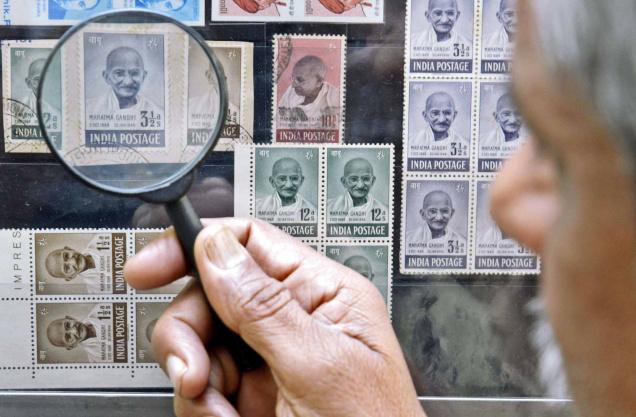
Philately, still a popular hobby./ Photo: K.Ananthan / The Hindu
Philately still holds considerable charm, not just as a hobby but also as an investment
It was Bhaskara Sethupathy (1868 to 1903), the raja of Ramnad, who sponsored Swami Vivekananda’s visit to Parliament of the World’s Religions, Chicago. Philatelist C. Selvaraj learnt about this as he built up his stamp collection on Sethupathy. “These stamps were issued in 2004. I bought a full sheet of 40 stamps for Rs. 700 at a philately exhibition in Pune. Along the way I brushed up my history too. More recently, I bought another sheet for Rs.900. The dealer originally quoted Rs.1,500 for but agreed to sell it for less. It’s a buyer’s market and is the right time to build your collection,” he explains.
Stamp collecting as a hobby is far from over, say philatelists in the city. It is actively pursued and is an investment option.
A. Ramalingam, a retired tailor, has been collecting stamps for four decades. “I took to it in my school days, and now the stamps are an asset, an investment worth many lakhs. From the Gandhi stamp issued in 1947 to the recent one of Ekalavya in December 2013, I have them all,” Ramalingam says with pride. Pointing to a rare stamp of Gandhi issued in Rs.10 denomination in 1948, he says, “It costs over Rs.30, 000 now.” His son A. Suresh continues to add to the collection.
Selvaraj participates in philately and coin exhibitions across the country. He has commemorative stamps (mint or unused) based on the theme of Tamil Nadu. “The postal department issued about 2,500 commemorative stamps from 1947 to 2013. I have the entire collection that includes stamps on buildings such as the High Court, churches, mosques, personalities such as MGR, Sivaji Ganesan and Gemini Ganesan, and freedom fighters,” he says.
Commemorative stamps are significant because they are limited in numbers. “In the 70s and 80s when our economy flourished, more such stamps were issued, often over 10 lakhs. That was also when philately and coin collection picked up. Now, for example, if they issue commemorative stamps of Sivaji Ganesan, they are fewer and so always in demand,” says Selvaraj.
Philatelists say investing in stamps should be done with care. There are catalogues issued by philatelic clubs that list the stamps along with their value for buying and selling. Now, thousands of philatelic transactions take place everyday on eBay and online auctions. Collectors from around the world meet online regularly, discuss and exchange stamps.
A. Nazeer Ahamed who runs a medical shop logs on to websites to update his knowledge on stamps. He has collected stamps for 20 years. “Youngsters approach us regularly for guidance,” he says.
He has commemorative stamps, stamps that never got cancelled, and some notable ones such as one of Beghum Akthar (1993) and water birds (1944) that were issued in soluble ink. “Because the soluble ink affected the quality of the stamps, the postal department withdrew them. Now, they are rare. I also have stamps on Rajkumar Shukla (2000) that was issued in limited numbers.”
Nazeer also has a postal department theme, “My stamp or nam thabaal thalai’. “ You can add a photograph of your family member, friends and relatives along with the stamp. I got it done for a number of children in my locality. They were hooked to the hobby,” he smiles.
Selvaraj also has a set of 263 coins in copper nickel and silver, the British India coins issued between 1835 and 1947. Rajagopal’s special set of coins include Rs.75, Rs.60, and Rs.100 denomination. The latest is the Rs.1,000 Tanjore coin issued on the Bragadeeshwarar temple. He says: “The hobby is enriching and keeps you away from bad habits.”
The Philatelists, Coimbatore
The Philatelists, Coimbatore was started in 1977 by a group of seven dedicated philatelists and currently has 80 members. The annual membership fee is Rs. 200. P.R. Krishnan, its secretary and founding member says: “Thirty years before, stamp collection was a popular hobby among school children as most schools had a Nehru Stamp Club. Now, the scene has changed. Parents don’t encourage children anymore to pursue the hobby. Video games and TV have distracted the children. They are constantly on Facebook. In order to get them interested in philately, we conduct a two-day workshop, where we teach school children the rudiments of stamp collections. It is sad that India has only around 50,000 stamp collectors, whereas a country like China has 10 million of them. In the 1950s, 10 sets of Gandhi Stamps cost just Rs.173. Today, they are valued at over two lakhs. Also, nine sets of first day covers that cost a few hundreds are now over Rs.11 lakh.
A noble pursuit
George V was an ardent stamp collector and the top 10 rich people of the world such as the Sultanate of Brunei, Queen Elizabeth, Princess of Monaco and Princess of Spain have a number of investment portfolios. One of them is stamps. That’s why it’s called the hobby of the kings. To join Philatelists, e-mail: prkrish77@gmail.com
source: http://www.thehindu.com / The Hindu /Home> Features> MetroPlus> Society / by K. Jeshi / Coimbatore – January 09th, 2014
Music should begin at the ‘nabi’ or navel, move to the ‘hrud’ or heart, then ‘kanta’ or throat, and give the ‘rasa’ or emotion
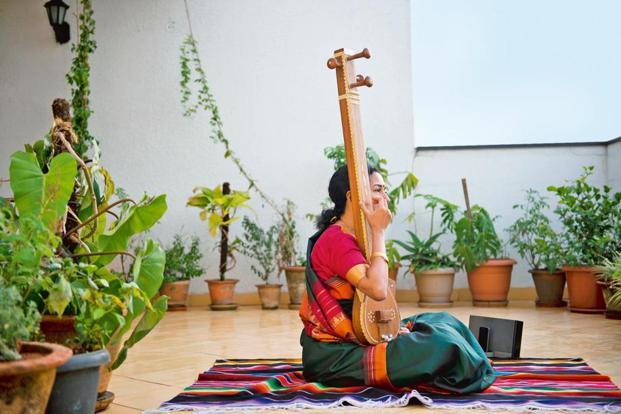
Narayan’s teacher prefers that she practise before dawn. Photo: Aniruddha Chowdhury/Mint
My music practice always begins with the strings of the tambura. I’d like to say that mine is an old-fashioned Tanjore-style stringed instrument made from jackwood and rosewood with a spherical gourd that rests comfortably on my lap when I sit cross-legged on the floor for practice. But it is not. My tambura has been downloaded—for free, I might add—from YouTube. With a click, I can choose any of the octaves I typically sing at: G or G sharp being the usual ones. In Carnatic music, we call it “5 or 5.5 kattai”, respectively. When I chant in Sanskrit, I choose a lower octave: more like 3.5 or 4.
My music teacher prefers that I practise before dawn. He actually prefers that I emulate the system demonstrated in that great Carnatic music film, Sankarabharanam. In the movie, a boy trainee wakes up before dawn, stands neck-deep in a flowing river and sings: Sa-ri-ga-ma-pa-dha-ni-sa. The slowly rising notes are the Carnatic equivalent of Do-re-me-fa-so-la-ti-do, which, with some variations, conforms to our tones.
For some reason, I feel ridiculously happy singing those simple notes, because they link us Carnatic singers with that other great stream of Indian music: Hindustani.
I am well beyond Saregama though.
I have been singing for 30 years, not at concert level but at comfortable-before-home-audience level. I sing kritis or compositions, typically by Muthuswami Dikshitar, who is my favourite composer.
Like all Indian singers, I begin with the basics, just to warm up my voice. I don’t sing at dawn, standing in running water. I sing after my children have left for school and before the milkman, jasmine-flower man, ironing-man and housekeeper ring my doorbell in a fairly continuous fashion: the incessant drone of Indian life. If I want quiet, I get an hour, say between 7am and 8am, for my practice. Or at dusk; or anytime during the day. I sneak in a song when possible. I sing when I walk down the stairs—the acoustics are good in staircases.
I am a better listener than I am a singer. I have never sung on stage and I doubt I ever will. I sing Bollywood songs in the shower. I do a mean Summertime. Carnatic music is different. I grew up venerating its traditions and when you do that, it is hard to break free and gain the confidence to sing before an audience unless you are really good. I am not. I am good enough to know that I am not good enough. So I sing at friends’ homes; really close friends and only if I know they mean it when they ask for a song. Mostly, I sing for myself. I wonder why I sing because practice isn’t easy. It isn’t even pleasant. I mess up and hate it when I do that. After all these years, I say, scolding myself. You can’t get that simple note right.
For such a slacker in life—I can walk over clothes lying all over the floor, no problem—I am intensely self-critical when it comes to Carnatic music. I tried teaching my daughters. It didn’t go well. I would tell myself not to frown when they got a note wrong. I always frowned. I couldn’t help myself. That was the least of it. The tongue-lashings came after about 10 minutes. “Open your mouth and sing. I don’t want to hear that false voice. You are not an opera singer, singing in a high-pitched falsetto. You are a Carnatic musician. Your notes should begin at the navel, rising up to the heart and come out through the throat: Nabi, hrud kanta rasana,” as Thyagaraja sang in the song, Sobillu Saptaswara. Music beginning at the nabi or navel, moving to the hrud or heart, then kanta or throat, and giving the rasa or emotion.
After two classes, my children walk out in tears. Never again will we sing Carnatic music, they swear. I stare after them, feeling like I have lost something; like some part of me is torn out and discarded. Please, I plead. I promise I won’t yell at you. Let’s do a short class tomorrow. Just half an hour. I’ll buy you ice cream.
And so it goes. Just last week, I started the latest instalment of my music class with my daughter. I begin with the best intentions. I tell myself to stay positive and not be too critical. Two minutes later, I become a shrew; I start screaming. There is no hell worse than knowing perfection but not being able to achieve it; not being able to tolerate the lack of it in your students, or in my case, my daughters.
I am not a perfectionist. Ask my friends and they will agree. But bad music has my self-control collapsing. Even today, when I hear my daughter singing—Coldplay, Gotye, Avicii, Black Eyed Peas, or whatever it is that she sings that day—I think to myself: “Wrong. All wrong. It isn’t coming from the navel. It doesn’t have a rich timbre.”
My voice doesn’t have a rich timbre either. For that, you need decades of practice. It is like the Japanese artist, Katsushika Hokusai, who did the wood-block print of The Great Wave Off Kanagawa, said: By 90, I will have penetrated its essential nature. He was talking about painting, but the same applies to Carnatic music.
Shoba Narayan is practising Mokshamu Galada , in the beautiful ragamSaramathi.
source: http://www.livemint.com / Live Mint & Wall Street Journal / Home> Leisure> The Good Life / by Shoba Narayan / Saturday – January 11th, 2014
A quiz programme on the history, heritage and culture of Coimbatore-styled ‘Murugappa Kovai Quotient Quiz 2014’ will be held in the city on January 25.
Organised by the Murugappa Group of Chennai, the programme is open to students from Class V to XII. The programme would offer prizes totalling over Rs 1 lakh and trophies for the top 3 schools in the finals.
In a release, the organisers said that there would be a written preliminary round ahead of the finals that would be open to student teams of 3 each. There was no cap on the number of students the schools could field. There would be audience rounds too.
Registration for the quiz programme would close on January 22 and for details and registration, the interested students could log on to www.murugappa.com.
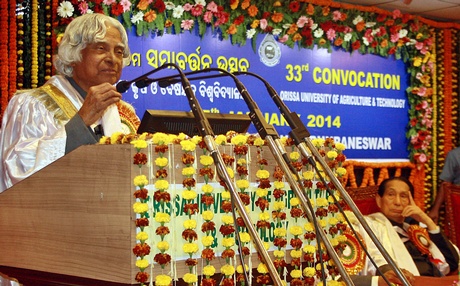
Former President APJ Abdul Kalam delivering the convocation address at the 33rd convocation of OUAT in Bhubaneswar on Saturday. | EPS
Former President APJ Abdul Kalam said if trained teachers educate and motivate students in schools, absence of school infrastructure is immaterial.
Speaking at a special meeting of teachers organised by the School and Mass education (S & ME) Department here on Saturday, Kalam cited examples about the education system in Singapore and Finland.
He stated that the Governments there have prioritised primary education and are spending a lot of money on the primary school teachers. He administered an oath to the teachers at the end of his speech.
He asked them to encourage the students to develop a spirit of curiosity, to celebrate the success of the students and treat every student equally.
When asked by a teacher if internet based knowledge can replace teachers, he replied that nothing can. Only a teacher can radiate knowledge, which a machine can never, he said.
S&ME Department Secretary, Usha Padhee said that they will create digital video copies of Kalam’s speech and mail it to the teachers who could not attend the meet.
More than 200 teachers attended the meeting the Capital High School.
source: http://www.newindianexpress.com / The New Indian Express / Home> States> Odisha / by Express News Service – Bhubaneshwar / January 26th, 2014