Justice K.N Basha, a retired judge of the Madras High Court, took charge as the chairman of the Intellectual Property Appellate Tribunal on 28 August 2013. He was appointed by the Director of the Department of Industrial Policy And Promotion of The Union Ministry of Industry And Commerce.
About Justice K.N Basha
• Justice K.N Basha was born in May 1951 and he studied in Madras Christian College and finished his law degree in Madras Law College.
• He enrolled as advocate in 1976 and joined the office of senior advocate N T Vanamamalai.
• In 1985 he established independent practice as a civil and criminal lawyer.
•Justice K.N. Basha was appointed judge of the Madras high court on 10 December 2005, and he retired on 13 May 2013.
About Intellectual Property Appellate Board
Intellectual Property Appellate Board (IPAB) was constituted by the Union Government in the Ministry of Commerce and Industry on 15 September 2003 to hear appeals against the decisions of the Registrar under the Trade Marks Act, 1999 and the Geographical Indications of Goods (Registration and Protection) Act, 1999.
The Intellectual Property Appellate Board has its headquarters at Chennai and holds sitting benches at Chennai, Mumbai, Delhi, Kolkata and Ahmedabad.
source: http://www.jagranjosh.com / Jagran Josh / Home> Current Affairs / August 29th, 2013
You had heard of human soccer players participating in various leagues. Robot soccer players are not far behind. Students of IIT Kharagpur have been developing robot soccer players that are participating in FIRA – the world’s most prestigious robo-soccer championship – in Kuala Lumpur, Malaysia. The championship that started on August 21 will be on till August 29.
A team of 40 students from the institute – KGP Cubs – has gone to Kuala Lumpur to take part in the championship. Of the 36 robber soccer teams from tech schools across the world, the only two teams from India that have been selected to participate in the FIRA championship are IIT-Kgp and IIT Madras.
It took the IIT Kharagpur boys four years to make these robots. And no ordinary robots these – each a soccer dynamite! Now armed with these robots, the KGP Cubs, as the team has been christened, has gone to participate in the world’s most prestigious robo-soccer championship – FIRA – that is at the moment on in Malayasia’s Kuala Lumpur. The championship started on August 24 and will be on till August 29.
At least 36 robo soccer teams from tech schools across the globe are participating in the championship. The only two teams from India that have been selected to participate in the FIRA championship are IIT-Kgp and IIT Madras. While the IIT-Kgp team is called KGP Cubs, the IIT Madras team has been named Sahas.
The selection is done on the basis of technological specifications provided by FIRA. The robots have to be built in accordance and should be able to perform soccer specific feats as specified.
In the past, IIT-Kgp had participated in the championship just once in 2009. However, the robots were not indigenously built then and much of the technological inputs had to be imported and assembled on campus. This did not deter the team’s entry into the championship but it did disadvantage the team’s position when it came to critical scores since teams that built their own robots naturally had an edge.
Over the last four years, the IIT-Kgp robot soccer team, consisting of 40 students from across departments, has been perfecting its own robots so that this time they can take on a level playing field.
“We are thrilled that for the first time we are being able to play with our indigenous robots. This time our students have been able to make two-wheeled robots that can perform all the feats but are yet to look like the traditional robots that have human-like limbs and are able to use them. Hence, they are participating in the Mirosot Robocup tournament which offers the second highest level of difficulty. We hope to improvise on the robots by next year to enter the most difficult level as well,” said Jayanta Mukherjee, head of the computer science department of the institution and the guide of the team.
The field and the ball for the tournament are provided by FIRA and the robots of the challenging teams fight each other on this field. Almost like a five-a-side tournament played by humans, only five robots from each side will play each knock-out game.
“Apart from the robots, there is a server and a camera that we have developed, just like other teams. The camera placed just above the robots sends the image to the server that directs the robots to deal with the challenges on the field. This might sound complicated but actually takes a split second to happen,” said Harsh Surana, a student of manufacturing engineering, who is the leader of the institute’s team. The robots defend their goal, dribble the ball and pass it to their team members and try to outdo their opponent teams much like human footballers.
The KGP Cubs are divided into three sections mechanical design, embedded electronics and artificial intelligence. These involve expertise from the departments of electrical, mechanical, computer science and electronics, aeronautical and even naval architecture and hence the team has students from across these departments.
source: http://www.articles.timesofindia.indiatimes.com / The Times of India / Home> City> Kolkata> IIT Madras / by Jhimli Mukherjee Pandey, TNN / August 27th, 2013
The Chennai Corporation has begun a green drive to retrieve the palmyra and the move has received appreciation from tree-lovers and environmentalists.
Called the Karpaga Virutsham, the palmyra was once abundant in the city. In the last two decades it has vanished due to rapid urbanisation.
“The palm tree is drought-resistant and requires little water. Even saline water will not affect its growth,” says ‘Nursery’ Rajendran, a tree-lover who supplies saplings.
However, the IIT Madras campus has a large number of this indigenous species.
Listing many places from where the palm has disappeared, he said Siruseri and Oragadam were such places. “I was asked to assist in cutting palm trees in Siruseri. But, I have opted out,” he recalls. Each and every part of the tree is useful but its slow growth deters people from rearing it though it does not require maintenance.
source: http://www.newindianexpress.com / The New Indian Express / Home> Cities> Chennai / August 30th, 2013
Lanco Infratech today said its 120 MW Tanjore power project has received five star rating from the British Safety Council UK for excellence in Health and Safety Management System.
The high rating has been given for Lanco Tanjore Power Company Ltd (LTPCL), operating 120 MW combined cycle power plant in Tamil Nadu.
“We are delighted that our efforts and commitment towards environment, health and safety management has been acknowledged by British Safety Council,” LTPCL’s CEO P Panduranga Rao said in a statement.
source: http://www.articles.economictimes.indiatimes.com / The Economic Times / Home> Power / by PTI / August 26th, 2013
My diet differs from time to time depending on the kind of work I am doing. I am mostly on a low-carbohydrate diet. I prefer to give myself a day off from dieting every week, and eat the things that I love. Since the food that we eat and our mood is closely related, it is essential to enjoy the foods that we like to eat — of course, in moderate quantities.
I am not a gym person. I find walking on the treadmill very boring. I enjoy doing outdoor activities, like trekking and cycling.
I have always been a fan of pilates, even before I became Miss India, because it is learning a different exercise every day. It is a core exercise so it helps with my body posture in modelling as well. I have also always been interested in Zumba. It is very exciting indeed.
When it comes to my skin, I prefer to keep things natural. I cleanse and tone twice a day and that’s about it.
But I make sure to apply sunscreen while going out to avoid the tan, especially important for a climate like India’s. Sunscreen is not just good as a sun block, but it keeps the dirt from entering your skin pores as well.
I don’t use hair conditioner regularly, only after a show when my hair is exposed to chemicals. Even without it, my hair is naturally healthy.
But I have recently used a shampoo and conditioner, which claims to contain egg, and it has shown very good results.
– Rochelle is a model and TV anchor.
As told to Papri Das
source: http://www.deccanchronicle.com / Deccan Chronicle / Home> Lifestyle> Health & Wellbeing / DC / Rochelle Rao / August 29th,2013
Tamil Nadu lagging behind Himachal Pradesh, Delhi, Punjab and Haryana
Mushroom production has tremendous scope in Tamil Nadu.
However, the State does not have the number of entrepreneurs to meet its requirements, laments S.S.T.Rajenthran, who won the “progressive mushroom grower” award in 2011 from the Director of Mushroom Research, Indian Council of Agricultural Research, “for his outstanding contribution to the mushroom industry.”
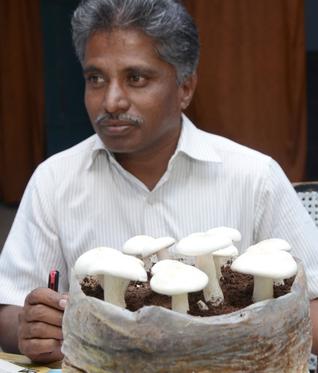
S.S.T.Rajenthran with milk mushroom. / Photo: R. M. Rajarathinam / The Hindu
Mr.Rajenthran, 46, is an ITI-educated entrepreneur who is into mushroom production for the past over 25 years. He has a unit near Thuraiyur, about 25km from here.
The ICAR has recognised his expertise in milky and oyster mushroom cultivation. He also supplies high quality spawn to mushroom growers.
It has commended his “keen interest in providing support to small and marginal mushroom growers and his efforts in popularising mushroom consumption among common public.”
Mushroom has excellent medicinal properties. It is rich in protein, fibre, and amino acids. Mushroom is a 100 per cent vegetarian food and is good for diabetes and joint pains. Pickles, pappad, soup powder, health powder, capsule, health drinks and pakodas can be made using mushroom. It has no cholesterol and helps in purifying blood. It has low sodium and substantial vitamin and minerals.
Mr.Rajenthran calls it an “agri-based industry.” But officially it has been classified as horticulture. India is so gifted that it could grow temperate, sub-tropical, and tropical mushrooms.
During 1989-92, marketing of mushroom was a problem in Tamil Nadu. “It is no more so. Chennai alone gets five tonnes of mushroom a day at present from various parts of the country.”
“However, Tamil Nadu is now nowhere in the national map and it is Himachal Pradesh, Delhi, Punjab, and Haryana which are doing well in this sector.” It has good export potential for countries such as China, Singapore, Dubai, and Europe.”
“It is quite remunerative and fetches at least Rs.200 a kg at present. The profit margin is 30 to 40 per cent.”
Mr.Rajenthran, who is now concentrating on milky mushroom cultivation, says that its shelf life could be five days as against one day of button mushroom. If kept refrigerated, milky mushroom could be kept for 10-15 days.
With respect to reports that mushroom could be cultivated at low cost – even as low as Rs.50, 000 to Rs.1lakh, he says, “Whenever you use timber for the production chamber, there is every possibility fungus might affect the timber which in turn would hurt the mushroom in due course,” he contends. Hence, investment is a major problem for the entrepreneurs, he adds.
According to him, mushroom production requires a temperature of 28 deg C to 35 deg C and a humidity of 75-80 per cent. Hence a humidifier is a must. Besides CO2 should be totally removed from the chamber and there should be fresh air.
For a production unit of 30 X 15 ft, a minimum of Rs.9 lakh would be required. A crop requires 45 days and at least 1.5 tonnes could be harvested per crop. “On an average, 10 tonnes per unit is possible per annum.”
Besides, he suggests that one set up a spawn and compost unit at Rs.25 lakh so that he could supply spawn and compost ready to produce mushroom within a radius of 50 to 100 km.
Mr.Rajenthran, who advocates organic farming of mushroom, suggests that the State government introduce mushroom in the noon meal scheme to serve nutritional food to children and promote mushroom industry. Self-help groups could produce the same and supply, he adds.
Mushroom production requires very little land and can be a good source of employment for educated youth. The two primary inputs for mushroom production – agro-waste and labour are easily available. Integrated mushroom production in existing farming system will supplement the income of rural masses and will lead to inclusive growth, he adds.
source: http://www.thehindu.com / The Hindu / Home> News> Cities> Tiruchirapalli / by G. Sathyamoorthi / Tiruchi – February 03rd, 2013
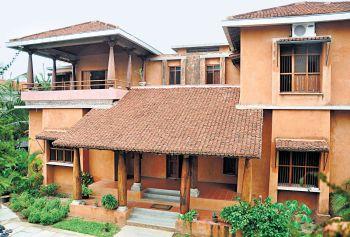
Cosy living: A house built in the traditional Karaikudi style off ECR, Chennai. — Bijoy Ghosh / The Hindu
Nestled in a corner of a small lane that branches off from East Coast Road, Ramesh and Priya’s (names changed) house reminds one of ancestral homes in Karaikudi. “Some of our friends ask us if this house is hundred years old,” smiles Priya as she greets me at the door.
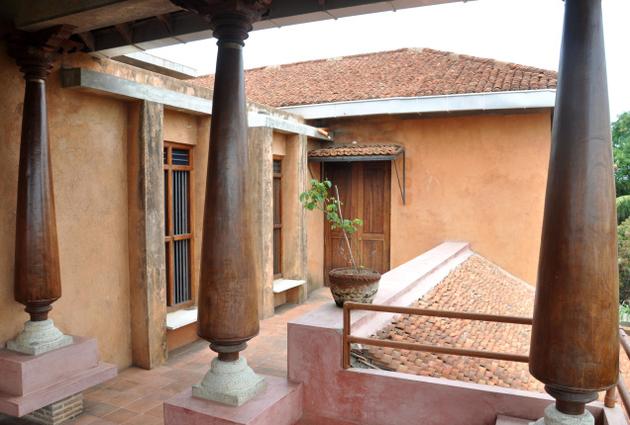
There are raised platforms or “thinnais” near the steps leading to the doorway, reminding one of scenes from R. K. Narayan’s novels. Sunlight streams in from the roof down to the central courtyard, which is bounded by thick pillars. “The courtyard is a common feature not only in traditional Indian homes, but also in Italy and France,” says Ramesh, Priya’s husband.
Ramesh and Priya lived in the US for several years before deciding to move back to Chennai. About five years ago, the couple asked an architect based in Pondicherry to create the blueprint. The house was built over three-and-a-half years.
STUMBLING BLOCKS
Finding skilled artisans who would stick to a timeline proved to a big problem. Often times, says Ramesh , the workers would suddenly drop the job on hand and go back to their village for a couple of days. “Staying abroad while the work was going on was a good thing. We weren’t so upset about things not moving on certain days. Had we been here, it would have been more difficult to handle the stress,” he adds.
There were other challenges as well. One of the unique features of the house is the lime plastering that has been used on the interior walls of the house – a building technique that is slowly fading out.
Very few people know this art, and they are extremely secretive about the formula. “When they are mixing the lime, they didn’t want anyone else to work on the house for fear of others finding out. So work had to come to a halt on other areas while this was ongoing,” says Ramesh.
Authentic touches
Windows and wood were salvaged from old houses in Karaikudi. Several trips were made to villages to secure and transport the materials, which ran to a few tonnes in weight. “We got the horse cart that was used to transport the stuff as a bonus!” says Ramesh pointing to the vehicle, which is placed in a corner of their spacious garden. Some block-printed tiles were sourced from Rajasthan.
Traditional aesthetic elements abound in every corner. The pillars in the central courtyard are made of rosewood and polished with linseed oil. Coloured oxide is a unique feature of this home – the side room boasts a large platform, floor and walls made of blue oxide, while one of the front rooms has a large square platform of green oxide, which complements a brown leather sofa.
NO EMBELLISHMENTS
The natural patterns in the oxide enrich the rooms, which otherwise are kept simple and free of embellishment. Little block-printed tiles and patterned niches have been discreetly added to the walls to lend a touch of colour and art.
The kitchen, which was Priya’s pet project, is an open space with a counter that runs along the walls, open shelves, and a ledge for storing mugs and other small cutlery.
An antique almirah with wire netting occupies one corner. Even as the daily cooking is going on, the sounds of pots and pans being used filters out to the rest of the house, lending it a very cosy feeling.
NATURAL HARMONY
The central courtyard is open all the way up to the roof, creating a “chimney effect” for the hot air to rise – hence, temperatures within the house are a couple of degrees lower than the outside. Also, the family relies on ground water for all purposes – even drinking and cooking. “The water goes through so many layers in the ground that it is naturally purified, and fortified with minerals. We actually don’t need RO or artificial purifiers to ‘treat’ the water,” says Ramesh.
As with any eco-conscious home, the garden is an important part of the house. Several plants and trees are being raised in the space outside the home.
And efforts are made to ensure every square foot is put to good use.
For example, Priya points to two beautiful lily ponds in the garden – “Those were formerly pits dug up to mix the lime in. When the work was finished, we converted them into ponds.”
source: http://www.thehindubusinessline.com / Business Line / Home> Industry> Real Estate / by Yamini Vasudevan / August 24th, 2013
Tired of taking your special one to swanky malls or movies? Well, this Madras Week , TOI lists out some places you could take him/her to get a real feel of Chennai we love so much…
Take a walk!
When was the last time the two of you took a walk and spoke with each other? Walks can be awesome as they help you notice little details about our city. While the Theosophical Society is a place that’s frequently-visited, the Semmozhi Poonga is a place where peace and greenery seem to almost co-exist with the bustling chaos associated with the roads in Chennai. Colleges in the city are a wonderful place to just take a stroll — campuses such as the IIT, Anna University and Madras Christian College are some examples. While at IIT, if you’re lucky, you might spot a deer or two as well. But, please do keep in mind that these are educational institutions — and we hope you understand what we’re referring to!
On a science trip
We’re sure that your loved one would have mentioned at least once how he/she top-scored the last in science in, perhaps, class 4B or 5C (isn’t that how we used mention them?). Now, this is your chance to get back. Take him/her to the Planetarium near Kottupuram or the Museum at Egmore. Before doing so, just search the Internet and find out about the stuff they usually talk there. That way, you can show off in front of him/her and have your loved one in awe.
The view from the top
A bird’s-eye view of Chennai is something one cannot describe well in words — you have to experience it. So, why are you waiting — what better time than now to do that? While some of the swanky hotels do offer a breathtaking view of the city, there are other places where one can get the same experience without burning a hole in the pocket. The St Thomas Mount (or Parangi Malai, as referred to by locals) is one such place where you can even see aeroplanes taking off, considering its proximity to the airport. This is a place of worship, so please do bear that in mind while going there. The lighthouse at the Marina, which will be open to the public, is another option. From here, you can see the entire city and the sea too. Now, what could be more romantic than that?
source: http://www.articles.timesofindia.indiatimes.com / The Times of India / Home> Life & Style> Travel / by Srinivas Ramanujam, TNN / August 25th, 2013
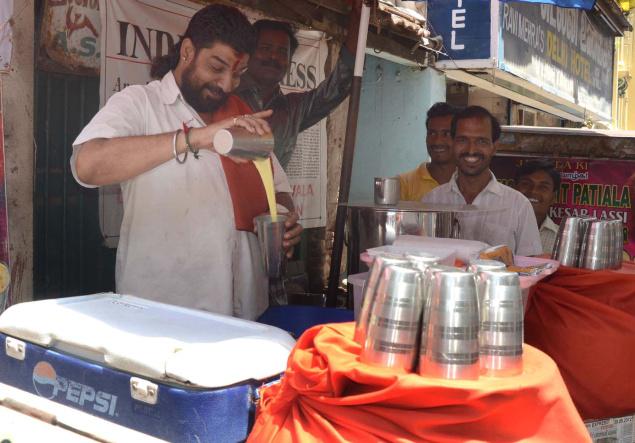
Dinesh Soni’s lassi shop on Mint street / . Photo: B. Jothi Ramalingam / The Hindu
His rugged physique has earned Dinesh Soni the moniker ‘Sowcarpet don’. But the former wrestler spreads sweetness through his lassi shop, says Vipasha Sinha
Everybody in Sowcarpet seems to know Dinesh Soni. He acknowledges everyone as he arrives at his shop on 343 Mint Street – Anmol Mohit Lassi.
A food stall owner introduces him jokingly as ‘Sowcarpet’s Don.’ As he has a daunting physique, rugged looks and rides a massive bike, I almost believed it. It’s his punch dialogue that breaks the awkward silence. He says, “Jab jab garmi ne mara hai, Anmol Mohit chaanch aur lassi ne sanwara hai (whenever the heat kills, Anmol Mahit buttermilk and lassi comes to the rescue).”
“I am a wrestler-turned-lassi walla,” he explains his rugged look.
He has named his shop after his son Mohit and his friend’s daughter Anmol, whom he treats like his own. Dinesh was born in Chennai but moved to Rajasthan for a few years, where he fought as a professional wrester. “After a point, my body gave up and my career came to an end. I had to support my family. I came back to Chennai and started this business. I have been selling my speciality, kesar lassi, for the past 21 years,” says Dinesh, who hails from a family of goldsmiths.
The reason he chose to venture into this business was to give the city, which is known for its hot summer, a taste of cool Indian drink. “My lassi is different from the ones that usually sell here. This is the reason why I have all kinds of customers come here regularly. Also, a wholesome glass of lassi provides my customers with the energy to keep them going through the day,” he says.
Apart from lassi, he also sells Mohit shampoo and hair oil, which he claims can cure all problems. But lassi will always be his first love. He hopes his son Mohit will join the business after he finishes engineering. “Ask anyone about Anmol Mohit lassi, and he will show the way to my shop. This is the brand I have built for years.”
source: http://www.thehindu.com / The Hindu / Home> News> Cities> Chennai> Down Town / by Vipasha Sinha / Chennai – August 24th, 2013
The National Council of Examiners for Engineering and Surveying (NCEES) has elected an Indian-American as its zonal Secretary/treasurer.
Sockalingam Sam Kannappan, Chairman of Enforcement Committee of Texas PE Board, was elected Secretary and Treasurer of Southern Zone (SZ). South Zone has 18 boards under its control.
NCEES is the American National Professional Engineers (PE) Board coordinating 50 national PE Boards, Puerto Rico and Virgin Islands. Engineering organisations from Canada , Mexico, Japan and other countries work with NCEES.
NCEES conducts examination for fundamental (FE) and Professional Examination (PE) through four zones.
Kannappan is a registered Professional Engineer in Texas with 25 years of experience in design, analysis, and software development for the petrochemical, refinery, and pipeline industries. He graduated with Masters Degree in Mechanical Engineering from the University of Texas at Austin.
Kannappan is a native of Nattarasankottai in Sivaganga district of Tamil Nadu.
source: http://www.business-standard.com / Business Standard / Home> PTI Stories> International> News / by Press Trust of India / New York – August 28th, 2013