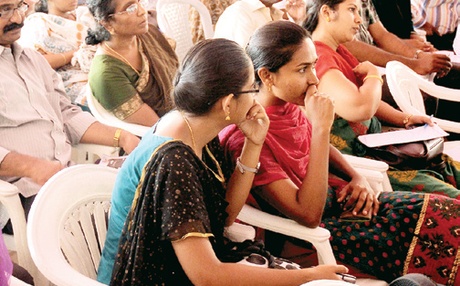
The Ethiraj College for Women celebrated its Founder’s Day on the birth anniversary of V L Ethiraj.
This was the 65th anniversary of the college. Justice Hariparanthaman of the Madras High Court was the chief guest.
Speaking at the event, the judge said that he had initially been reluctant to take part in the celebrations as he wanted to steer clear of partaking in an event which could prospectively involve litigants whose cases he might one day be called upon to judge. He, however, added that after reading the biography of V L Ethiraj and after understanding the ethos of the college, he could not desist from attending the event. Hariparanthaman spoke of the need for the continued education of women in order to usher in a more egalitarian society. He also spoke highly of the founder of the college, and shared several anecdotes involving V L Ethiraj that he had read and heard about, demonstrating Ethiraj’s integrity, honesty as well as his legal and moral acumen.
A M Swaminathan, the chairman of the board of trustees, Ethiraj College for Women, praised the chief guest for his representation of the poor and the working class when he was a practising lawyer.
The chairman also said that the day was celebrated to ‘plug the gaps in the historical record’. The history of the college titled ‘Soaring High at Sixty Five’ and a booklet on the life of V L Ethiraj were released at the function.
source: http://www.newindianexpress.com / The New Indian Express / Home> Cities> Chennai / by Express News Service – Chennai / July 20th, 2013
V.V. Mineral, a mineral exporter, has acquired Dhanalakshmi Srinivasan Sugars, an integrated sugar mill complex for an undisclosed sum.
The operating sugar mill commissioned in 2010 in Perambalur, Tamil Nadu, was set up with an investment of over Rs 350 crore with a capacity to crush 3,500 tonnes sugarcane daily, a 23-MW cogeneration unit and plans for a 60-kilolitre a day distillery.
Senior executives in the previous management and the new team, who did not want to be quoted, confirmed the deal was finalised early this month.
Dhanalakshmi Srinivasan group operates a chain of educational institutions including schools, arts and science colleges, engineering, medical, nursing and polytechnics.
V.V. Mineral, based in South Tamil Nadu, is among the world’s largest exporters of Garnet and Ilmenite.
A senior executive said the new management plans to concentrate on sugarcane development to strengthen raw material security.
source: http://www.thehindubusinessline.com / Business Line / Home> Companies / by R. Balaji / Chennai – July 16th, 2013
Solar Energy Park in Paramakudi taluk of Ramanathapuram district will be ready in three months that would facilitate the power generation of 100 MW to the Tamil Nadu Generation and Distribution Ltd (Tangedco) in April 2014.
C.Narasimhan, Chairman, Raasi Green Earth Energy Private Ltd (RGEE) said at a press conference here on Tuesday that the company is establishing the energy park in joint venture with Tamil Nadu Industrial Development Corporation. The “Bhoomi Puja” would be held on July 21 at Kavanur. The company will be acquiring 600 acres of land for the project before the end of this month and had already acquired 200 acres till now.
The park with ‘semi plug and play facilities’ will be ready in the next three months. After that, it would be ready for the companies to set up solar power units. The company has contracted with Larsen and Tubro for an Engineering Procurement Contract for executing the project.
C.Narasimhan said, “More than 37 companies evinced interest in setting up their units in the proposed park and seven companies, including two Germany-based companies,that would soon be signing commercial agreements with RGEE.”
Earlier in December 2012, the AIADMK government has announced that it would take steps through TIDCO in setting up of the solar energy plant in Paramakudi taluk of Ramanathapuram district. The expected cost of the project is Rs. 920 crore that would create 2,000 direct and indirect jobs.
According to sources, the other solar energy park will be established in districts like Tiruvannamalai, Ariyalur, Pudukottai, Dharmapuri, Tiruchi and Perambalur.
source: http://www.truthdive.com / TruthDive.com / Home> News / by Saravanan Jawahar / July 18th, 2013
A 26-year-old girl has stormed yet another male bastion and has landed the job of a loco pilot in Madurai division of Southern Railway.
Though Madurai railway division already has a woman loco pilot, B A Deepthi, who recently joined as assistant loco pilot, is the youngest. Besides, she is the only woman to pilot trains now as the other loco pilots are assigned to control room.
Deepthi, a native of Thiruvananthapuram, joined duty on July 4 after undergoing a two-month training at Golden Rock, Trichy, and completing another 20 days of road learning exercise in Madurai division. Currently, she navigates passenger trains in the division.
“A job in railways was my passion from childhood, but I can’t say that I was very inclined towards piloting locomotives,” she said. After acquiring a diploma in electronics engineering, she applied for a job in the railways and cleared the examination.
Employees of the Southern Railway were surprised at a young woman coming to the job. Many passengers, who spot Deepthi, initially were also surprised. However, they all congratulate her. On Friday, she co-piloted Madurai – Dindigul passenger train, which arrived at the Madurai junction by 9.10am. When she arrived at Madurai junction, a group of women passengers praised her saying that she has become a role model for women.
Loco pilot K Vinod Kumar who piloted the Madurai – Dindigul passenger said Deepthi has already shown signs of excellence in the job. “The job needs high amount of concentration and a great sense of responsibility as hundreds of passengers travel, trusting us. Deepthi seems to have understood the job’s elements and is doing well,” he said.
As an assistant loco pilot, Deepthi is assigned the tasks of monitoring signals and communicating with the loco pilot of the train, keeping a watch on essential gauges of the locomotive, and assisting the loco pilot in operating the train. “I am enjoying my work and it is quite interesting,” Deepthi said. “I think there are some more women loco pilots in the division but they are doing office works. I enjoy piloting the locomotives at present and am learning the skills eagerly,” she added.
source: http://www.m.timesofindia.indiatimes.com / The Times of India, Mobile / Home / by J. Arockiaraj / July 14th, 2013
10,269 applicants for medical seats are first generation learners | EPS
Forget success stories of first generation learners in the top 10 rank lists. At this year’s first round of MBBS counselling, a whopping 519 students who got admitted to government medical colleges are the first in their families to aspire towards a graduate degree. In fact, the number of medical aspirants who hailed from homes where no one had been to high school or college was a staggering 10,629 of the 28,785 applications received. It is inspiring to see that many of them came alone, as their parents are employed as daily wagers in their respective towns, and collected their admit cards at the Kilpauk Medical College, during the MBBS counselling held recently.
A very small proportion of these 519 students hail from the city, with the majority of them hailing from smaller districts like Erode, Salem, Tuticorin and the educationally-reputed Namakkal. “Most often we have found that first generation graduates who manage a high cut off and manage to get MBBS admission are from very small villages or very poor backgrounds. Even economically downtrodden students in the cities – Chennai, Coimbatore and Madurai – usually have at least one parent who has finished high school or some sort of degree,” said a member of the Medical Education Selection Committee.
This includes students like Keerthana, the daughter of a lorry terminal worker in Namakkal who had an enviable cut-off of 199.75 and managed to get admitted to Madras Medical College on the very first day. She had said after the counselling that her strength and determination to become a doctor came from the fact that people like her father had no hope of ever getting quality healthcare unless he waited for hours on end in a public hospital. Incidentally, her school has come forward to foot her educational expenses as far as college is concerned.
One advantage for first generation learners is that the tuition fees of Rs 4,000 out of the Rs 12,750 they have to pay every year, will be returned to them by the government.
While this applies only for those admitted to state-run hospitals, those getting admitted to self-financed medical colleges also have a great advantage to help them study – with official fee structures ranging from Rs 2.3- Rs 2.5 lakh a year, the government will bear half the amount and first generation learners need to pay only half their fees.
source: http://www.newindianexpress.com / The New Indian Express / Home> Cities> Chennai / by Express News Service – Chennai / July 01st, 2013
In a novel move to curb stealing of newborn babies, the Coimbatore Medical College Hospital on Tuesday launched a mechanism to splash the names of baby’s mother, father and time of birth of the baby on a moving screen. The hospital has also made arrangements to show the handing over of the newborn to the relatives in a television kept near the moving screen outside the labour ward.
K Veeramuthu, a 27-year-old employee of a private company in Ondipudur, was happy to ‘see’ the message in the screen mentioning that his wife Sumathi had given birth to a baby boy on Monday morning at 9.05am. “When I saw the message with the names of me and my wife splashed on the moving screen, I was happy,” he said.
The screen was operated on a trial basis for the last few days and came into full effect on Tuesday.
“With this, we hope incidents of child thefts can be eliminated,” said Dr Isaac Christian Moses, the deputy medical superintendent of CMCH.
Besides this mechanism, CCTVs are also in place in the hospital to track the movement of visitors and patients.
This is expected to act as an additional mechanism to prevent child thefts and detect any suspicious activities. However, the television at present is not working.
Officials said that this will start transmitting images in the coming days of the handing over of the newborn baby. Dr M Swathinthradevi, a senior doctor at the maternity ward, said patients responded positively to the development. “Patients are happy with the new device which helps them get information at the earliest,” she said.
“This set-up will help to avoid confusion over the condition of the mother and baby. It will also stop relatives from pestering nurses and other staff about the condition of the mother and baby,” Veeramuthu says.
source: http://www.articles.timesofindia.indiatimes.com / The Times of India / Home> City> Coimbatore / TNN / June 27th, 2013
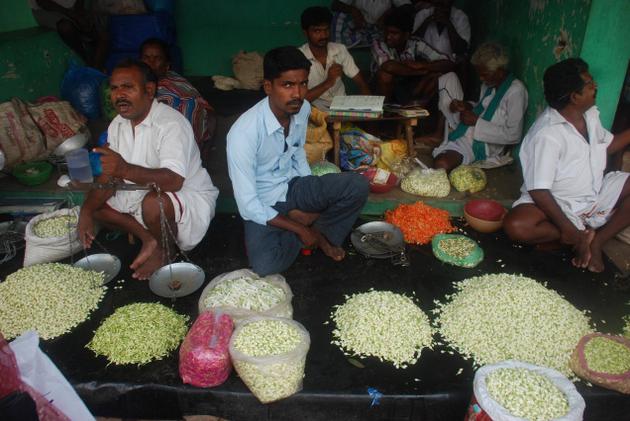
At the Madurai flower market./ Photo: A. Shrikumar / The Hindu
From the jasmine fields to the flower market, Madurai Malli is a phenomenon that rules the whims and wants of traders and flower-lovers
At the Mattuthavani flower market, we first encounter putrefying garbage and slushy floor. Heaps of flower petals and leaves rot in the open and cattle roam around binging on them. There is only chaos, noise, rush and ubiquitously unpleasant odours.
A village woman pushes us aside dragging a huge gunny bag along. A man yells out flower names “Kanagambaram, Champangi…” Old women bargain with lungi-clad traders sitting cross-legged and holding a weighing balance. . Intricately woven garlands are displayed at every shop.
We wait for the moment, an explosion of colours and scents. And there they arrive. Rose varieties including Tajmahal, Jerpura, Dutch rose and Gladiator from Bangalore, ‘Champangi’ from Pallapatti in Dindigul, ‘Kozhi poo’ from Usilampatti, ‘Kanagambaram’ from Chinnamanur in Theni and ‘pattu rose’ from Rajadhani Kottai in Kodai Road… the scene changes to ariot of hues and a medley of fragrance.
But what we can’t escape or ignore is the strong refreshing whiff of ‘Gundu’ malli. There is no dearth of colourful blooms in the market but every buyer seems to be searching for the queen of blooms. Jasmines from various villages become one here, under the tag ‘Madurai malli.’
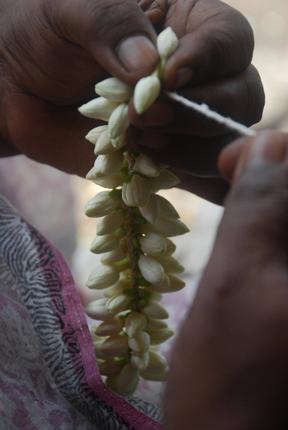
A jasmine bud. / Photo: A. Shrikumar / The Hindu
“Flowers from every village are different in texture and size,” says Rameswari, a buyer from Simmakkal. “We feel the bud between our fingers to check the quality .” Suddenly voices takes over as a fierce bargaining is on to fix the rate of the flower for the day. the After much haggling, the `farmer-trader-buyer’ trio arrive at a consensus. . “Every hour, the price varies depending upon the quality and demand,” says Muthu, another buyer. “The peak season of jasmine is during March to July. The quantity of flowers arriving at the market dwindles in winter.”
S. Ramachandran, president of Madurai Flower Market recalls the days when every farmer would bring 10 to 15 kilos of jasmine every hour. “Now, it is down to just 10 per cent,” he says.
Around Madurai, jasmine is cultivated in more than 30 villages spread over north and south blocks. The flowers from Eliyarpathi, Valayankulam, Salvarpatti, Parapathi, Parampupatti, Sundarangundu, Thirumal, Solanguruni, Vellakulam and Veppangulam are much sought-after for their size and texture.
What makes Madurai grown malli so unique? “The malli grown in our belt is bigger and the stem is stronger. It lasts long and the fragrance is intense. It’s because of the soil quality and the tropical climate,” says Mokkai a farmer from to Eliyarpathi, a village off the Arupukottai Road.
This village, as we discover, is known less by its name and more by its flower’s fame. Malli is the name of every first flower and every second girl child here. Our eyes feast on the blue hills, green fields, red earth and colourful people as we walk through Mokkai’s three-acre field. Long rows of lush green plants studded with bunches of sparkling white buds, steal the sight. We feel the moist earth – freshly watered — and inhale as much of the scent until it hits our brains.
“Beware!” warns, Samayakkal, a sexagenarian, from behind. “Snakes are waiting to greet you,” and we retreat in a huff. “We start our day before the dawn breaks. I have been doing this work for four decades and feel the fragrance in my fingers forever,” Samayakkal flashes a paan-stained smile. “Butwe have to brave the snakes,” her voice trembles remembering one of the workers who died of snake bite while working in the field two months ago.
It’s because of people like her that the much-acclaimed Madurai malli reaches places the world over, on time. “We dispatch the first batch of flowers at 6 a.m. to the airport to be sent to other countries and cities. From then on, every hour, we keep sending batches for the local and outstation markets,” she says.
Jasmine means more than just a flower to the 1,100 farmers and 10,000 other people dependent on it. It’s the lifeline in more than 30 villages in the south block. Mokkai, who has been cultivating malli for two generation, says, “Over the years, the production has come down to a quarter of what it used to be.” Scarcity of water, poor appreciation of the produce, shrinking farmlands and labour shortage seems to be the major reasons. Sadly, dry fields and dying jasmine are a common sight today.
Our next stop is Thirumal, a hamlet near Thirumangalam, where jasmine is said to be as common as any street-side flower. Butwe had to search the fields with malli playing hide-and seek! We found every other crop — groundnuts, ladies finger and brinjal – but not jasmine.
“Ealier, this village had only of jasmine fields. Now people have switched over to other plants,” Kathiresan narrates another heart-wrenching story about the slow death of jasmine . “Farmers should be involved in activities related to jasmine development,” he says. “Most traders and officials are far removed from the ground reality ,” says Kathiresan, whose four-acre jasmine garden has shrunk to 30-cents.
Though jasmine farming doesn’t require copious rains, the flower needs one lakh litres of water per acre, every 10 days to get maximum yield. The first buds can be harvested within 60 days of transplantation of saplings.
The parent sapling (pathiyam) for all the jasmine plants is obtained from Thangachimadam near Rameswaram. The sea breeze and optimum temperature is said to favour the growth of jasmine saplings in the coastal town.
The plant reaches up to three feet in three years time and lasts for 20 years yielding flowers every season. In each bunch, the plant gives up to twelve flowers. As jasmine buds bloom in the evenings, they are plucked in the early mornings to be sent to outstation markets.
A jasmine strand being woven in Madurai./ Photo: A. Shrikumar / The Hindu
The Madurai-bred jasmine has been accredited with a GI tag and has high potential to earn ample foreign exchange. “But, says Ramachandran, also a member of Madurai Malli Development Council, “the city lacks international connectivity, so the flower has to be channelled through other airports. As a result, other jasmine varieties from places like Sathyamangalam are exported in the name of ‘Madurai malli.”
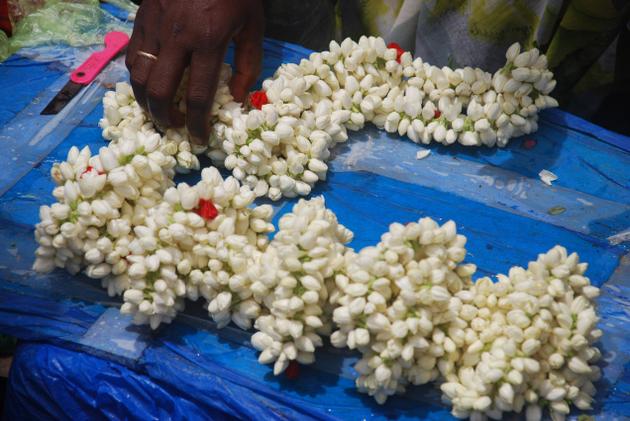
A jasmine garland. / Photo: A. Shrikumar / The Hindu
The Council trains farmers and flower vendors on the techniques of marketing and weaving and also provides financial aid to encourage farmers to continue jasmine cultivation. “We want to save the flower from becoming extinct,” asserts Ramachandran.
source: http://www.thehindu.com / The Hindu / Home> Features> MetroPlus / by T. Saravanan and A. Shrikumar /Madurai – July 26th, 2013
There are many who say that it is impossible to keep India clean, but N Panchampatti panchayat in Athoor union has set an example by bagging the cleanest village award of Dindigul district from the Tamil Nadu government.
The man behind this cleanliness drive in the village is the panchayat president K Karuppiah, who has been elected for the second consecutive term. One thing that helped him in this endeavour is his experience with the engineering department of the Indian Army. Earlier, he helped the village bag the ‘Nirmal Puraskar’ award for the best panchayat in the year 2008.
Karuppiah, who belongs to the AIADMK, makes it a point to go around the streets of the 12 wards in the panchayat almost every day. At first, the people were educated on the importance of depositing the garbage in the dustbins placed near the street corners. When some residents refused to comply, the panchayat put up sign boards warning them of being fined Rs 100 if they continued to dump the waste in open places.
Then, steps were taken to prevent open defecation by ensuring toilets for almost all the 2,000 houses in the village. This has more or less been achieved. The green cover was enhanced by planting and nurturing about 300 to 400 trees on the roadsides.
Villagers and shopkeepers are asked to say no to plastics, but Karuppiah says that he found it to be a tough task. Now, the four sweepers in the village segregate the plastic in the garbage and it is sold for Rs five a kg. The sweepers are very regular in their duty and play an important role in keeping the place clean. Self-help groups in the region shred the plastic, which can be sold for Rs 25 a kg. The material can be used to lay roads, says Karuppiah.
The panchayat president says that they are planning to set up a garbage recycling unit where the perishable and non-perishable waste would be segregated and used for the development of the village with the Rs 5 lakh they have received through the cleanliness award. “The cost would be higher than Rs 5 lakh but we believe that only a recycling unit would ensure the permanent cleanliness of the village so the panchayat administration is working towards it,” he added.
source: http://www.articles.timesofindia.indiatimes.com / The Times of India / Home> City> Madras> Cleanliness / by Padmini Sivarajah, TNN / July 01st, 2013
Global Health City of Global Hospitals Group has opened Global Cancer Institute at Chennai. The facility will now offer the most comprehensive organ specific multi-super speciality services to treat a wide variety of cancers in adults and paediatrics.
“We are on a constant quest to bring to our patients the best treatments in the form of clinical expertise and technology. Towards this, we have been continuously investing on the most advanced technologies to augment our cutting-edge clinical expertise. I am personally very delighted that, today we bring to the people of Tamil Nadu, the Global Cancer Institute, equipped with TrueBeam STx. It is now a complete one-stop destination for one of the most advanced organ specific cancer treatments and radiation therapy treatments in the world, said Dr K Ravindranath, chairman & managing director, Global Hospitals Group.
Global Cancer Institute’s team consists of organ specific cancer experts wherein there are super specialists to treat cancers in each of the organs. The services include surgical oncology of head, neck, breast, liver, brain tumour, spinal and gastro intestinal, medical -oncology, onco haematology and bone marrow transplantation, interventional oncology, diagnostic and preventive oncology, palliative care and pain management. There is also a Tumour Board to formulate the best possible evidence-based cancer treatment programme for every patient. The Board constitutes an expert panel of organ specific cancer specialists, who will review each and every case and formulate the best possible treatment programme.
Dr. Sumana Premkumar, sr. consultant, Radiation Oncology, commented that the “TrueBeam STx is an advanced radiation therapy machine engineered to perform the most sophisticated radiation therapy and radio-surgery procedures with pinpoint accuracy and ultra-fine precision. It works by choreographing highly sophisticated system – imaging, beam delivery and motion management – and makes it possible to deliver treatments quickly while monitoring and compensating for tumour motion. It will enable faster, accurate tumour targeting in the treatment of challenging cancers throughout the body, including those in the brain, pancreas, liver to name a few”. Already installed and operational, radiation oncologists at Global Health City are routinely performing complex procedures with amazing precision and patient comfort.
The facility was inaugurated by governor of Tamil Nadu Dr K Rosaiah, in the presence of Mike Nithavrianakis, British deputy high commissioner, Chennai.
source: http://www.pharmabiz.com / PharmaBiz.com / Home> News> Hospitals & Clinics / by Pharmabiz.com’s Bureau – Bengaluru / Monday – July 01st, 2013
Music and fusion are an integral part of the city and have always summed up the spirit of what Madras has always stood for| Martin Louis
What is it that inspires artists to make Chennai the centre of their art? Is it the culture — a mix of the various genres of music that resonates in every inch of the city or is it the religious fervour that it incessantly palpitates with? Making an attempt to portray all the elements that make the Southern city that embrace modernity without sacrificing traditions, Madras Musings, an exhibition inaugurated at Gallery Veda recently, combines art works by both established and upcoming artists.
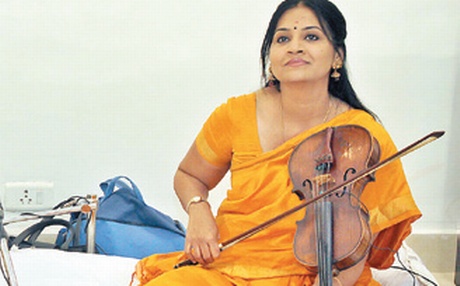
The exhibition opened on Friday on a musical note. Featuring musicians like violinist Padma Shankar and percussionist Akshay Ananthapadmanabhan, nothing could have been more appropriate to symbolise Madras through music. The artistes engaged in an hour-long collaboration, Sounds of Chennai, picking up compositions that included Carnatic music, film-based classical songs and popular film numbers.
The art work encompassed a wide variety of mediums – acrylic, water colours, fibre glass and other mix of materials that highlighted the diversity of Chennai. Referring to the city as Madras, the focus was on the imprints of erstwhile Madras that is today – a far cry from its past glory. Yet, there were a few elements that remain intact and have been woven into the fabric of the modern city.
Madras Musings features works of artists like Anamika Veeraraghavan, Aneesh K R, Aparajithan Aadimoolam, Gukan Raj, Guranathan, Jacob Jebaraj, Janarthanan, Kasa Vinay Kumar, Krishnapriya C P, Kumaresan Selvaraj, Manisha Raju, Suresh S, Vennimalai, Vijay Pichumani, Vijayakumar, Yuvan Bothi and Yuvaraj among others.
The show is on till July 17 at Gallery Veda, Nungambakkam. Phone: 4309 0422
source: http://www.newindianexpress.com / The New Indian Express / Home> Cities> Chennai / by Express Feature – Chennai / July 03rd, 2013