Ramnad farmer blazes new trail

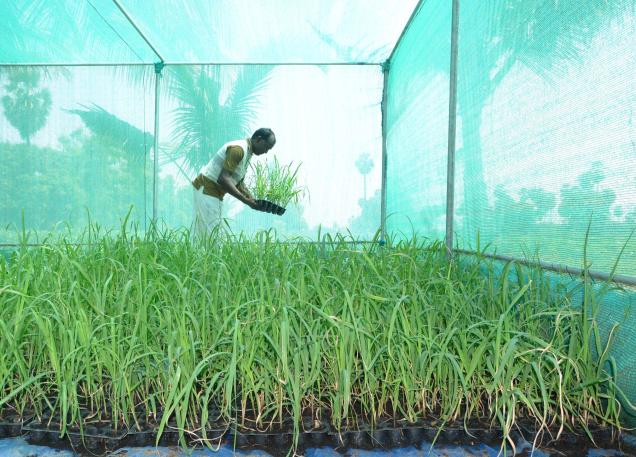
Innovative: Ramanathan in his sugarcane nursery. / Photo: L. Balachandar / The Hindu

Sugarcane nursery boasts low overheads and high yield

P. Ramanathan, a 42-year-old farmer, sits beside a heap of seed sugarcane in his coconut grove, chipping buds from the cane stalks.

The farmer from Akramesi, a remote village near Pandiyur in Nainarkoil block, is all smiles. He is the first farmer in the district to raise a single bud chip sugarcane nursery, a cost-effective alternative to conventional cultivation.

Optimistic

It has been just two months since he started raising the nursery with the help of Sakthi Sugars, a private sugar mill, but Mr. Ramanathan is optimistic. The single bud sugarcane growing system is gaining popularity among the farmers as a low-cost option.

In the conventional system of sugarcane cultivation, four tonnes of seed cane are cut into pieces with two to three buds and the stalks planted in the furrows. This has posed problems for the farmers in transporting, handling and storing of the seed sugarcane.

In the process, the seed sugarcane undergoes rapid deterioration, reducing the viability of the buds and sprouts. To overcome the snags, reduce the overheads and increase the yield, the Sustainable Sugarcane Initiative (SSI), inspired by the System of Rice Intensification (SRI), had been developed and is fast catching on in Dharmapuri and Erode districts, B. Ilangovan, Deputy Director, Horticulture said.

Shade net house

Mr. Ramanathan is raising the nursery in a shade net house, with a capacity to grow three tonnes of seed sugarcane, and with two hand lever machines for chipping buds provided free of cost by Sakthi Sugars.

“From one tonne of seed sugarcane, we can chip 80,000 buds, which means we can raise as many seedlings in the nursery,” the farmer points out. If he bought one tonne of seed sugarcane for Rs.2,400, he would spend another Rs.2,000 to chip the buds, soak them in a solution of calcium chloride, urea and a fungicide before placing them in trays for sprouting.

Still, he makes a profit of nearly Rs.4,000 per tonne, selling the seedlings each at Rs.1.30 and reselling the budless sugarcane for crushing. After soaking for 10 minutes, the buds are covered in a wet gunny bag and kept indoors for five days before they are placed in sprouting trays filled with manure and stored in the shade net house for the next 15 days.

After sprouting, the seedlings are exposed to sunlight for another 10 days before being removed for planting, he said. He started raising the nursery two months ago, and has already sold 30,000 seedlings. Currently, he has an order for supplying 1.5 lakh seedlings. In 40 days, he expects to chip buds from seven tonnes of sugarcane and raise 5.6 lakh seedlings. This could increase manifold, if he uses an electric powered machine.

Gets a boost

Mr. Ramanathan got a boost recently when Collector K. Nanthakumar, along with a retinue of officials, visited his nursery and was all praise for his venture. Under the system, 100 per cent germination is assured, Mr. Ilangovan assures sugarcane farmers. He said the incidence of pest attack and disease was also reduced significantly.

The National Agriculture Mission helps farmers set up shade net houses and provides a subsidy of Rs.600 per square metre. For wooden shade net houses, the subsidy is Rs.410 per square metre. Nurseries for tomato and chilli could also be raised in shade net houses. At the moment, there are few takers among the local farming community. But with Mr. Ramanathan blazing a new trail, hopefully innovative methods of farming will be the wave of the future.

source: http://www.thehindu.com / The Hindu / Home> News> National> Tamil Nadu / by D.J> Walter Scott / Ramanathapuram – April 30th, 2013
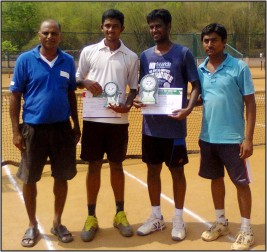
AITA 30K Raghuveer cup men’s tennis : Vijay Kannan triumphs


Caption: The winners in the AITA Raghuveer Cup 30k Men’s Tennis Tournament seen with the prizes: (Standing from left) N.P. Raghuveer, Suraj R. Prabodh (runner-up), Vijay Kannan (winner) and Sabareesh (Chief Referee)./ Star of Mysore

 Mysore :

Second seed from Tamil Nadu and former Davis Cupper, Vijay Kannan playing attacking tennis on both the flanks scored an upset win over top-seeded Karnataka lad Suraj R. Prabodh 6-2, 6-2, and won the men’s singles title on the concluding day of the 30K AITA Men’s Tennis Tournament for the Raghuveer Cup at the Raghuveer Tennis Academy courts here on Friday.

Vijay Kannan dominated the proceedings right from the beginning and broke Suraj in the second and fourth games and wrapped the first set with ease at 6-2. In the second set too, he capitalised on the unforced errors of his rival and took full control and went on to win the set and tie at 6-2.

Results

Men’s singles: Final: Vijay Kannan (TN) bt Suraj R. Prabodh (Kar) 6-2, 6-2.

Semi-finals: Suraj R. Prabodh (Kar) bt Nikki K. Poonacha (TN) 6-7(4), 6-3, 6-4; Vijay Kannan (TN) bt Tushar

Mandelkar (CG) 6-2, 6-2. Quarter-finals: Suraj R Prabodh (Kar) bt Prithvi Haas (AP) 6-2, 6-2; Nikki Poonacha (TN) bt S.Prateek (Kar) 6-3, 6-0; Tushar Mandelkar (CG) bt Darshan Srinivas (Kar) 6-1, 6-4;Vijay Kannan (TN) bt Rashien Samuel (Kar) 6-2, 1-6, 6-2.

Men’s Doubles: Final: Nikki K. Poonacha/Tushar Mandelkar bt A.K. Pardhasarathy/Fahad Mohammed 6-3, 6-0;

Semi-finals: Nikki Poonacha/M. Tushar bt S.S. Mahesh/K. Prateesh 6-3, 6-3; A.K. Pardhasarathy/Fahad Ahmed (AP) bt Suraj R. Prabodh/S. Prateek 6-4, 3-6, 10-7

source: http://www.starofmysore.com / Star of Mysore / Home> Sports News / April 27th, 2013

The art of rescuing and revamping old saris

Sujata Pai isn’t just a sari designer. She revamps them as well. Ask her why she finds it terribly exciting and she says it is like giving new life to an old treasure — especially for women who have plenty of unused saris in their cupboards. Brimming with innovative ideas, her aim is to make bridal saris which are wearable for all occasions. “It all started because of my wardrobe. I hardly took quite a few saris off the shelves. But after adding personal touches to make the sari look unique, I’ve loved wearing them,” she smiles.

With varied hues, Sujata’s label, ‘Ambi’ reflects her simple style with a range of fabrics like Chanderi, Benaras silk, georgettes, chiffons, organzas, tussar and Maheshwari. Woven withwith handpicked embroidery, patchwork and block prints, her designs are deeply entrenched in Indian culture. Sujata explains, “Whenever I come up with a sari design, I think to myself: ‘Imagine I’m going to wear it’. So, I put in extra care for each one.” Incidentally her range of garments also includes lehenga saris, salwars, anarkalis and skirts.

When it comes to the six yards of silk, minimalistic design has been Sujata’s mantra. “Previously saris were designed in a rigid manner, but now it takes more of an Indo-western avatar to attract young women,” she says. Using handwoven silk, the sari maker opines that traditional craftsmanship ought to be taken forward to the global market in an effective way. Going light weight and easy to drape is the way to do that, she says. “The panels are pre-stitched so you don’t even need to pleat the sari,” smiles the  psychology graduate who has mastered the art of the weave without a degree in designing or textiles, but is inspired by Sabyasachi Mukherjee, Ritu Sharma, and Manish Malhotra

(For more details, contact: 9840778558)

source: http://www.newindianexpress.com / The New Indian Express / by  Express Features – Chennai / May 02nd, 2013

Hidden Histories : Ill-fated castle

Brodie’s Castle on the banks of the Adyar is one of the historic homes of Chennai. Photo: Special Arrangement / The Hindu

Brodie’s Castle, along the Adyar, is said to have brought ill luck on several of its residents

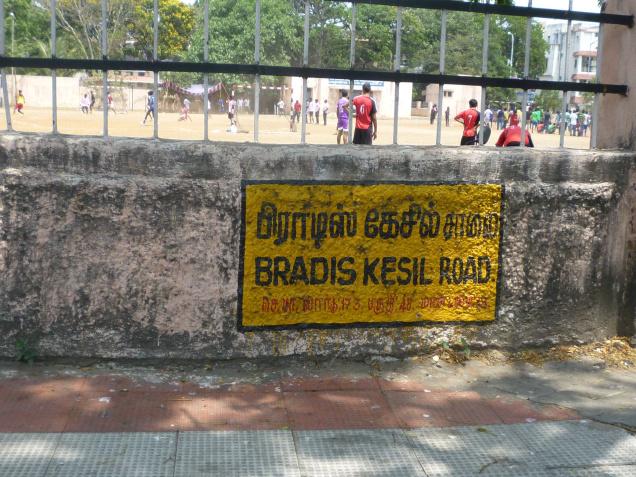
Bradis Kesil Road, says a signboard towards the end of R.K. Mutt Road. This is what lack of awareness and official apathy have done to one of the most intriguing places in the city.

Brodie’s Castle on the banks of the Adyar is one of the historic homes of Chennai. It is said to have brought ill luck on several of its residents. James Brodie, of the firm of Jarvis and Brodie, built it in 1796. Perhaps inspired by an eponymous castle in Scotland, he designed it with sloping outer walls and two castellated turrets. The nearest settlement was Mylapore and the road leading there became Brodie’s Castle Road. Today most of it is R.K. Mutt Road, with the last short stretch alone retaining the old name.

Shortly after he moved in, Brodie’s businesses failed forcing him to rent out his castle. The first tenant was Sir Thomas Strange, Chief Justice of the Supreme Court of Madras. Brodie moved back in 1802 only to drown in the Adyar. The business family of Arbuthnot then purchased Brodie Castle. They rented it out as a house by the river fetched high rent in hot Madras. It was also an artist’s delight making it a favourite subject for watercolours.

In 1810, Edward Vaughan, chaplain of St. George’s Cathedral, moved in, only to lose his wife immediately. He rose to become archdeacon and stayed on at Brodie’s Castle till his retirement in 1829. In 1866, Brodie’s Castle was in the news for the wrong reasons when James McIvor of the Bank of Madras was its occupant. His two daughters, an aide-de-camp to the Governor and the president of the Madras Corporation were killed in a boating accident.

In 1906, the firm of Arbuthnot crashed and Brodie’s Castle was bought, in the distress sale that followed, by Subramania Pillai of the firm of P. Venkatachellum, famed for its condiments and curry powders. It became one of the 75 houses that Pillai owned in Madras. He chose to rent out Brodie’s Castle. Charles Cotton, chief secretary, was a tenant, and he filled the house with fine furniture and art. He was one of the few lucky residents.

Chief Justice Sir Lionel Leach occupied it in 1937. One afternoon in October 1943, the Adyar burst its banks and destroyed many of Sir Lionel’s possessions. Lawyers had a good time imagining the dour Judge sitting in his high-backed chair and futilely commanding the river to rise no further. In 1949, Brodie’s Castle became the residence of P.S. Kumaraswami Raja, the then Premier of Madras State. He lost his post following a stunning electoral defeat in 1952, despite contesting from his family stronghold of Srivilliputhur.

Brodie’s Castle was never a residence thereafter. In 1956, it became home to the Central College of Karnatic Music, now the Isai Kalluri, and in 1968, was renamed Thenral. Maintained after a fashion, by the PWD, it survives, and is worth a visit.

source: http://www.thehindu.com / The Hindu / Home> News> Cities> Chennai / by SriRam V. / May 02nd, 2013

A leaf out of ancient Tamil literature

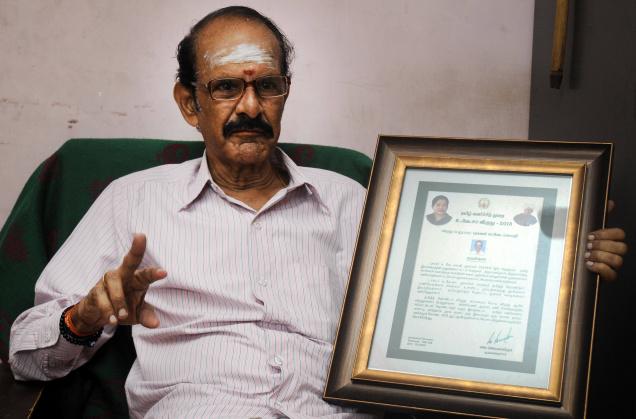
Ma. Ve.Pasupathi at his residence in Villivakkam. Photo: K. Pichumani / The Hindu

Deciphering palm-leaf manuscripts, Ma. Ve Pasupathi has published 40 literary works. He recently received the prestigious U Ve Sa award for this singular work. T. S. Atul Swaminathan in conversation with the scholar

A few minutes into a conversation with Ma. Ve. Pasupathi, it is clear this Tamil scholar follows closely in the footsteps of the grand-father of Tamil literature, Mahamahopadhyaya Dr. U.V. Swaminatha Iyer.

And it is fitting that he has received U Ve Sa award by the Tamil Nadu Government for his contribution to Tamil literature, especially compiling palm leaf manuscripts and handwritten manuscripts. The award was conferred on him by Chief Minister J. Jayalalithaa on April 15 at the Secretariat.

Ma. Ve. Pasupathi has published 40 Tamil literary works from palm-leaf manuscripts, written more than 70 research articles, and plain-texted eight literary works, including 1,832 songs in Thirupudai Marudur Puranam. He is a former honorary curator of Dr. U.V. Swaminatha Iyer library, Besant Nagar.

‘More than 16,000 people in 30 districts across the State are in possession of 5, 84, 134 Tamil palm leaf manuscripts. But till date, it has been difficult to find what has been written. The need of the hour is experts, who can read and translate these manuscripts,” says Pasupathi. Restoring palm-leaf manuscripts will bring many classical Tamil literature works to light, he adds.

Dr. Uttamadhanapuram Venkatasubbaiyer Swaminatha Iyer played an instrumental role in publishing long-forgotten works of classical Tamil literature that lay encrypted in palm leaves, he points out.

He adds, “The writings on palm-leaf manuscripts can be in Tamil, Sanskrit or Grand alibi dating back to 18 or 19 century.

The ability to understand where a poem or prose ends and begins has to be mastered.”

Ma. Ve. Pasupathi can be contacted at  9444881281.

source: http://www.thehindu.com / The Hindu / Home> News> Chennai / by T. S. Atul Swaminathan / Chennai – April 22nd, 2013

Museum in Gummidipoondi offers a ‘hearty’ welcome to visitors

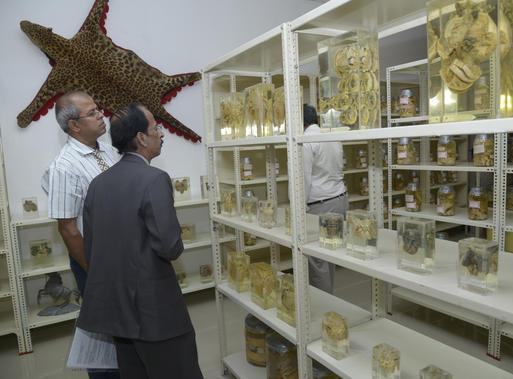
Visitors at the Maurice Lev & Saroja Bharati Cardiac Museum at Frontier Mediville at Gummidipoondi on Saturday. / Photo: V. Ganesan / The Hindu

In the vast room guarded by a solid ornate wooden door are about 8,000 hearts. None of them beat. Jostling against the translucent fluid in glass jars, the hearts sit, in all sizes, shapes, colours, and stages of disease. Welcome to the Maurice Lev and Saroja Bharati Cardiac Museum at Frontier Mediville in Gummidipoondi, about 50 km from the city.

The museum has not only hearts – most of them human, with some animal specimens – but also heart components. “If we put every specimen we have in a jar of formalin, we’ll need 10,000 containers,” says K.M.Cherian, chairman and CEO, Frontier Lifeline Hospital and Frontier Mediville. “It is the largest collection of cardiac pathology hearts anywhere in the country, possibly even the world,” he claims.

Pathology is the branch of medicine that studies the altered anatomy of an organ. A surgeon corrects the structure or functionality of an organ, and so, unless he or she gets the pathology and biochemistry right, he or she is likely to be just a person with a scalpel.

The museum gets its name from the primary contributors to the heart section, Maurice Lev and Saroja Bharati, from the Maurice Lev Congenital Heart and Conduction Systems Centre, Chicago. It cost about $1,00,000 to ship the specimens, and a further $1.5 million in insurance, Dr. Cherian says.

“I had not even imagined that these hearts we collected since the 1970s would be in India one day. But, here they are,” Dr. Bharati explains. “Every heart is different. When you look under the microscope, even the hearts of identical twins are not identical.” As someone who has written the pathology reports of over 9,000 hearts, she should know.

In the museum, inaugurated by Governor K.Rosaiah on Saturday, are hearts at various stages of disease, and repair, diaphanous valves which put you in awe of a cardiac surgeon’s skills, pacemaker probes nesting in hearts split wide open.

“This has been my dream. I visited Prof. Lev and Bharati in Chicago when they were just setting up the museum to spend months studying the anatomy of the heart,” he explains, giving us a personal guided-tour of the museum on its inaugural day. “I want students to benefit from this wealth of information, completely free of cost. Some professors of pathology from other countries have also expressed interest in visiting the museum.” And what is the favourite specimen in the hall? Dr. Cherian doesn’t bat an eyelid, “Mine.” It probably is happiest ticking in the good doctor’s chest cavity at the moment, but is it to be available for display sometime in the future? “For sure!” he says, “I don’t believe either in burying or burning the body.”

source: http://www.thehindu.com / The Hindu / Home> News> Cities> Chennai / by Ramya Kannan / Tiruvallur – April 28th, 2013

Veteran musician dies at 91

Veteran musician T K Ramamoorthy died at his Royapettah residence in Chennai on April 17. He was 91 and survived by wife and 11 children.

Ramamoorthy partnered with film musician Vishwanathan to compose music for more than 700 South Indian films from the 1950s. The duo known as Mellisai Mannargal (the kings of light music) gave hundreds of memorable songs in films likeRatha Kanneer, Pudhayal, Pathi Pakthi and Nichaya Tamboolam.

Born in Tiruchy, about 250km from Chennai, Ramamoorthy became an accomplished violinist by 16 years of age and gave concerts under his parents’ tutelage.

He was spotted by film musician C R Subburaman and taken to Madras (the present-day Chennai) to work for AVM studios. There Ramamoorthy met Vishwanathan, who was an expert at harmonium, keyboard and piano. Vishwanathan was seven years younger to Ramamoorthy but they had an instant rapport.

Their big break came when Subburaman died in 1952 while composing for films Devadas, Chandi Rani and Marumagal.

The two musicians completed Subburaman’s work and became inseparable until 1965. They were the highest paid musicians of that period and honed generations of singers and musicians besides taking film music to a light racy level.

After their amicable separation in 1965, Ramamoorthy composed music only for 19 films whereas Vishwanathan had more professional success. However on the request of friends, the pair came together again for the 1995 Tamil film Engurintho Vandhan but did not continue their partnership.

Ramamoorthy and Vishwanathan have won many national awards, the most recent being a felicitation ceremony organised by Chief Minister Jayaram Jayalalithaa in 2012.

source: http://www.gulf-times.com / Gulf Times / Home> International> India> Tamil Nadu Round Up / by Umaima Shafiq / April 21st, 2013

Women share success stories in public life

Trichy :

Most of the elected women representatives in local bodies are usually prevented from acting on their own by their male family members. Though the officials have issued warning against such practice, it still persists in many parts of Trichy and neighbouring districts. Nevertheless, some of the women break such barriers and act on their own. A group of elected women representatives from six districts of Dharmapuri, Tirupur, Madurai, Cuddalore, Erode and Pudukkottai converged at an event in Trichy on Thursday to share their successful stride in public life. Surprisingly, no woman representative from Trichy turned up for the meet. The women expressed satisfaction in serving the people on their own by not depending on their male family members.

T Pasupathi, the president of Pullaneri village panchayat in Madurai district told TOI, “The encouragement from my family was a key to contest in election and to succeed. But I never depend on my family members to execute my work as a president. I want the women to shine in their life equal to men. In my career as a president, I stopped four child marriages in our area. Further, my service for the welfare of the women would continue.”

The aim of Dhanuskodi Saivarasu, the president of Mangathevanpatti village panchayat in Pudukkottai district is to strive hard towards getting 50% reservation for women. She said, “After creating awareness, most of the elected women representatives are prevented by husbands, children and fathers. In my case, my husband is helpful and does not interfere in my work.”

The story of C Nagalakshmi is an example for many women how to strive hard in life without support from others. Nagalakshami, a deserted woman, having two children won the election for ward member in Uppiliyakudi village panchayat. She said, “Though my husband separated from me, I hope that I would succeed in my life. With support from our people, I won the election. Despite many hurdles from men, I still want to serve for the people.”

Even though some of the women are brave enough to struggle in public life, there are many cases in Trichy where the male family members of the elected local body women representatives take care of the official duties of the women. District collector Jayashree Muralidharan last year issued a circular to all local bodies warning against the practice. Nevertheless, it continues in Trichy, told an official of the panchayat department in Trichy.

It can be mentioned in the context that the Trichy district administration cancelled the cheque signing power of 13 village panchayat presidents under Section 203 of  Tamil Nadu  Panchayat Act 1994 on charges of alleged irregularities.

Surprisingly, most of the ‘punished’ presidents in Trichy are women. The officials say that the irregularities were done by their husbands or other members of their family.

source: http://www.articles.timesofindia.indiatimes.com / The Times of India / Home> City> Madurai / by R. Gokul, TNN / April 19th, 2013

Hill hamlet to get power, water in 4 weeks

The district administration has taken measures to provide electricity and water connection to the tribal villagers in Melvalasai, Kezhilvasai and Akkarapatti.

The administration had also directed the village panchayat to constitute the Forest Rights Committee, to speed up the process of making these basic amenities available to the villagers. District Collector Dr Vijay Pingale, who visited the tribal villages on Wednesday, by walking nearly 8 kms on the steep Kalvaranyan hills, told Express,“We are taking steps to provide electricity to the tribal villages within a month. Power now is available in Kodaram, two-kms from the villages, in Villupuram district.”

After electricity connections are provided, the villagers would get drinking water too. “We will also make efforts to repair the solar lighting facility, which had not been functioning for the last two years,” he said. Further, Pingale said, “We are also planning to bring the tribals to the plains, if they are interested in accepting the house pattas and agriculture lands on the foothills.”

The village panchayat has been directed to form the Forest Rights Committee, comprising two-thirds of women, to avail the basic amenities.

“The committee is entitled to pass a resolution to avail 13 basic needs such as establishing ration shops, formation of roads, health centres and creating water sources,”  District Forest Officer, Tiruvannamalai (South), V Naganathan said.

“We have asked the tribals to pass a resolution seeking drinking water and electricity facilities after forming the Committee. It will be taken into consideration and suitable action will be taken to fulfil their demands,” the Collector added.

source: http://www.newindianexpress.com / The New Indian Express / Home> States> Tamil Nadu / by J. Shanmugha Sundaram / ENS – Tiruvannamalai / April 19th, 2013

A dark brown Muse


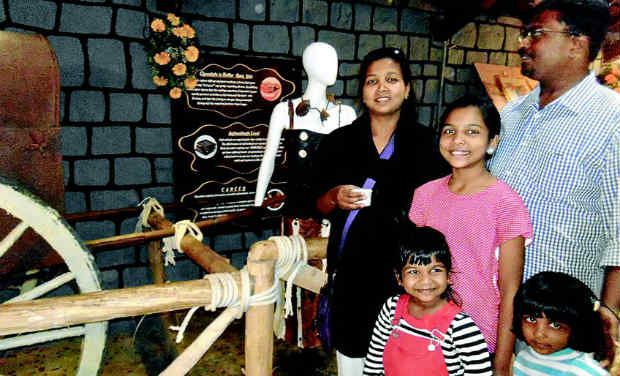
Chocolate lovers at the newly-opened museum in Ooty. / -  DC
Chocolate lovers at the newly-opened museum in Ooty. / – DC

Ooty: 

If it is A.R. Rahman for music, then it is Rahman brothers in the Nilgiris hills for home-made chocolates. The choco-brothers, well-known in the home-made chocoloate industry, have opened a new chapter in the annals of home-made chocolates as they have set up their chocolate museum — M&N Chocolate Museum — on Mysore Road, near HPF factory.

The brothers claim it’s a first-of-its-kind in the country and it gives an insight into the history of chocolate-making, especially the home-made chocolate.

The museum, with its vintage architecture and interiors that remind one of British country architecture, also boasts of models of horse carts, boat, idols, chocolate fountain, ancient chocolate making implements, cocoa seeds and the photographs of three Swiss men who were pioneers in home-made chocolate-making, along with signages on the health benefits of chocolates, besides a counter to house varieties of home-made chocolates.

Fazloor, the younger of the duo, who completed a course on chocolate-making at Ecolechocolate Institute in Canada and who conducted quite a few innovative shows on home-made chocolates here in the past, said home-made chocolates are a roaring confectionery industry now as people from all walks of life like them.

“The cool weather profile in Ooty gives a special flavour and taste to the home-made chocolates. We make a little more than 100 varieties of home-made chocolates using nuts, resins, dry fruits and even some herbs. Home-made chocolates need special touch of the hands to bring out the desired taste.

Of course, Ooty is famed for its nature, flowers, vegetables, spices and fruits. Home-made chocolates of Ooty, which carved a name for themselves, are extra-natural attraction in the field of confectionery with a touch of delicacy. That is why they easily attract the locals and tourists,” he added.

His brother Abdul, a mechanical engineer by profession who turned a chocolatier with some inspiration and help from his brother, said the chocolate museum is an attempt to give the much-needed insight into the history of chocolate-making which dates back to the Mayan era.

The Mayans were known to be the first users of cocoa. Cocoa is the basic ingredient in chocolates and in these modern times, home-made chocolate-making has leavened by vari-
ous innovations.

source: http://www.deccanchronicle.com / Deccan Chronicle / Home> News> Current Affairs / by B. Ravichandran, DC / April 27th, 2013