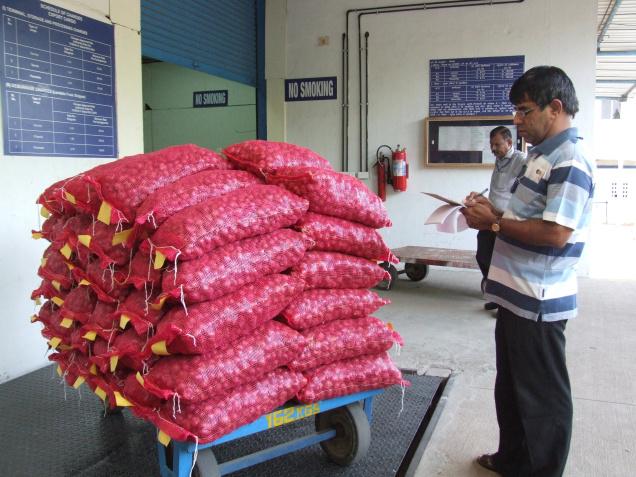
The drumstick growers in the Aravakurichi belt of Karur district are a happy lot now with arrivals picking up along with the price. The special shandies in the region are flush with fresh arrivals that are now fetching a remunerative price for the growers.
Drumstick is grown on more than 40,000 acres of land both as a garden crop and field crop in Aravakurichi belt. The major drumstick producing areas include Tadakoil, Venjamangudalur, Santhapadi, Esanatham, Ammapatti, Koththapalayam, and 20 other villages from where around 20 to 30 truck loads of drumstick are despatched to various destinations every day. Traders from Kerala, Karnataka, Andhra Pradesh, Maharashtra, Rajasthan, Delhi, Madhya Pradesh, and West Bengal come down to Aravakurichi and nearby areas routinely to buy moringa in lots at the special shandies that would come up on the roadsides.
“We feared that the harvest might take a steep dip because of the adverse climatic conditions in the flowering stage of the crop. But fortunately nature has been benevolent to us and we have seen as good a harvest like any good year this time and we are doubly happy that the price is also pretty good. One bundle of drumstick, weighing around 2 kg, fetches the growers Rs. 15 to Rs. 20 and that is a good thing,” said T. Palanisamy from Santhapadi village.
The current first season for the crop lasts from April to June and the growers are happy that at the initial stage itself the price is good. They hope that the price line should hold for the season, they said. “The price tag has given us traders a big surprise as many of us felt that the price would fall due to adverse weather conditions and such other factors. But that was not to be and the drumstick prices have got off to a steady start. At present, we are purchasing along with the local traders but soon many like us from the north and Bengal would arrive and we could not fathom what will happen to the price when they perhaps next fortnight,” says a regular trader Mohammed Aijaz from Gurgaon area of Haryana.
source: http://www.thehindu.com / The Hindu / Home> News> Cities> Tiruchirapalli / by L. Renganathan / Aravakurichi, April 05th, 2013
A group of engineering students at SRM University in Chennai—one of the country’s top engineering schools—have invented a set of high-tech electrified underwear to prevent rape.
In the wake of India’s “rape epidemic ” which has rocked the country and sent tourism plummeting by as much as 25 percent (35 percent among women), the students decided to take matters into their own hands with a set of underwear that can electrocute attackers while protecting the wearer.
As a progressive American guy, it’s tempting to dismiss the anti-rape undies as misguided and inadvertently reinforcing the “rape culture” that tacitly places responsibility on women and their clothes in addressing violence. It’s tempting to suggest they just go have a SlutWalk and tell men it’s their responsibility not to be rapists, end of story.
But I’m not an Indian woman living in the middle of a rape epidemic, so I have no idea what I’m talking about.
Two of the women in the student group who invented the electric underwear are women who think that the danger calls for a more immediate defense than protest and slow cultural change. The group said :
After stepping into the real, cruel world we realised that our smile could not last for long as the threat to our purity and integrity always lingered on. Lawmakers take ages to come up with just laws and even after that, women are unsafe. Hence, we have initiated the idea of self-defence which protects the women from domestic, social and workplace harassment.
The underwear, called Society Harnessing Equipment (SHE), deploys a 3,800kV charge to anyone touching the outside of the underwear while protecting the wearer with a polymer lining. It’s also equipped with GPS and can notify cops in real-time in the event of an attack, supplying them with the victim’s location through the GPS.
“The shocks can be emitted up to 82 times,” the group says. “This could give women freedom from situations faced in public places.”
source: http://www.deathandtaxesmag.com / Home> News / by Alex Moore / April 2013
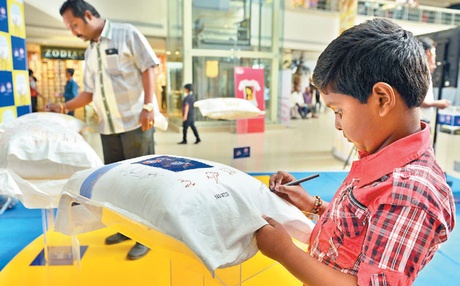
Later this month Mahendra Singh Dhoni is going to receive a peculiar gift — 30 pillows bearing personalised notes and good luck messages from cricket-crazy fans in Chennai.
On Tuesday and Wednesday, Chennai’s Express Avenue mall was a forum for the fans of the Chennai Super Kings to meet and show off their talents, at a promotional event organised by Gulf Oil, the champion team’s sponsor.
While the fans did not need too much cajoling to take to the stage and entertain shoppers at the mall, thousands of people walked up to the pillows and signed them. ‘Dhoni, my superhero’, ‘I love you, MSD’ were prominent messages on the pillows, branded with the CSK emblem.
“The pillow concept is themed on our current TV advertisement that has become very popular. The ad plays on the fact that our products are long-life lubricants that take care of your vehicle for a long, long time. The response has been great so far, especially since we also have a lucky draw contest, wherein five lucky fans will get to meet the Chennai Super Kings team at a meet and greet session when they come to the city,” said Ravi Chawla, president and COO of Gulf Oil.
Attempting a mall activation to attract youngsters in a city that loves cricket almost as much as shopping seems to have paid off — the stage was never left empty, with groups of young boys shaking a leg to typical Madras-kuthu, others attempting break dance, mimcry or beatboxing.
“This is our third year of association with CSK. The team is young and vibrant and they are the champions. CSK not only has a massive fan following across the country, but the Tamil Nadu market is important for us. We will continue such novel promotions at other cities CSK visits to play matches, like Delhi, Mumbai and Bangalore,” Chawla said.
source: http://www.newindianexpress.com / The New Indian Express / Home> Cities> Chennai / Express News Service – Chennai / April 04th, 2013
Narain Karthikeyan has confirmed to AUTOSPORT that he will continue in Auto GP with Zele Racing in Marrakech this weekend.
The former HRT grand prix driver competed in last month’s Monza opener after agreeing a late one-round deal to drive for Michael Zele’s team.
“I have just confirmed that I will do the race in Morocco,” Karthikeyan told AUTOSPORT on Wednesday. “It will [continue to] be a race-by race deal, I think.”
A fifth place in the Monza opender , achieved after charging from the back of the grid, and a retirement from race two with brake failure left the Indian seventh in the Auto GP drivers’ standings.
The continued short term arrangement with Zele keeps Karthikeyan’s options open, although the 36-year-old admits there are no firm plans to switch to another category.
“Nothing much else is happening at the moment so I guess this keeps my eye in and helps stay race fit,” said Karthikeyan.
After skipping round one at Monza to compete in the clashing GP2 race in Malaysia, Daniel de Jong is set to join the Auto GP grid in Morocco as a third Manor MP Motorsport entry.
source: http://www.autosport.com /Auto Sport / Home> Auto GP News / by Peter Mills / Wednesday, April 03rd, 2013
using the panels will be ready on April 8. / by Special Arrangement / The Hindu
Panels made of glass fibre reinforced gypsum can replace brick walls and RCC slabs, and are resistant to quakes.
Can panels made of gypsum reinforced with glass fibre be used as load-bearing walls replacing brick in a multi-storied building? Can they also be used as floor/roof in place of reinforced cement concrete (RCC) slab? The simple answer is, yes.
A few years ago, Rapidwall Building Systems, Australia, developed a technology to make gypsum strong and water-resistant enough to be used as load-bearing walls. This is by calcining process where glass fibre is combined with gypsum plaster to produce glass fibre reinforced gypsum (GFRG) panels. Now, researchers at IIT Madras have gone a step further.
They have developed a technology to make GFRG panels to be also used as floor/roof, thus eliminating the use of RCC slabs. An eight-storied building, for instance, can be built using the panels as load-bearing walls, floors/roofs and staircases.
They also collaborated in the indigenous development of an excellent water-proofing material. Water-proofing is essential for prolonged durability of the GFRG panels, especially in the case of roofs and toilets.
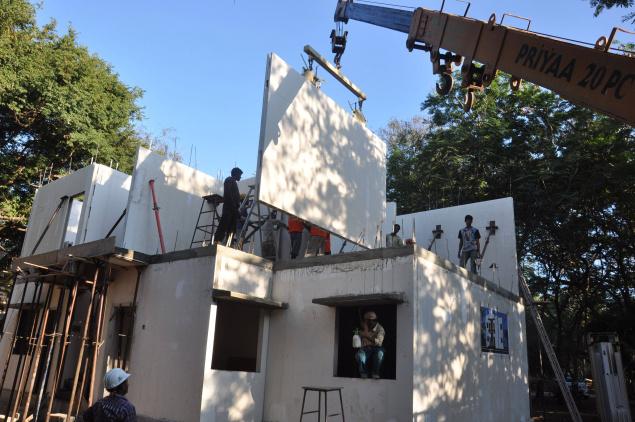
A demonstration building — ground plus first floor — is being built inside the IIT-M campus. The building, with electrical and sanitary fittings, will be ready on April 8 — just 29 days of construction after the foundation was completed. “It will be ready for occupation when it is completed,” said Prof. Devdas Menon, Department of Civil Engineering, IIT Madras.
The building will have four units — two with a carpet area of 269 sq.ft are for the economically weaker section, and another two, with a carpet area of 497 sq.ft, are for the low-income group (LIG).
A few years ago, a couple of buildings were constructed at the GFRG panel manufacturing plants at RCF in Mumbai and FACT Cochin, and one at Visakhapatnam using the IIT technology. “Those were pilot projects,” said Prof. Menon. “This is a demonstration that the material can be used for cost-effective, mass-scale and quickly buildable housing, with improved water-proofing.”
What makes the rapid construction possible is that the panels are prefabricated and cut to desired sizes based on room sizes with openings for doors and windows.
A panel has two skins of 15 mm thickness that are interconnected at regular intervals (25 cm). The cavities formed by these interconnections are used for several purposes — filling with concrete, and laying electrical conduits and plumbing pipes.
In Australia, the Rapidwall technology has been used for constructing several 2-3 storied buildings. Since the walls act as load-bearing structures, every cavity in the panel is filled with concrete. They use conventional RCC solid slabs for the roof/floor.
“We recommend the use of two steel bars instead of one and filling all cavities with concrete in the lower floors in the case of a high-rise building,” said Prof. A. Meher Prasad of Civil Engineering Department, IIT, Madras. The number of concrete-filled cavities and steel bars keeps reducing from the ground to the topmost floor. The topmost floor will need very few concrete-filled cavities.
A reduction in amount of concrete used in turn reduces the total weight of the building. The ripple effect is the reduction in the foundation cost. The demonstration building at IIT Madras is about 25 per cent cheaper than conventional ones. “There will be greater savings when used for mass-construction,” Prof. Menon stressed. Aside from the savings and speed of construction, the buildings are subjected to lesser earthquake forces. This is because of their lighter weight.
For the floor/roof, the panels are placed over the vertical wall panels and the top skin of every third cavity is cut open. Steel reinforcement is placed in these cut cavities before being filled with concrete. The concrete-filled cavities tend to behave as hidden beams. The panel is then covered with a 5-cm thick concrete topping.
Since the panels have a smooth finish, the need to plaster them (as in the case of brick walls) does not arise. The total weight of the building (dead weight) is reduced substantially
According to the IIT researchers, tests conducted have shown that GFRG panels reinforced with concrete are also capable of resisting lateral loads caused by earthquakes. During an earthquake or strong wind, buildings tend to sway and the walls are subjected to enormous loads exerted laterally.
The Building Material & Technology Promotion Council (BMTPC) has approved GFRG for construction in India.
source: http://www.thehindu.com / The Hindu / Home> S & T > Technology / by R Prasad / April 03rd, 2013
The Madras Medical College got an x-ray machine in 1900, five years after it was invented. Twenty years later, the Bernard Institute of Radiology at MMC got a separate building. Today it offers at least 1,000 images on MRIs, CTS and digital x-rays, hospital dean Dr V Kanakasabai said.
The hospital subsidizes the cost of imaging so that CT scans cost 350-500, while MRI scans cost 2,500. “Some of these images cost at least 15,000 in private hospitals. Here they are offered free for mentally ill and unconscious accident victims,” Kanakasabai said on Monday during the 79th Institute Day celebrations.
The institute was named after Captain Bernard, who got 8 lakh sanctioned for a separate building for the department in 1928. Eight years later, the institute was equipped to offer diploma courses for doctors and paramedics in radiology. Even today, a postgraduate degree (MD) in radiology at MMC is one of the most sought after. “It’s one of the most popular courses. We offer four postgraduate seats. Every year, we see a tough fight among students for this course. Students pay nearly 2.5 crore to do this course in private colleges and universities,” he said. In 2012, it started post-graduate diploma courses radio diagnosis and another in radiotherapy. This year, BSc Radio Diagnosis and BSc Radiotherapy have been introduced.
The interventional radiology wing, an arm of the department, does vascular grafting and coil embolism for poor under the Chief Minister’s Comprehensive Health Insurance Scheme. The department also offers up to 170 radiotherapy procedures everyday to cancer patients. “Six lakh patients a year are treated at the department,” said director Vanitha.
source: http://www.articles.timesofindia.indiatimes.com / The Times of India / Home> City> Chennai / TNN / April 03rd, 2013
Scores of leaders of political parties and artistes paid their homage to media baron and sports administrator B. Sivanthi Adityan, who passed away on Friday. The body of 76-year-old owner of popular Tamil daily “Dina Thanthi,” was taken in a procession from his Poes Garden residence to the electric crematorium at Besant Nagar where it was consigned to flames.
Earlier, a steady stream of mourners paid their last respects to the Padmashri recipient who was also an industrialist, educationist, philanthropist besides being associated with Indian Olympic Association and various other sport bodies.
President Pranab Mukherjee, Prime Minister Manmohan Singh, Governor K. Rosaiah and chief minister J. Jayalalithaa were among those who condoled the demise of Adityan.
DMK chief M Karunanidhi, Union ministers G.K. Vasan and Jayanthi Natarajan, MDMK chief Vaiko, DMDK Leader Vijayakant, CPI state secretary D. Pandian, CPI (M) state secretary G. Ramakrishnan, TNCC president B. Gnanadesikan and BJP president Pon Radhakrishnan were among those who paid floral tributes to Adityan at his residence.
Members of film fraternity including superstar Rajni, actor-politician R. Sarathkumar, Sivakumar, director Bharatirajaa and music director Illaiaraja also paid their last respects.
In his message to Malathi Adityan, wife of Sivanthi Adityan, Mukherjee said his contribution to society as a philanthropist and educationist would always be remembered.
Expressing profound grief, Manmohan Singh said the country had lost a true champion of the media, who believed that journalism was meant to serve the common man’s need for information.
Rosaiah said, “I am deeply shocked and grieved to hear about the demise of B. Sivanthi Adityan…his death is an irreparable loss to media and to sports in particular.”
In her message, Ms. Jayalalithaa said Adityan’s demise was a huge loss to journalism and sports. The Indian Newspaper Society too paid rich tributes to B. S. Adityan who was one of its past presidents.
source: http://www.deccanchronicle.com / Deccan Chronicle / Home> News> Current Affairs / DC / April 2qst, 2013
Its little wonder that Tirupur, which has established itself as a knitwear export hub on the global map is today attracting labour, not merely from the neighbouring districts in the State but from other parts of the country as well.
Industry insiders say that the number of job seekers from Assam, Bihar, Odisha, Uttar Pradesh and Nepal among others is on the rise. From just around 5000-odd persons about four years back, the number is estimated to have risen to 40,000+ at present.
Preferring anonymity, an industry source said that some units have established recruitment offices in Bihar and Odisha. ‘With local labour becoming scarce, we have no option but look elsewhere to fill this void by allowing migrants from the north,’ the source said.
LABOUR DYNAMICS
And the labour dynamics is witnessing a change not just on the shop floor, but on the streets, canteen and eatery as well.
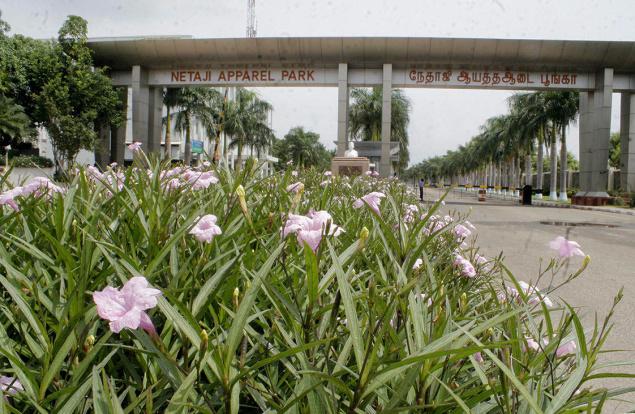
The Nethaji Apparel Park (NAP), on the outskirts of this dollar town houses 54 units and provides employment to around 17,000 labourers.
According to R. Subramaniam, Executive at NAP, at least 7000 of the total workforce at NAP units were from the northern and central parts of the country. “Most of the northern companies prefer to engage north Indian labour,” he said, justifying the significant rise in the number of migrant labour.
And in recent years, some of the garment exporters seem to have gone to the extent of getting cooks from these states to enable the workforce appease their hunger. “We realised that the migrant workers from north Indian states missed their food and decided to address this issue,” said an exporter.
J-Marks Exim (I) Private Ltd has, for instance, five units at NAP. Not less than 65-70 per cent of the workforce in this company is from the North.
Rakesh, aged about 21, is working in the bundling section at J-Marks. Hailing from a village near Varanasi in Uttar Pradesh, this youngster came to Tirupur two years back.
Stating that his uncle introduced him to this knitwear exporting unit, Rakesh told this correspondent that he has been able to send home around Rs 12,000 every alternate month. “Ours is an agricultural family. We cultivate wheat in our farm. I usually go home during the harvest season. My people are using this money for building a house,” he said.
Lakshman, a co-worker with Rakesh at the same unit says he came to Tirupur to eke out a living. These two along with ten others from Uttar Pradesh take turns and make their meal. “It’s no big deal,” says Lakshman.
ACCOMMODATION
Subramaniam said accommodation was becoming a major issue, with rentals hitting the roof. “We have a women’s hostel, which can accommodate 1,000 women. Many more are coming up in Tirupur,” he added.
An industry insider meanwhile pointed out that workers from different States preferred to live in colonies. “Perumanallur, located about 12 km from Tirupur is a Nepalese settlement,” the source said.
The units continued to provide conveyance. “Earlier, one would see the locals commuting in these buses. Now, a majority of the occupants in these buses are from other states,” said Subramaniam.
According to the NAP Executive, the employer reference is sought when such migrants seek rental accommodation.
source: http://www.thehindubusinessline.com / Business Line / Home> News> National / by L.N. Revathy / Coimbatore – April 18th, 2013
The average monthly handling of cargo at the airport has gone up to 243 tonnes now against the 100 tonnes in 2010-11. File Photo: R. M. Rajarathinam / The Hindu
Cargo terminal records highest monthly handling in March
Cargo exports from Tiruchi Airport have registered 44 per cent growth during 2012-13. The cargo terminal has also registered a new high by handling 395 tonnes of international cargo during March, the highest ever for the airport so far. The previous high was 313 tonnes handled in January early this year.
The cargo terminal at the airport has totally handled 2,920 tonnes of cargo during 2012-13 against 2,022 tonnes recorded during the previous financial year.
“The continued growth places Tiruchi International Airport as one of the leading cargo terminals among the non-metro airports under the control of the Airports Authority of India in the country,” said S. Dharmaraj, Airport Director.
The rise in exports come in the wake of the increase in the uplift capacity from Tiruchi after Tiger Airways started lifting cargo from here to Singapore in September last year.
Tiger Airways was the fourth major airline to lift cargo from the city after Sri Lankan Airlines, Air Asia, and Mihin Lanka. Air India Express, the other major operator from the city, remains the only airline that does not lift cargo though it has international operations from here.
The total available uplift capacity of the airlines for cargo from the city is around 350 to 400 tonnes a month and the terminal is inching towards full capacity utilisation, airport sources said.
The average monthly handling of cargo at the airport has also gone up to 243 tonnes now against the 100 tonnes in 2010-11.
Airport sources also indicate that the composition of the cargo exported from Tiruchi was also gradually changing though perishables, mainly vegetables and flowers, continue to account for 85 per cent of the exports. Of late, consignments of readymade garments, fabrics, leather goods, pharma products, tea, food products such as ‘murukku’ and other eatables, and household goods are gradually coming in.
Exports are mainly to Kuwait, Dubai, Colombo, Singapore, Kuala Lumpur, and Colombo. The export market to Europe is still largely untapped for want of connectivity, as far as the airport here is concerned.
The expansion of the runway, paving the way for wide-bodied aircrafts, could lead to export of consignments to Europe from here. For instance, most of the handmade textile exports from Karur, headed for European markets, are currently sent by ship.
The cargo terminal is also expected to get a cold storage with a capacity of five tonnes soon with assistance from the Agricultural and Processed Food Products Export Development Authority (APEDA). Although tenders have been finalised by the AAI, the work order is yet to be issued pending release of funds from the APEDA.
source: http://www.thehindu.com / The Hindu / Home> News> Cities / by Special Correspondent / Tiruchi, April 03rd, 2013
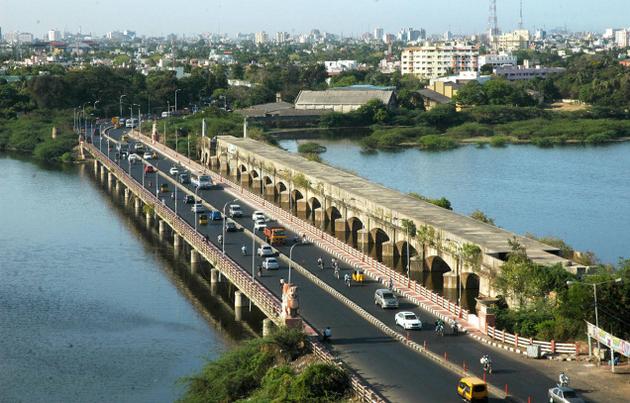
The Adyar bridge in 2010. Photo: M. Karunakaran / The Hindu
In this concluding part on old bridges, Anusha Parthasarathy explores some lesser-known ones, besides the big names that define Chennai
As the 1700s dawned, more villages came under Madras. Governor Thomas Pitt, who took over in 1698, is credited with adding five more towns to the city — Trivatore, Nungumbaukum, Vasalavada, Catawauk and Satangadu. Soon, more bridges would be needed.
An Island bridge was projected by Yale in 1690 but wasn’t built until 1715, connecting the Fort to the Island, but this was damaged over and over again and was later removed because there was a diversion of the stream on which it was built.
Following this was the Triplicane Bridge, also known as St. George’s Bridge, Lord Willingdon Bridge, now the Periyar Bridge. According to Vestiges of Old Madras, it connected the Island to Triplicane, and the Fort to San Thome and the Mount. This was sometime between 1715 and 1718.
Periyar Bridge, a multi-arched bridge rebuilt in 1805, is of a different alignment.
THE MARMALONG BRIDGE
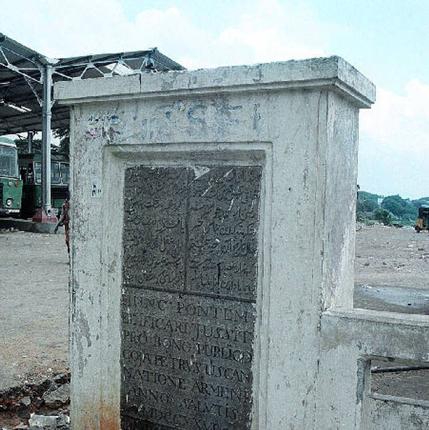
In 1726, one of the most popular bridges of Madras was being built — Marmalong Bridge, the first across the Adyar River. Built by the Armenian Coderjee Petrus Uscan (who came to Madras in 1724) with his own money, the bridge was named Marmalong after Mambalam, a village on the Adyar River, west of San Thome. The plaque on one of the pillars of the old bridge still exists, even if in another place altogether. There is no trace of Uscan’s arched bridge now and a concrete structure, Maraimalai Adigalar Bridge, has taken its place.
The plaque refers to the wealthy Armenian Coja Petrus Uscan / . Photo: S. Mahinsha / The Hindu
In 1755 came the Wallajah Bridge, connecting the Wallajah Gate of the Fort to the Island. The bridge ends and in the middle of this stretch is the Monroe statue, says S. Muthiah’s Madras Rediscovered. According to Vestiges of Old Madras, a stone inscription on the west end of the bridge says, ‘Wallajah Bridge, erected by Order of Government in 1755…’ This was widened and the new bridge, with concrete on one side, is now called the Quaid-e-Millath Bridge.
Except for those mentioned above, it has been difficult to pinpoint dates for the other bridges that were built in the 1700s and 1800s. While there is some information about a few of them, the stories of most arched bridges are foggy, to say the least.
Archival information
Hemachandra Rao has diligently gathered details from the State archives and other sources. “There is a rather old bridge down Chintadripet which leads to Ripon Building, called Law’s Bridge. A name plaque still exists,” he says. “If you look down at the river, you can even see an abandoned boat jetty nearby.” The bridge, however, is now full of garbage and just a walk down is an assault on one’s senses.
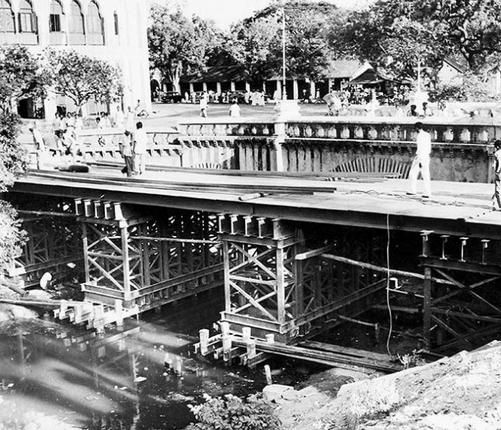
The famous Napier Bridge, which connects the entire stretch of the Marina with the Fort, was built in 1869 by Francis Napier, then Governor. This bridge was widened in 1999. “On this bridge, the arches are on the top, a rather different one,” says Rao.
Chepauk bridge, put up in 1961./ Photo: Parthasarathy / The Hindu
Other bridges are the Chintadripet Bridge, which connects Chintadripet with Egmore. Turn right and you will land on St. Andrew’s Bridge, which is now popularly called Gandhi-Irwin Bridge. “When these bridges were constructed is not clear and there is very less information available,” says Rao, who also pinpoints that a left from Chintadripet bridge will take one down Lang’s Garden Road and to Harris Bridge (now Adhithanar Bridge), which, according to the plaque on one of its stone walls, was built in 1855.
Binny Bridge, adjacent to Connemara Hotel, is named after John Binny, whose residence became the Imperial Hotel, which is now the Vivanta by Taj Connemara. This also seems to be called Commander-in-Chief’s Bridge, which would lead us to think it was built in 1825 (according to H.D. Love’s book). “If you go down that road, you can see the arches of Anderson Bridge as you approach the Pantheon Road signal,” says Rao. This bridge is named after Dr. James Anderson, who had a botanic garden in the area once. The bridge was built in 1829.
There seems to have been a Monroe’s Bridge but it is no longer in use. An Elphinstone Bridge (1840) on River Adyar, seems to be the one in disuse on the side of the current Adyar Bridge, says Rao. Basin Bridge, named after a basin nearby to purify water, is one of the bridges on the Buckingham Canal. There seems to have been a Granduff Bridge nearby (named after an erstwhile Governor) but one can’t pinpoint its location. Chepauk Bridge, Royapuram Bridge over a railway line (the arches are clearer since there is no water beneath) and the Ice House Bridge are the others.
More links to the past
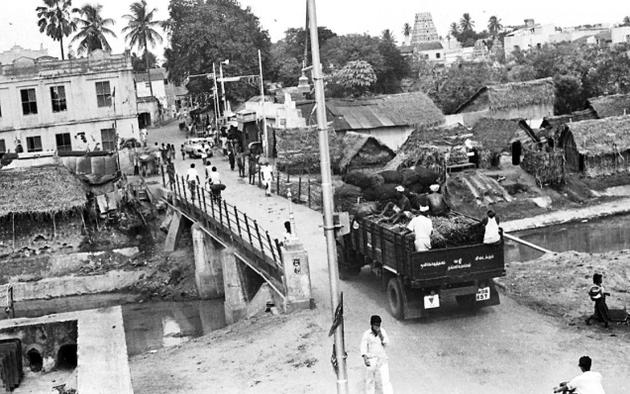
On the other side of Mount Road and Triplicane are a few more bridges that aren’t really talked about. The Luz Bridge connects Mylapore and Luz, Mundakanniamman Koil Bridge connects Luz to Kutchery Road and the Cancer Institute Bridge. Pycrofts Bridge, one on Edward Elliot’s Road (now R.K. Salai) near the DGP’s office, is lesser-known.
Mundakanniamman koil bridge in Mylapore /. Photo: K.N. Chary / The Hindu
Even as the arches grow weary and their colours turn dull, these bridges witnessed the growth of this city, from its humble beginnings to the metropolis it has now become.
source: http://www.thehindu.com / The Hindu / Home> Features> MetroPlus / by Anusha Parthasarthy / April 16th, 2013