Trichy airport makes profit, but expansion stalled

Trichy :

The profit-making Trichy airport should be provided all it needs, to make it truly international, G K Chaukiyal, member (operations) of Airports Authority of India, said on Wednesday. Chaukiyal said the AAI was controlling around 125 airports in the country and only 10 or 12 are making profits. However, Chaukiyal denied the Trichy airport was one of the 11 airports listed for privatisation.

Chaukiyal was on a customary visit to the Trichy airport that was recently accorded the international status to inaugurate the new barracks for the CISF personnel that has been constructed at a cost of Rs 73 lakh and the first-of-its-kind sniffer dog kennel at a cost of Rs 39 lakh. In May, last year, another Member (Air Navigation Services) AAI, V Somasundaram inaugurated the automation system of Air Traffic Services (ATS).

Airport director S Dharmaraj said the airport was making a profit to the tune of Rs 3 to 4 crore annually and it was increasing at a rate of five to 10 per cent. However, regional executive director, southern region D Devaraj, said that “This year the profit was touch-and-go.” Devaraj said the passenger traffic was increasing at a rate of 13% and the AAI had singled out five airports – Trichy, Coimbatore, Mangalore, Benaras, and Lucknow – for infrastructure development.

Chaukiyal said it was remarkable that Trichy airport was making profit and hence it should not be neglected and every possible help must be extended to make it grow. The infrastructure development includes the automatic dependent surveillance broadcast (ADSB) considered to be the next generation surveillance technology for tracking aircraft.

But Trichy airport has been plagued by many navigation ills on the infrastructure front and the single largest ill is the shorter runway that at present measures up to 8,136 feet and this does not enable larger aircraft to land. It serves as a great impediment to large-scale exports from this region even though there is admittedly unprecedented potential for products like banana and other textile items from the region. All efforts to expand it to at least 12,000 feet has met with a lot of hurdles including land acquisition for the project.

When asked about the inordinate delaying in the expansion process of the airport, Devaraj told TOI, “Land is always the problem. Let the state government give us the land, we will start the expansion work at once.”

source: http://www.articles.timesofindia.indiatimes.com / Home> City> Madurai / TNN / March 28th, 2013
‘Princess of Honey’ to lure via net

Soon Jawadhu Hills would have an exclusive website to promote the area as a tourist spot. The website will carry interesting information and photographs of tourist spots in the area.

With the aim of promoting the scenic Jawadhu Hills as an ecological hot spot and haven for adventure buffs, the district administration is set to launch the website to attract tourists to the humble yet exquisite area on the Eastern Ghats.

After christening the Jawadhu Hills as the ‘Princess of Honey,’ the district administration and the newly constituted Jawadhu Hills Development and Tourism Promotion Society will launch the website in mid April. The website would have information on the gigantic Neer Maruthu tree in Melpattu(believed to be 1,000 years old), Beeman Falls and the eco-park in Jamanumarthur. “We are planning to launch the website on April 15. From the very next day, the newly identified trekking and mountaineering points will be opened for adventure sports lovers,” Collector Vijay Pingale told Express. The district administration has already designed an exclusive logo for the Princess of Honey — Jawadhu Malai. We will send the project reports to the Tourism Department, he said.

source: http://www.newindianexpress.com / The New Indian Express / Home> States> Tamil Nadu / by Express News Service – Tiruvannamalai / March 29th, 2013

Ramanujan museum in Erode proposed

House where math whiz was born identified

RamanujamCF30mar2013

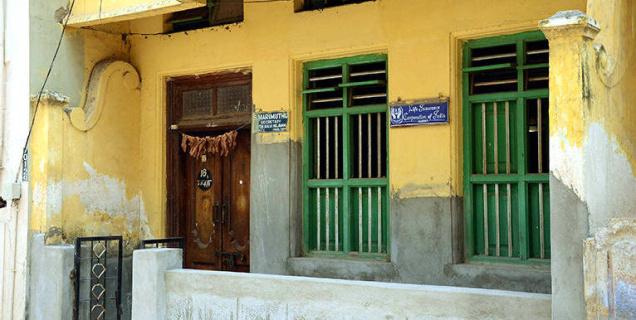
The house at Azhagiya Singar street in Erode where Srinivasa Ramanujan was born. /  Photo: M. Govarthan / The Hindu

The Erode Corporation on Wednesday expressed its desire to convert into a mathematics museum the house where Srinivasa Ramanujan was born. The Corporation passed a resolution to this effect, moved by Mayor Mallika Paramasivam. A proposal to convert the house on Azhagiya Singar Street into a museum will be submitted to the State government.

Though it was known that Erode was the birthplace of the maths genius, the house where he was born remained untraceable until recently. It was located following the efforts made by Susumu Sakurai, professor and head, Department of Math, Tokyo University of Science and Technology, and Professor and President of Tamil Nadu Science Forum N. Mani.

“We had the information that Ramanujan was born in a house that was situated exactly between a Siva temple and its water tank. After extensive search, we found it and confirmed that Ramanujan was born in the house that had the door number 18 in Azhagiya Singar Street,” Mr. Mani said.

The house will be a huge inspiration to children if it is converted into a museum. “It should not be neglected. We should celebrate the math genius by making his birthplace a museum. We already adopted a resolution demanding the State government to convert the house into a museum. It is good to know that the civic body has now come forward to convert it into museum,” Mr. Mani told The Hindu.

source: http://www.TheHindu.com / Home> News> National> TamilNadu / by Staff Reporter / Erode, March 28th, 2013

Tirupur textile exporters feel relief with new order flows

Rs 20,000-cr industry turns around in first three months of 2013, after 3 years of negative growth; labour, power issues persist

TshirtCF30mar2013

After reporting a decline for three years, the Rs 20,000-crore textile industry at Tirupur, knitwear hub of India, has reported a growth in exports during the first three months of 2013.

Iry has attributed the growth to new markets, explored in the past 10-12 months. Meanwhile, labour and power shortages are going to be major obstacles, say industry representatives.

Exporters from this town, about 450 km from Chennai, said the Free Trade Agreement (FTA) expected to be signed anytime with the European Union, would help them compete with Bangladesh, which is now enjoying duty-free benefits.

A Sakthivel, president, Tirupur Exporters Association, said: “We started seeing some sign of relief from January, from old and new customers (mainly from the non-traditional markets).”

Exports fell 10-15 per cent in 2009-10 and 2010-11; in 2011-12, it was flat, thanks to the rupee’s appreciation against the dollar. In 2006-07, when the industry clocked around Rs 11,000 crore, it had set a target to reach $4 billion (Rs 21,800 crore) by 2012. However, it could reach only $2.75 bn (Rs 15,000 crore).

The general global downturn, rupee appreciation, increase in costs (power, transportation, yarn, logistics, diesel) and the high court’s decision to close dyeing units had hit the industry badly after 2008.

“We are seeing some sign of relief now. Between January and March, we have seen five per cent growth, though margins continue to be under pressure,” said Sakthivel.

Industry representatives have said the growth was mainly due to contribution from new markets into which it had ventured in the past one or two years. These include Japan, South Africa, Israel and South America. It also saw some relief in the US markets, along with new orders.

“The concern is the European market, which used to contribute around 50 per cent to the industry,” said Sakthivel.

With the new order flows and opening of new markets, exports from Tirupur are expected to touch Rs 14,000 crore in 2013-14. While the order inflow is good news, exporters are struggling to convert these enquiries to orders.

A leading exporter said lack of power and shortage of labour hurts the industry.

“The power cut ranges from seven to eight hours during the day. In the night, every two hours, power goes for one hour,” he said. “Average delay (job orders) in delivery ranges from 10-15 days. An airlift to meet customers requirements means additional cost.”

The recent increase in diesel prices is also hitting the industry, said Sakthivel. “Our FOB value has increased by two per cent because of the increase.”

Exporters have asked the government for a ‘gold card’ scheme, to enable them to buy diesel at the international price from a designated  oil marketing company. And, to allow duty credit scrip at five per cent of garment exports for the performance in 2012-13, for issuance of scrip from 2013-14. The scrip will be used for offsetting customs duties on speciality fabrics.

The Association estimates 50,000-75,000 more workers are required immediately to meet the new demand. The industry had lost a lot of workers after the downtrend, which had resulted in closure of many units.

source: http://www.business-standard.com / Home> Companies> News> News / by T E Narasimhan / Chennai, March 28th, 2013

Chinnalapatti still honours Cupid during annual festival

Madurai :

Chinnalapatti in Dindigul district is one of the few places where the ancient festival for the god love , known as Kamayasamy (cupid), is celebrated with splendour for over 140 years and this year’s festival is currently underway with people from all communities joining the celebrations.

According to M Sivamurugesan, president of the festival committee, the festival coincides with Holi in North India. “Chinnalapatti is among the very few places where the festival is still celebrated. We have palm leaf manuscripts to prove that our forefathers have been celebrating it for 140 years,” he said.

The twelve-day festival begins at the end of Masi and continues till the fullmoon day on Panguni. A small shrine for Kamayan exists inside the ancient Muniappasamy temple at Chinnalapatti. A zamindar family, now headed by S Muthukumar, is the traditional trustees of the temple.

The festival commences with the temple priest, Palandi, carrying the deity’s replica made from sticks of peepal, mango and wildcane in a procession through the village streets. Then it is installed on a temporary pedestal and villagers take turns to decorate the deity with flowers of their choice, with each community vying with each other to deck up the deity the best possible way.

Each day, the villagers make offerings of a variety of food prepared at home. It is offered as ‘prasad’ to the other villages. Kamatchi, a villager, says that the important part of the festival is the recitations about the life of Kamayasamy. “According to mythology, Lord Shiva took a long penance and refused to even look at Goddess Sakthi, following which birth came to a standstill in the world. Worried, cupid sent his son-in-law to bring him out of that state. When Shiva opened his third eye, Cupid was burnt to death, though he was later resurrected,” she said.

This story is the base of this festival also. On the penultimate day of the festival, the deity is set on fire with people throwing salt and pepper into the fire. It is said that doing so keeps skin ailments that usually erupt in summer at bay. Dry field beans are boiled and offered to villagers. Then the most important ritual of getting a transsexual to mourn for the dead deity is held. Interestingly, the transsexual who has been performing the ritual for the villagers for the past 12 years is Xavier, a Christian from Mettupatti in Dindigul.

The festival helps to strengthen bonds between communities as communal barriers are given a go-by by the vilagers.

source: http://www.articles.timesofindia.indiatimes.com / Home> City> Madurai / by Padmini Sivarajah, TNN / March 23rd, 2013

National seminar on Philosophy at Madras University

V-Ramasubramanian,-JudgeCF29mar2013

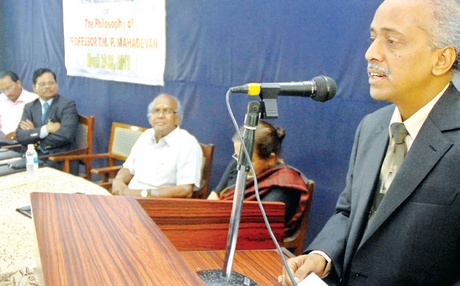
V Ramasubramanian, Judge, Madras High Court, speaking at the seminar on Tuesday | R Satish Babu / The New Indian Express

A three-day seminar on ‘The Philosophy of Prof T M P Mahadevan’ was organised by the Department of Philosophy, University of Madras, here on Tuesday. The seminar was inaugurated Justice V Ramasubramanian, Judge, Madras High Court.

Justice Ramasubramanian, in his address, recalled and praised the efforts and contributions of Mahadevan to the field of philosophy, religion and human values. He further said that there was a need for the University of Madras and other universities to focus on subjects like Philosophy and History. He further stated that nowadays philosophy, which teaches ethical and human values that form the basis of  a good society, is not being taken seriously.

Vice-Chancellor of the University of Madras, Professor T Thandavan, in his speech, praised the efforts and works 0f T M P Mahadevan and recalled how Mahadevan helped in advaitha, At the same time, the VC also assured that he would extend all possible help bring the subject of philosophy on a par with other subjects.

The other dignitaries who spoke at the seminar included Prof  S Paneerselvam, HOD, Dept of Philosophy, who  welcomed the gathering, Prof G Mishra, Dept of Philosophy, University of Madras, Prof Bhuvan Chandel, Member Secretary, CSC, New Delhi and  Prof Sebastian Velassery, Dept of Philosophy, Punjab University, Chandigarh.

source: http://www.newindianexpress.com / The New Indian Express / Home> Cities> Chennai / by Express News Service – Chennai / March 27th, 2013

Megamalai sanctuary is flourishing, points first census

Theni :

The first wildlife census carried out in Megamalai wildlife sanctuary since its formation last year has revealed interesting aspects about the thriving wildlife in the 40,000 hectares of forest lands. The highlight of the findings is the spotting of a tigress with a cub. Signs spread across the sanctuary also point to the presence of leopards. The findings confirm that grizzled squirrels are no longer the monopoly of Srivilliputhur sanctuary, as they could be seen in good numbers in Megamalai.

Census volunteers found the tigress in Upper Manalaru region in Chinnamanaur range. The discovery cheered the wildlife lovers who were campaigning for the creation of the sanctuary. “The thriving wildlife and tigress with a cub is a sign of a healthy forest. It kindles hope for the revival of the River Vaigai since a healthy forest can ensure water supply to the river which is the lifeline of five districts down south,” said C P Rajkumar of Vaigai Association for Nature and Mountain  Ranges (VANAM), the partnering NGO for the census.

A large number of herbivores like sambar deer, spotted deer, mouse deer and barking deer were found across the entire sanctuary during the census. Elephants, including a single tusker, are also among the finds. Sloth bears and wild dogs were also spotted directly by the volunteers.

Altogether, 43 transects were created in the sanctuary which is divided into six ranges like Varusanadu, Chinnamanur, Kandamanur, Megamalai, Cumbum and Kudalur. As many as 56 volunteers, along with forest officials, had combed the sanctuary to enumerate the wildlife between March 23 and 24. R Venkatasamy, wildlife warden said that they had used range finder, compass and GPS to find out the angle and spot of the sightings and to record the findings. “The census was very satisfactory and the data classification is in process and after that the exact number of animals can be ascertained,” he said.

World Wildlife Fund (WWF) assisted the wildlife officers and volunteers to make the census operations more scientific. WWF members were involved in studying the topography of the sanctuary and mapping the transects for the census. D Boominathan, landscape coordinator of Western Ghats – Nilgiris Programme said that they used various techniques as the census was being done for the first time. “To be on the safer side, we studied carnivores’ signs like pug marks, rake and scratch marks and carcasses for kill signs. Dung count was used to study elephant distribution and one day was dedicated for beat survey to study the distribution of species and abundance of them, especially with herbivores. The modern gadgets used in census were helpful to make accurate measurements of wildlife,” he said.

“Spotting a tiger with her cub is a very positive sign that the breeding is happening in the forest,” he added.

source: http://www.articles.timesofindia.indiatimes.com / Home> City> Madurai / TNN / by J. Arockiaraj / March 20th, 2013

From Black to brilliant hues

ayeshaCF28mar2013

COLOURS AND CONTRASTS: Ayesha Kapur at her store in Phoenix Market City. /  Photo: R. Shivaji Rao / The Hindu

In Chennai to launch her eponymous brand of accessories, Ayesha Kapur, a familiar face after her Bollywood debut film Black, talks about her passion for acting and love of all things Indian

She’s dressed in black. That’s predictable, given that Black (the movie) introduced her to the world. But talk to Ayesha Kapur and you realise she loves vibrant colours. It’s all the more apparent when you look at ‘Ayesha’ her eponymous accessory brand which is all about rainbow hues — electric blue rings, headgear with vibrant animal prints, virulent pink bracelets, and bright, trendy hats. “Black highlights many colours which explains why I am teaming these colourful chains, bangles and accessories with a black outfit,” says Ayesha who was in the city to launch her new showroom at Phoenix Market City, Velachery.

GREAT TEAM

Ayesha, the brand, was established in 2010 with the first store coming up in Ahmedabad followed by Chennai and Bengaluru. Today, there are 39 stores across 16 cities. “My mother and I came up with the idea. She owns a shop called Casablanca in Puducherry and even at the age of five I used to give my opinion about the merchandise. We soon realised we made a good team,” she says. Of course, they do have arguments or a “healthy exchange of views” as they prefer to call it. The mother-daughter duo believes that because of the two different perspectives they bring in, every customer who comes to the store finds something that appeals to them. One of the specialities of Ayesha is that most of their collections give traditional Indian designs a modern twist.

“Our pricing is great too. When you are young, you want to buy a lot of things the minute you enter a shop. You don’t want to spend all your money on one thing. I have been to stores where I have liked the earrings on display but did not want to spend all of thousand bucks only on a single pair. At Ayesha, you can pick up a lot of stuff without having to worry about burning a hole in your pocket,” says the 18-year-old.

Though she’s just finishing her high school at Deerfield Academy in Massachusetts, she finds the time to research trends and come up with themes and ideas. “There’s a team in India that works on production. My job is to understand what young people like,” she says pointing to a range of kitschy laptop sleeves that are a hit with the younger crowd. “It’s cool to carry one of these to school/college. I carry one with pink hearts and my friends love it.” After a hard day at school, designing for Ayesha is her idea of fun. Besides this, her hobbies include writing poems and short stories, and riding horses, something she misses when she is away from home.

After school, the young actor plans to take a year-long break and focus on her brand and her Bollywood career and this includes learning Hindi. “In my first movie, I worked with two of the best in the industry — Sanjay Leela Bhansali and Amitabh Bachchan — maybe that’s why I loved it so much. I was completely at ease and this helped bring out the best in me. I love acting; it’s a passion,” she says. In school, she takes part in theatre productions and has the habit of mumbling her lines to herself no matter where she is when she’s preparing for a role, something that freaks out her friends. And is there any particular role she would love to play? “I’d love it if they made an Indian version of Harry Potter. I’d like to play Hermione Granger. I would also enjoy a role involving horses.”

And do her friends in the U.S know of her exploits in India. “When I enrolled in school there, some of them had heard that a “Bollywood actor” had joined them. But most of my schoolmates don’t know this; neither do I go around telling people about it. I dated a guy for three months and only towards the end did he find out,” she laughs. Having been in the limelight at the age of nine and among the youngest film award winners, she feels she was lucky to have grown up in Auroville where she was protected from the public eye. “When I went back to Auroville after two weeks in Mumbai I was confused. That’s because in Mumbai I had to meet over a hundred journalists and suddenly Auroville seemed so quiet and serene. It’s not easy to adapt,” she says.

At a time when most youngsters are keen on studying and settling abroad, Ayesha is certain she wants to come back to India. “There is something about the chaos, the colours and the smell of India. My family is here, my career, my horses are here…I love India,” she signs off.

source: http://www.TheHindu.com / Home> Features> MetroPlus> Fashion / by Priyadarshini Paitandy / March 25th, 2013

Luring adventurers with water scooters

Water_scooterCF27mar2013
Picture for representation only
Chennai:
This summer you can literally cool off by surfing on the placid estuary on the ECR riding on the water scooters. The Tamil Nadu Tourism Development Corporation (TTDC) hopes to lure the adventurers youth to its two boathouses near here by additionally deploying the water scooters.
Though the TTDC could not induct these Yamaha make ‘wave runners’ as scheduled, it hopes to add four more to its fleet of water scooters by this month end.
“Steps have been initiated to procure the water scooters for the Muttukadu and Mudal­iyarkuppam boathouses, as an added attraction,” a senior Tamil Nadu Tourism Dev­elopment Corpora­tion official said.
Located about 36 km from here, the Muttukkadu boathouse, offers rowing and speedboat riding. It presently has 15 row boats, 27 speedboats and 9 pedal boats besides two high-speed aqua scooters. Mudaliarkuppam boat house, which is another water sport facility on the East Coast Road, has water scooting and kayaking facilities, in addition.
Meanwhile, the e-initiatives of the TTDC, which is operating a chain of 55 hotels with a fleet of 23 coaches, has yielded “satisfactory” results.
It is the first state-run corporation to have launched on-line booking for tours and hotels and has notched up  Rs 2.80 crore through on-line bookings during 2011-12 fiscal as against Rs 2.15 crore  during the previous year. Its turnover was Rs 101.60 crores in 2011-12 – 10 per cent increase
over the previous year.
source: http://www.DeccanChronicle.com / Home> News> Current Affairs /DC / by J.V. Siva Prasanna Kumar / March 25th, 2013

Modern gadgets to improve teaching by visually challenged

Madurai :

To keep abreast of latest technologies that enhance teaching, the visually challenged teachers under the banner of Blind Teachers Association (BTA), Madurai Branch, arranged a special technical session for their members. More than 300 visually challenged teachers are members of the branch that has jurisdiction from Karur to Kanyakumari districts and 90 of them from Madurai and nearby districts participated in the workshop held on Saturday.

Pune-based innovation company, Persion Technologies, announced during the event that it will come out with an interactive whiteboard for blind teachers by next month. Kiran Deshpande, director of the innovation and applications wing at the company, said the whiteboards will display whatever one keys into a laptop. The company will be also offering the device at comparatively cheaper prices, he informed.

V Elangovan, BTA chairman, observed that the teaching technology is changing fast and the education department too adopts lot of such technologies into teaching. “We feel that we should be adequately prepared for the technologies in the market. The response from our teachers was very enthusiastic,” he said.

At the worshop, teaching-aids developed by the Pune firm were demonstrated. An input-cum display device helps to feed all standard shapes, charts, scientific and mathematical symbols in any standard application. A Braille embosser for printing ordinary books into the Braille and a scanner device that reads out the printed sheets were also found useful for blind teachers.

“The general challenge we face during the class room is the control of students because we can’t see the activities of the students in a class. Using such modern equipment will help to increase the involvement of students,” said M Kalidoss, a history teacher in Kodukkampatti High School in Madurai.

Nicholas Francis, director of Helen Keller  Talking Library, who inaugurated the workshop, remarked that the visually challenged are the pioneers in utilising modern technologies among the differently abled community. “The visually challenged teachers should not be left behind with technological advancements and should strive hard to learn these scientific tools,” he said.

Elangovan said that the association is planning to hold similar workshops in Tirunelveli in the coming days for the benefit of blind teachers from Tirunelveli and Kanyakumari districts.

source: http://www.articles.timesofindia.indiatimes.com / Home> City> Madurai / TNN / March 25th, 2013