NBT goes all out to motivate regional language publications

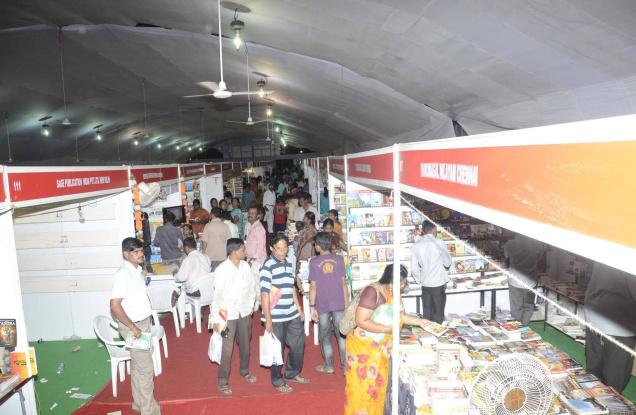
Book lovers browsing through the collection at the final day of the book fair in Tiruchi on Sunday. /  Photo: M. Srinath / The Hindu

The National Book Trust (NBT), India, under the Union Ministry of Human Resource Development, is going all out to motivate the regional language publications to participate in a big way at the World Book Fair scheduled at Pragathi Maidan in New Delhi in February next year. Until its last edition, the World Book Fair organised by NBT, was held once two years. Following overwhelming response from book lovers, it was decided to make it an annual affair.

The NBT has already launched an exclusive World Book Fair 2013 website to create awareness on the forthcoming expo, Mr.T.Mathan Raj, assistant editor (Tamil), NBT, told The Hindu on Sunday. The book fair in Tiruchi organised by NBT concluded on Monday.

50% discount

To rope in more regional language publishers, the NBT has been providing 50 per cent discount in stall rent. NBT has also come forward to provide one stall free of cost to each regional language publishing association .

In Tamil Nadu, this offer has been made to BAPASI, which has been organising Chennai Book Fair successfully every year.

The regional publishing houses, which will find the rent of stalls too high, can take advantage of this offer, to display their works. He said that every year one country will be accorded the status of ‘guest of honour country’ at the World Book Fair.

For the February 2013 fair the honour has been bestowed on France. The theme of the forthcoming fair is ‘tribal literature’ and the NBT has planned to register indigenous literature in a big way at the World Book Fair.

Platform for discussion

The World Book Fair will provide a good opportunity to regional publishers to meet renowned writers and publishing houses of world languages, with whom they can hold negotiations on vital issues of copyright, and forge links.

Referring to the Tiruchi Book Fair, which the NBT organised for the first time in association with district administration and Rotary Club of Tiruchi, he said that the fair was a big hit and the locals wanted to extend the expo by some more days.

Mohammed Hussain, president, Rotary Club of Tiruchi, said that the fair had gladdened the book lovers of Tiruchi and neighbouring districts and publishing houses that had put up stalls.

source: http://www.TheHindu.com / Home> News> Tiruchirapalli / by Syed Muthahar Saqaf / October 16th, 2012
Vijaydasami classes in and around T. Nagar

Vijaya Sethuram will conduct classes on general and therapeutic yoga from October 24 at Nungambakkam. For details, contact 94444 50254.

***

Classes on Carnatic vocal, slokas, and fundamental Tamil and Hindi for children will be conducted from Vijayadasami at Valasarawakkam. Devotional songs are taught for women. For details, contact 6515 4763/ 72002 60017.

***

Kala Netrii’s Learning Academy will conduct classes on Carnatic vocal, sloka recitation, western dance, Bharatanatyam, bhajans, keyboard, guitar, drums, karate, yoga, drawing and Painting, fabric and glass painting, handwriting, abacus, embroidery, storytelling, puppetry shows, vegetable and fruit carving, and others. Classes will be conducted at Balalok Matriculation Higher Secondary School, Virugambakkam. For details, contact 98402 23811 / 93805 45423

***

Smart Skills’s Vocational Training Institute offers a self-employment courses in tailoring, machine embroidery, aari and zardosi exclusively for women. Admissions open from October 15. Classes will be held from Monday to Sunday with flexible timings between  9 a.m. and 7 p.m. First 10 registration will get Rs.1000 off on course fee.

The institute is located at No. 257, Alagirisamy Salai, K.K. Nagar. For details, call 7299904686.

source: http://www.TheHindu.com / Home> News> Cities> Chennai / October 15th, 2012

NABARD adds more power to solar mission

Subsidy for the scheme increased by 10 per cent

National Bank for Agriculture and Rural Development (NABARD) has enhanced its support to a Central Government scheme to promote solar power.

To promote commercial marketing of solar accessories, Ministry of New and Renewable Energy (MNRE), had launched the Jawaharlal Nehru National Solar Mission with subsidy for solar lighting and small capacity photovoltaic systems, which would be routed through NABARD.

R. Shankar Narayan, National Bank for Agriculture and Rural Development, Assistant General Manager, told The Hindu here on Wednesday that the subsidy for the component had been increased to 40 per cent from the hitherto 30 per cent.

Modified guidelines

The NABARD had formulated the modified guidelines in consultation with MNRE and it would be applicable for all applications financed by banks after March 15. As per the guidelines, the units could be located both in urban and rural areas and the models could be home lighting systems or inverter-based systems capable of handling general AC loads. Beneficiaries were eligible for capital subsidy of 40 per cent.

Loan to manufacturers

The loan would be released directly to manufacturers, who have been approved by the Union Ministry. They have to provide Compact Fluorescent lamps (CFLs) of 9 W/11 W and LED (Light Emitting Diode) for home lighting systems as per specifications and modules prescribed by MNRE.

Of the total project cost, he said that 50 per cent would be covered by the bank loan with enhanced subsidy of 40 per cent and 10 per cent is the beneficiaries’ contribution as per Reserve Bank of India (RBI) norms.

The banks have also been instructed not to charge interest for the subsidy component.

The loans extended by the banks will have a repayment period not exceeding 5 years. The loan repayment period would have a minimum lock in period of 3 years.

He informed that 100 per cent refinance would be provided by NABARD to the implementing banks for the bank loan portion.

All commercial banks and Regional Rural Banks were eligible to cover the financing done on or after 15 March for projects approved by MNRE.

Mr. Shankar Narayan said that effective implementation of the scheme through banks was likely to give a further boost for solar systems in the country. Tamil Nadu Energy Development Agency (TEDA) office located in Madurai could be contacted for further details.

source: http://www.TheHindu.com / Home> News> Cities / by R. Sairam / Madurai, April 12th, 2012

Songs to sing along

At the audio launch of Lollu Dada Parak Parak

What it is about…

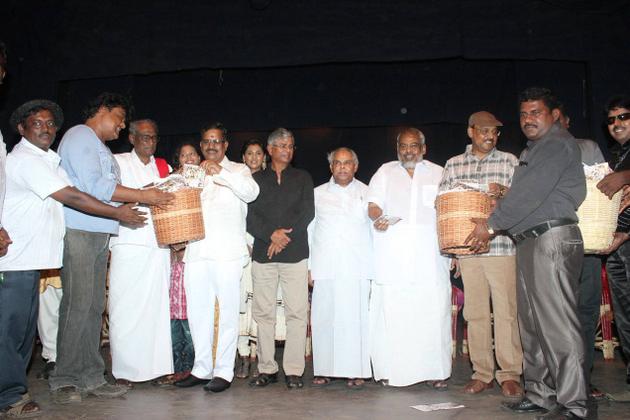
The German Hall, T. Nagar, venue of the audio launch of Rajkennady Films’Lollu Dada Parak Parak, resembled a shop. Producer-actor Mansoor Ali Khan had created the ambience of a music store in which the audio CDs of the film were on display. Not just the ambience, even his way of marketing the CDs was unique — the price of a CD was only Rs. 15. “Rather than pricing them high and not selling a single CD, I priced them very low at Rs. 15 each, to ensure they found a place in everyone’s home,” said Mansur. CPI leader Tha. Pandian launched the cassette, and the first copy was received by producer-director S.A. Chandrasekaran. The film features Mansoor Ali Khan in the lead, with Shilpa, Parveen, Uma Shree, V.A. Murthy, Kumari Muthu, Vaiyapuri, Pandu, Shakeela, Delhi Ganesh, Kullamani and Haarthi playing important roles. The camerawork is by S.R. Vettri, editing by L. Kesavan, art by Rajan and direction by J. Jaikumar. Mansoor Ali Khan has directed the music and penned the lyrics, besides producing the film.

Music highlights

There are six songs in the album. The title song ‘Lollu Dada Parak Parak’ is sung by Mahathi and Mahina. The peppy ‘Aambam Pusa Baam’, sung by Roopa, Julaiha Ali Khan, Dilruba Ali Khan and Pavan, is for the front-benchers. Malathi’s melodious voice makes ‘Thiruvaruru Theru’ a must-listen. There’s also a number by Sirkazhi Sivachidambaram. J.S.K. Sona sings ‘Panam Panam’, which is subsequently repeated by the director himself. ‘Punagai Poove’, sung by Sriram and Krithika, wraps up the album.

What they say…

Producer-music director-lyricist-hero Mansoor Ali Khan: I’ve acted in 150 films in all the South Indian languages. I have produced six films , and this is my seventh. My first Tamil release was Velai Kedachirukku, but it wasCaptain Prabhakaran that made me a popular name. As far as writing lyrics and scoring music are concerned, I have done it for two of my earlier films and this is my third. Lollu Dada is an out-and-out entertainer.

Director J. Jaikumar: I had worked as an assistant to Velu Prabhakaran. Mansoor Ali Khan and I became friends when we both happened to work together on some films. I am grateful to him for the directorial break he has given me with his home production Lollu Dada. It’s a comedy with around 42 comedians acting in it. The story is about a man (Mansoor) who is unable to get back the money he has lent.

source:  http://www.TheHindu.com / Home> Arts>  Cinema / by S.R. Ashok Kumar / October 13th, 2012

TI Cycles enters into licensing tie-up with Nick

Mumbai:

Murugappa Group-owned TI Cycles has entered into a licensing deal with kids broadcaster Nickelodeon India to launch new range of  bicycles and tri-cycles for the Indian market.

The products are designed around two of Nickelodeon’s popular characters, Ninja Hattori and Dora the Explorer.

Kids can choose between eight different variants with specialized features priced between Rs 6900 to Rs 8000. The collection will be available across 200 plus BSA Hercules exclusive outlets in the country.

Tricycles tor the 2-4 year old fans will also hit markets soon.

Viacom18 Media Sr. Vice President – Consumer Products & Communications Sandeep Dahiya said, ” Cycling has always been one of kids’ favorite pastimes. We are happy to partner with TI Cycles to create an exciting range of bikes and trikes, which now makes it possible for kids, to ride with their favorite Nickelodeon characters – Dora the Explorer and Ninja Hattori.”

TI Cycles has successfully established a chain of exclusive retail outlets for their brands BSA and Hercules across the country. BSA Champ, from TI cycles of India caters exclusively to kids.

TI Cycles GM marketing and retail Rajesh Mani said, “We are very happy to join hands with Nickelodeon which is an extremely popular kid’s channel. Both the characters, Ninja Hattori and Dora the Explorer enjoy tremendous fan following amongst the kids. So with the exciting toons and our forte in the bicycle segment, we are sure the cycles will sell like hot cakes.”

source: http://www.indiantelevision.com / Home / October 12th, 2012

Bharathiar University launches herbal ointment

G. James Pitchai, Vice-Chancellor of Bharathiar University (left) releasing the herbal product of the Department of Botany, 'RuBHeal', at the university in Coimbatore on Thursday. P.V.L. Rao, Director, DRDO-BU-CLS, is in the picture.

G. James Pitchai, Vice-Chancellor of Bharathiar University (left) releasing the herbal product of the Department of Botany, ‘RuBHeal’, at the university in Coimbatore on Thursday. P.V.L. Rao, Director, DRDO-BU-CLS, is in the picture. / The Hindu

The Department of Botany of Bharathiar University launched a herbal ointment ‘RuBHeal’ here on Thursday. The research product is said to have resulted from the use of medicinal wealth found in the Western Ghats. A patent has been filed for it.

Launching the ointment at a national conference on “Phytomedicine” at the university, its Vice-Chancellor G. James Pitchai urged scientists not to restrict research to academics, but extend it to the welfare of society.

“Universities are fertile fields of research. Research should be technologically practical, economically feasible and environmentally safe,” he said.

P.V. Rao, Director of the Defence Research and Development Centre-Bharathiar University-CLS, said economic value of traditional knowledge was often identified as a reason of conserving and documenting cultural practices.

“To rationalise the use of natural resources in the modern healthcare system, it is necessary to explore these systems with scientific approaches,” he said.

M.J. Nanjan, director, TIFAC, JSS College of Pharmacy, Udhagamandalam, said there were many challenges in quality control and standardisation of herbal drugs / traditional medicine. Quality criteria for herbal drugs were based on a clear scientific definition of raw materials.

source: http://www.TheHindu.com / Home> National> TamilNadu / by Staff Reporter / Coimbatore, October 06th, 2012

Nobel laureate studies shrimp to map immune system

Chennai:

French Nobel laureate  Jules A Hoffmann is pushing for a collaboration with Annamalai University to study viral infections in shrimp to understand the human immune system.

Professor Hoffmann of Strasbourg University in France, whose decades-long work on the fruit fly revolutionised the study of the human immune system, has evinced keen interest in studying viral infections in shrimp and identified it as an important research area for joint Indo-France collaboration.

“There are a lot of parallels between the study being undertaken by Annamalai University and the research we did on fruit flies. Since we have experience in this area, we can jointly work with the University to identify constituents of other organisms and gain insights into how the human immune system works,” said Hoffman.

Hoffman, along with Professor Bruce A Beutler, was awarded the Nobel prize in physiology or medicine in 2011 for the discovery of the key principles for the activation of the immune system. The duo discovered receptor proteins that can recognise microorganisms and activate innate immunity which can destroy invading micro organisms. This discovery has made possible the development of new methods for preventing and treating diseases.

The Nobel laureate, who was in the city to participate in the 25 years of celebration of Indo-French Centre for Promotion of Advanced Research (IFCPAR), on Thursday delivered a lecture on ‘Antimicrobial Defence of Drosophila: A Paradigm for Innate Immunity From Flies to Humans’ at Anna University.

Hoffmann also stressed on the need to study infectious diseases and expressed the hope that there would be cures for all kinds of diseases, including HIV and cancer, in the next 10 years.

“When I began my research we lacked enough resources and infrastructure which frequently impeded our study. With advancement in technology over the last decade, we should be able to find cures for all kinds of infectious diseases in the next 10 years or so,” he said.

Praising the progress India had made in the scientific sector, Prof Hoffman said future collaborations with the country could not be ruled out.

source: http://www.timesofindia.indiatimes.com / Home> City> Chennai / TNN / October 12th, 2012

Christian Dior’s magic element: Madurai’s jasmine flower

Chennai:

The flower market of Tamil Nadu’s Madurai is a crowded, busy place. It is the place the perfumer creator of French fashion house  Christian Dior, Francois Demachy, visits every year to imbibe the fragrances that help him create the floral perfumes that Dior is renowned for.

(Dior uses extracts of jasmine sambac and tuberose sourced from Tamil Nadu, along with other raw materials, for J’adore, one of the top selling fragrances in the world.)

Dior uses extracts of jasmine sambac and tuberose sourced from Tamil Nadu, along with other raw materials, for J’adore, one of the top selling fragrances in the world. “Jasmine sambac is used in all J’adore fragrances due to its olfactory qualities,” says Demachy, who was in Madurai recently. “For me, it is a very strong and unique ingredient, and I link its uniqueness to Indian soils.”

That is why he has been making a yearly trip to Tamil Ndu for the last eight years. For him, it is essential to see the flower grow. “It is important to feel the flower and see it in the ground, see the people who grow it and keep it in your mind like a bank,” says Demachy, who is usually off to the fields by the crack of dawn.

When Demachy joined Dior after 28 years with Chanel, J’adore was already their best selling perfume. “But I used jasmine sambac as a key ingredient for different versions, like J’adore L’Absolu, J’adore L’Or and J’adore Eau de Toilette,” says the perfumer, who is from Grasse, which is also known for its jasmine. Dior has been sourcing jasmine sambac for J’adore from the beginning. “It is one of the main ingredients along with other key raw materials like rose damascena and ylang ylang,” says Demachy.

The fragrance of many flowers that bloom in the soil of Tamil Nadu also permeate the House of Dior. “We use jasmine sambac and jasmine grandiflorum from Tamil Nadu and tuberose for J’adore Eau De Parfum, Poison, New Look from La Collection Privee CD and Escale a Pondichery,” says Demachy.

Jasmine CE Pvt Ltd has been supplying Dior with jasmine grandiflorum, sambac and tuberose extracts since 2007. “We are completely aware of their quality specifications, and products are supplied accordingly. We also hold stocks for them and supplies are made just in time for their production,” says Raja Palaniswamy, director of Jasmine CE Pvt Ltd. His company owns small fields close to Coimbatore, where the flowers are grown organically.

source: http://www.articles.timesofindia.indiatimes.com / Home> City> Chennai / TNN, October 07th, 2012

Magic Dots – Kolam Workshop – Oct. 13, 2012

Learn to draw beautiful kolams this Navaratri. Creative Ladder in T. Nagar is organising a workshop in kolam on Oct. 13, 2012 from 2.30 to 5 p.m.
The workshop will be conducted conducted by Gayathri Shankarnarayan who is also known as Kolam Gayathri and will be held at Creative Ladder, South Boag Road, T. Nagar

Gayathri has learnt kolam from Guinness world record holder MR. Ramdev and Kolam Naayakan Mr.Hanumantha Rao.
Special technique using fingers 1 to 5 fingers to make beautiful designs will be taught.

Traditional patterns, Kalyanakolam or padikolam, Big dots kolam, Maharashtra Rangoli, Chikku kolam, Maa Kolam will be part of the workshop. Open to kids and moms.

Workshop Rs 1500/-
Contact 9380515031 for registration.

source: http://www.youcee.in / Home> What’s On / by The Editor / October 2012

Grave matters at Presidency

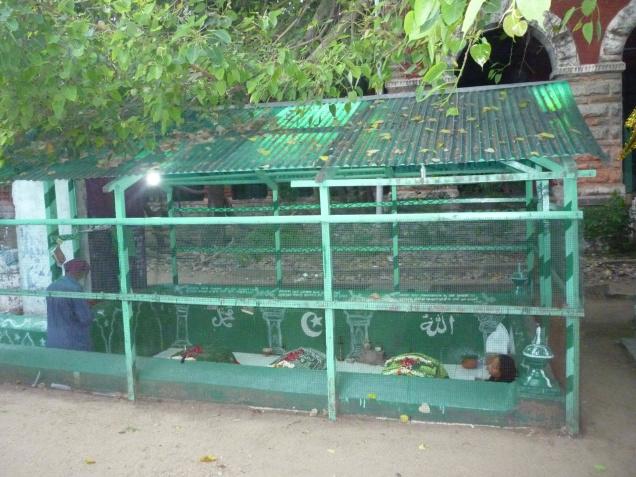
 The graves belonged to members of the erstwhile ruling family of Arcot.  Photo: Special Arrangement / The Hindu

The graves belonged to members of the erstwhile ruling family of Arcot

I was invited to visit Presidency College last week. It is a campus I had always intended exploring, it being the first major work of Robert Fellowes Chisholm in Madras city. Wandering about the place was a fascinating experience but what intrigued me was the presence of three Mohammedan graves on the southern side, almost in the shadow of the main building.

It being evening, there was not a soul to explain the significance of the tombs. Scrawled in chalk on the wall of the enclosure were the names of the three people buried within – Hazrath Syed Zahoor Ali Shah Qaderi, Hazrath Syed Zainab Beebi Saheba Qaderi and Hazrath Syed Shahbuddin Ali Shah Qaderi. All three are in good condition, painted repeatedly and with a roof of recent origins, protecting them from the elements.

Just as I was leaving, there turned up a Muslim gentleman who began making preparations for prayer. He informed me that the three graves belonged to members of the erstwhile ruling family of Arcot and that they had been buried here around 200 years ago. When construction of the Presidency College began, care was taken to leave the graves undisturbed. The trio enjoy saintly status and an Urs festival is conducted each year in their memory during the Islamic month of Rajab.

Who they are is a mystery. But what I did glean from S. Anwar, photographer and heritage enthusiast who researches the Islamic history of this region, was that this was once the garden of Sultan-un-nissa Begum, daughter of Nawab Mohammad Ali Walajah, who in the 1760s, built the magnificent Chepauk Palace.

Sultan-un-nissa was a strong-willed person. Her father’s death in 1795 saw her brother Umdat-ul-Umrah being installed as Nawab. He managed to resist the takeover of his kingdom by the British, and in this he was probably aided by his sister. On his death in 1801, the English forcibly occupied Chepauk and tried to get Umdat-ul-Umrah’s son to hand over the kingdom, citing the infamous Arcot debts as the reason. When Umdat-ul-Umrah proved a chip off the old block, his cousin, the willing Azeem-ud-Dowlah was installed on the throne. He signed away the kingdom, retaining Chepauk Palace and its gardens alone.

He was strongly castigated for this by Sultan-un-nissa and her son Rais-ul-Omrah Bahadur (after whom a street, now sadly truncated to ROB Street still survives off Mount Road). To which he replied that he may have lost the kingdom but he had at least saved Chepauk Palace without which they would have had no roof over their heads. The response to this was sharp – would it not have been better to lose a home to save a kingdom? Sultan-un-nissa finally settled in Basrah.

Given her resistance, her property must have been among the first to be confiscated. A part was allotted for the Presidency College in the 1860s, and the rest is history.

source: http://www.TheHindu.com / Home> News> Cities> Chennai / October 09th, 2012 / by Sriram V / October 09th, 2012