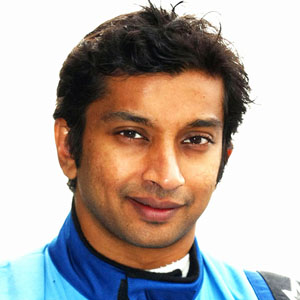
Narain Karthikeyan qualifies 23rd for Monaco Grand Prix

Monaco (Monte Carlo):

Indian F1 driver Narain Karthikeyan qualified 23rd for the Monaco GP, round six of the 2012 FIA Formula 1 Championship.
The blue-riband event of the series sees drivers take to the narrow streets of the Principality through the weekend. It was looking good for the HRT F1 driver as the opening practice session on Thursday saw him complete 26 laps, finishing ahead of the two Marussia drivers and his teammate Pedro De La Rosa.

“There were a few off-track excursions, but this is normal in Monaco when you are trying to find the limit”, he revealed.

The second Thursday practice was rained out, resulting in very little running.
This meant the one-hour final practice session was a busy effort, with the Indian completing 19 laps in final preparation for qualifying.

“It was looking good for qualifying, we had got a fair amount of running and since the circuit isn’t aero-dependent, we were closer to the cars ahead of us”, he said.

The start of the qualifying session was interrupted due to an incident which brought out the red flag.

But once the track cleared, it was back to business and after 8 laps Karthikeyan was able to post a 1:19.310, good enough for 23rd on the grid for tomorrow’s race.

However, the Indian revealed later that all didn’t go to plan.

“We both had three runs, and I was ahead of him after the first two runs on new tires when we both put on new set of super soft tyres for each outing.”

“However, when I expected the third set of new tires my engineer strangely called it off!  This meant I wasn’t able to improve a lot whereas Pedro went almost a second quicker.

“I wouldn’t have done that lap though, but I would have been closer.So I need to discuss this with the team.”

However, he remains optimistic for the race tomorrow, considering the weather forecast which predicts a chance of rain.

“It was supposed to rain during qualifying today but it didn’t. So hope we get some showers tomorrow as it will give us a chance to do something more than usual”, he concluded.

source: http://www.indiansportsnews.com / Home> Top Stories / Saturday, May 26th, 2012

Urbanised Mint Street loses heritage sheen

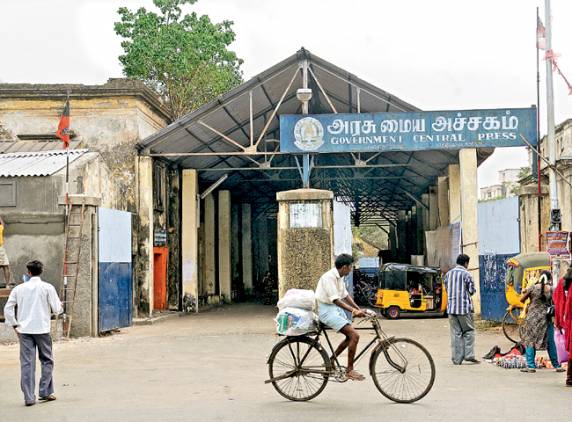
The Government Central Press, where the mint had existed, is the oldest surviving heritage building on Mint Street. — DC

It is known as the hub for wholesales, retailers, importers and exporters of all kinds of goodies, naturally attracting people for the variety of commodities and affordable prices.

This highly congested Mint Street, which got its name in 1840s when the British East India Company established its coin making facility, nurtures multi-lingual and multi-ethnic groups now.

The din, the crisscrossing rickshaws and vehicles, the crush of people are the quintessential elements of this oldest major street in Chennai.

The street runs from north to south through George Town. Though it sports an ultra modern look, the rapid urbanisation is making the street gradually lose its heritage value.

Some of the old structures are being pulled down and are getting replaced with modern buildings. The street also accommodates residential apartments.

The Company’s mint, which later became the Government Press and is still functioning; is an endangered heritage building. Initially many Telugus dominated this stretch and gradually it became the home for Gujaratis.

People from the Saurashtra region, associated with the cloth trade moved in as early as in 1740s. As pawn brokers and money lenders, Marwaris too joined the list of settlers here.

It was here that the historic Tondaimandalam Tuluva Vellalar (TTV) School, (1854), which is the home to one of the earliest music sabhas – the Tondaimandalam Sabha and the Hindu Theological School (1889) were established.

It also saw the first performance of Harikatha by a woman when in 1909, C. Saraswathi Bai, gave the first public performance of Harikatha, much against the stiff opposition to her taking the stage.

The old Post Office, a combination of classical Greek and Indo Saracenic architecture, Ekambareshwarr temple, Sree Chandraprabhu Maharaj Juna Jain temple, Sri Chandra Prabhu Jain Naya Mandir, Sree Gujarati Swetamber Murti Pujak Jain Sangh, Kandhaswamy temple, Renuka Parameswari temple besides a mosque and a church are found here.

source: http://www.DeccanChronicle.com / Home> Channels> Cities> Chennai / by J.V. Siva Prasanna Kumar / DC, Chennai / May 27th, 2012

Lighting up the lives of those in need

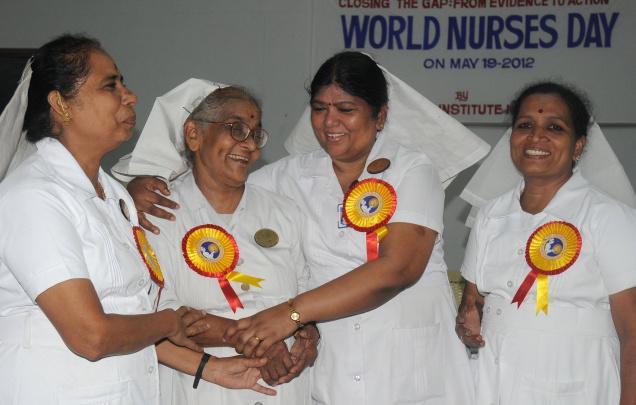
Dedicated to serving On International Nurse’s Day, several nurses were presented with lifetime achievement awards — Photo: R. Ragu / The Hindu

C.N. Janaki, in her nurse’s uniform and starched white cap that keeps wispy white hair neatly in place, has a quick smile that forms deep dimples in her cheeks. The matron is 70 years old and has 49 years of experience as a nurse at the Cancer Institute in Adyar.

NO REGRETS

Ms. Janaki lost her parents when she was 11, and her brother sent her to Avvai Home, a residential facility for orphans in Adyar. In 1964, after training as a nurse, she joined the Cancer Institute and has never looked back.

She barely recognises cancer as a dreaded disease. Unlike in the older days, thing are different now, she says. Ms. Janaki has remained single, devoted to her work. And what has she learnt from her experience? “That I have come this far is an achievement. I have done well in life. As for work, in the early years it was difficult. Now so many new techniques have come to make our job easy,” she said.

ACCOLADES RECEIVED


Ms. Janaki was one of the nurses in the State, chosen by the Tamil Nadu Dr. MGR Medical University, for this year’s lifetime achievement award, presented on International Nurse’s Day, which fell on May 12.

V. Renuka Devi, 54, also a recipient of the award graduated as a nurse from the Madras Medical College and has around 34 years of experience. Her daughter is in college and her husband is a lawyer practising in the Madras High Court. She enjoys her work at the hospital. “I have seen a lot of children come for treatment. What hurts me most is when I hear that someone has died despite treatment,” she says. It is difficult for her to hear of a child’s death. “When patients are treated and then they die, I am very upset,” she said.

Jeeva’s persona would put any patient at ease. An able leader, she organises International Nurse’s Day programmes at the institute.

‘MAKE A COMMITMENT’

According to Dr. V. Shanta, chairman, Cancer Institute, it was Ms. Jeeva who introduced the concept at the institute two years ago. On Saturday, she paid tributes to the nurses and urged them to rededicate themselves and to “make a commitment to do the job well”.

Jeeva travelled and worked abroad before she chose to come to the Cancer Institute. Her rich experience has helped her develop professionally, she said.

Perhaps the best motivation comes from forgotten achievements. T.G. Sagar, director of the Institute, recalled that it was a nurse in the early twentieth century, Mary Joseph, who first identified a malignant nodule, which later came to be known the Sister Mary Joseph nodule after her.

source: http://www.TheHindu.com / Home> News> Cities> Chennai / by R. Sujatha / Chennai, May 20th, 2012

IICPT urges industry to look at high pressure processing for food safety

Indian Institute of Crop Processing Technology (IICPT), Thanjavur, is now calling for the need to look at high pressure processing for food safety.

Food safety is the responsibility of the growers, manufacturers and processors and food handlers. The supply to consumers is in different forms such as fresh, preserved and processed products of plant, animal and marine origin.

During the past two decades, numerous researches on food preservation using emerging technologies have been developed. Since these processing techniques have little or no new thermal effects on food, they are commonly referred to as non-thermal preservation technologies. Among these emerging technologies, the most promising ones for food application are high-pressure processing and use of pulsed electric fields. Although the fact that high pressure kills microorganisms and preserved food in the early 19th century, its commercial benefit became available to the food processing industry in a decade ago, stated officials at IICPT.

The concept of high pressure treatment of foods involves subjecting food materials to pressures as high as 9,000 times the atmospheric pressure. It is uniformly applied throughout a food material independent of its mass and time, they added.

Typically, the pressurisation time for foods is independent of the quality of food placed in the pressure vessel, The presence of air in the food increases the pressurisation time, since air is more compressible than water.

According to IICPT, in contrast to the thermal treatment, high pressure processing does not break the ‘covalent bonds’ in food, and thus helps to preserve the flavour. The effect of high pressure on enzymes is largely due to the nature of the proteins.

In fact, the first commercial production of high pressure processed jam was carried out in Japan in 1992, which was well received by consumers. Since then a diverse range of foods, including fruit juices, vegetables, milk, yoghurt, cheese, fish, pork, beef, ice cream, Japanese unrefined rice wine and rice cakes containing herbs are processed using this technology, stated IICPT.

The non-availability of suitable equipment burdened early application of high pressure. There has also been considerable progress made in equipment design which has ensured global recognition of the potential for such technology in food processing. Moreover, high pressure technology can supplement conventional thermal processing for reducing microbial load or substitute the use of chemical preservatives. The advantage of high pressure technology includes that it enables, food processing at ambient temperature or even lower temperature. Causes of microbial death leads to improvements in overall quality of foods and it can be used to create ingredients with novel functional properties.

The food technologists globally recommend high pressure processing to prevent hazardous micro-organisms like E Coli, Salmonella and Vibrio. Presently the food industry is interested in eliminating the harmful organisms.

IICT officials’ said that High pressure processing was not likely to replace traditional methods. However, they observed that high capital expenditure could limit the application initially but this could be offset by lowering the cost expenses of lower operating costs if efficient energy systems were used.

source: http://www.fnbnews.com / Home> Top News / by Nandita Vijay, Bengaluru / Saturday, May 19th, 2012

The ice cream man

 BUILDING DREAMS: R.G. Chandramogan. Photo: R. Ragu

From push carts to parlours, R.G. Chandramogan has built his ice cream empire bar by bar. Priyadarshini Paitandy meets the man behind Arun and Ibaco

Juggling an ice cream in one hand and a notebook and pen in another isn’t the easiest thing to do, especially when you have to take down notes between mouthfuls of waffle cone. This is what I do when I meet R.G. Chandramogan at his office and start a conversation over an Arun ice cream as he traces the journey and growth of his company Hatsun Agro Products.

When Chandramogan was a school boy he would unfailingly put aside money for ice cream. Thirty-seven paise would be saved for an ice lolly and even though flavours weren’t many except vanilla, pineapple and strawberry, that was enough to bring a blissful smile to his lips.

Little did he know then that two decades down the line he would have an ice cream empire of his own. Surely, this is how Charlie must have felt when he inherited the chocolate factory. But in Chandramogan’s case he built it right from scratch, brick by brick or rather bar by bar.

“With a limited capital of Rs.13,000 I had to start something. So I started Arun ice cream in 1970. I was 21 then,” says Chandramogan. The factory was just an unassuming little place in Tondiarpet where three or four people worked and manually produced about 20 litres of ice cream per day. Ten paise candy was their first variety of ice cream and it was sold through push carts. Today of course it’s a different story. The automatic equipment produces 50,000 litres to 75,000 litres of ice cream per day.

Like most success stories that are laced with phases of initial struggle, his story too saw him plough through early hardships in the business. “We struggled a lot in the first 10 years. The top three players then were Dasaprakash, Joy and Kwality. They were financially ahead and had a bigger market. I lacked knowledge about marketing. I am not a graduate. So while I was struggling I did a course in marketing management, export management and personal management from Sabari College. In the first year our turnover was Rs.1,15,000. From 1981 we started growing and in 1991 Arun recorded a turnover of Rs. 3 crore,” he says.

Chandramogan began catering to ships, messes, colleges. Slowly he branched out to Pondicherry, Madurai, Sivakasi and Kumbakonam where his ice creams were a novelty and the other brands hadn’t yet tapped these markets.

While frozen dessert lovers were lapping up whatever came from the stables of Arun, Chandramogan busied himself with another venture — the dairy business. In 1995 he started Arokya milk. “We were procuring milk for our ice creams and so this idea came about. Today Arokya sees an annual turnover of Rs. 1,300 crores. We also manufacture butter, milk powder, ghee and curd. We are associated with 3,50,000 farmers and buy milk from 8,000 villages. We operate from nine different factories and our people travel 4,20,000 km to collect and distribute milk,” he adds. Hatsun dairy products are available across the country.

Hatsun has its dairy plants in Kanchipuram, Palacode, Salem, Madurai, Belgaum, Honnali. As for its ice cream, apart from Tamil Nadu they also have a plant in Seychelles. How does Arun sell in Seychelles, a market for other popular international ice cream brands? “We have a 70 per cent share of ice cream market in Seychelles. In Brunei we have a distributor who buys and sells our ice creams and there we are among the top four brands,” says the seasoned entrepreneur.

In 2012, Hatsun started yet another ice cream brand, Ibaco. This is the posh cousin of Arun ice cream and is based on the ice cream-by-scoop model. “Arun is a factory finished product and comes in cones, cups and sticks. As for Ibaco, it’s the scoop variety. You walk into an Ibaco parlour, choose the flavour and get it dressed with toppings. As of now Ibaco is available in Chennai, Bengaluru and Delhi. By next year I’ll be taking it to Mumbai, Pune, Hyderabad and Kolkata,” says Chandramogan.

But the launch of a new brand in no way means that Arun has been ignored. This season Arun’s got quite a few new flavours to pep up its range. There’s Berry Storm, Vanilla with Chocolate Fudge, Lemon Bar, Cream and Cookies among others. With myriad options available his favourite still remains the classic Arun chocolate cone. “Earlier I used to eat an ice cream every day. Now I try out ice creams when I travel to get a taste of competing brands,” he smiles.

After a day of cream, dairy and deals, how does he unwind? “I go to the gym, read books. Earlier I used to play badminton. I was a fan of the game and would go to watch Prakash Padukone play at tournaments. I even like watching tennis especially when Roger Federer plays. I am going to London to watch him play in November.” Who knows maybe the Swiss player could be roped in as the brand ambassador for Hatsun? Now that’s a thought!

***

Hatsun produces 18 lakh to 20 lakh litres of milk per day. Twelve lakh litres are used up for milk and milk products. Sixty thousand litres are used for ice cream. The remaining is used for ghee and skimmed milk.

source: http://www.thehindu.com / Life & Style> MetroPlus / by PriyaDarshini Paitandy / Chennai, May 17th, 2012

Young soldier confident of bagging medal at London Olympic Games

Udhagamandalam:

Ooty’s Olympic dreams may very well be fulfilled by a young soldier from the Madras Regimental Centre (MRC) at Wellington in the Nilgiris who has qualified for the London Olympic Games.

Twenty-two-year-old Sepoy K T Irfan is the third Indian walker to qualify for the Games when he finished 19th in the World Race Walking Cup at Saransk in Russia on May 12, covering 20km in 1:22:09 hours. The ‘A’ standard in the 20km walk event for the Olympics is 1:22:30 hours.

Since his enrolment in the army, Irfan has been working hard and his perseverance paid off in 2011 when he won the national championship in the 20km walk held in Kolkata and Patiala. He participated in various state and national events, setting records on two occasions in Cochin and Patiala.

“The soldier has made his regiment, the Indian Army and the entire nation proud. Through hard work, unparalleled focus and devotion, he has qualified for the Olympics,” said Brigadier S S Jadhav, VSM, commandant of MRC.

Irfan hails from a modest family in Kizhuparamba village in Malapuram district in Kerala. He chose to join the Madras regiment as a sepoy in 2010 and completed his training period of one year in 2011. At the regiment centre he had been given special one-on-one training.

Irfan has won more than a dozen awards including TN State Athletics Championship in 2010, Kerala State Athletics Meet award in 2010, Inter State Athletic Championship held in Bangalore in June 2011 and Open National Athletics Championship held in Kolkata and Patiala in 2011.

He returned from Russia just a couple of days ago and is training at the National Institute of Sports/ Olympic squad in Patiala. “My ambition is to excel in sports at the international level. I have got this far only because of MRC and I am grateful to the regiment. I was given special care and individual training which has enabled me to qualify for the London Olympic Games,” he said.

“Irfan’s achievement will motivate youngsters to join the army. He is the third soldier from MRC to enter the Olympic Games,” said Jadhav.

Famous footballer M Thangaraj, ‘dribbler par excellence,’ a native of Ooty serving at the MRC, played for the Madras Province. In 1948 he was selected for the Indian Olympic Team. He could not make the trip to England though. In 1953, as a member of the touring Indian team, he played in the USSR and Romania.

In 1981, Subedhar Major, I Ibrahim, attached to 9 Madras unit of the MRC, won the bronze medal in the 100 and 400 meters race in the Olympic Games. Ibrahim retired from service a few years ago.

Olympic dreams

Famous footballer M Thangaraj, ‘dribbler par excellence,’ a native of Ooty serving at the MRC, played for the Madras Province. In 1948 he was selected for the Indian Olympic Team.

In 1981, Subedhar Major, I Ibrahim, attached to 9 Madras unit of the MRC, won the bronze medal in the 100 and 400 meters race in the Olympic Games.

Quote

My ambition is to excel in sports at the international level. I have got this far only because of MRC and I am grateful to the regiment. I was given special care and individual training which has enabled me to qualify for the London Olympic Games — Sepoy K T Irfan, athlete

source: http://www.timesofindia.indiatimes.com / Home> City> Coimbatore / by Shanthi Thiagarajan / TNN / May 17th, 2012

Lakshmi Vilas Bank signs MoU with TCS for centralization of process

Mumbai, May 11, 2012:

 Lakshmi Vilas Bank, the leading, fast-growing Private Sector Bank today signed a MoU with TCS for centralization of back office operations and document management system.

This arrangement would facilitate centralization of the key processes like account opening, KYC compliance, loans and advances, Trade Finance, ATM card management and many more. This agreement would enable all the branches of the bank to collect applications or request forms from customers and forward them to Central Processing Cell (CPC) for processing. CPC (Central Processing Cell) will be responsible for all centralized business processes and Datacenter (DC) will provide and maintain IT related services like servers, data storage, network etc. The documents comprising of application forms and supporting documents collected at branches will be forwarded to the scan station for scanning and indexing. Primarily the Enterprise Content Management (ECM) will be deployed for data and document management.

The entire process would be implemented in two phases. Phase I would include the processes like Savings Account Opening, Current Account Opening, CC-OD/ Loan Account Opening (Post Sanction), Centralization of account opening under Financial Inclusion and more. Phase II will include Trade Finance, Opening Demat Accounts and 3 in 1 Accounts

Speaking on the occasion Mr. P.R. Somasundaram, MD & CEO, Lakshmi Vilas Bank said, “Centralisation is a natural and significant step in our journey towards leveraging technology for providing a faster, efficient and standardized service without, of course, losing our traditional ‘personal touch’ through our fairly large network.  We were looking for a technology partner who could bring in a banking-specific solution to the table to centralize the bank’s back office operations and document management system. This tie-up will assist the Bank in providing a single platform that can be used for centralizing all the processes.”

Mr. G Srinivasa Raghavan, Country Head, India Business, TCS added, “Banks are increasingly focusing on simplifying branch operations for enhanced customer experience and integrate back office operations for higher employee productivity.  TCS is delighted to partner with LVB in helping them transform branch processes and help establish integrated back office operations for higher cost efficiency.

source: http://www.lvbank.com / Home> Shareholders Info> Press Release / Mumbai, May 11th, 2012

Tyrexpo India to focus on radialization

Truck tire radialization to be a focus at second staging of Tyrexpo India in Chennai

A major focus at next year’s Tyrexpo India exhibition in Chennai will be the development toward increased radialization of truck and bus radial tires (TBR) in India.

Tyrexpo India 2013 will take place at the Chennai Trade Centre, Chennai, India, July 9-11, 2013.

Event organizer ECI International has identified truck and bus tire radialization as one of the most topical issues for the domestic market and will reflect this in the structure and content of the three-day exhibition.

“Indian and international tire manufacturers are making huge investments in new production capacity for TBR radials for the domestic market,” says Paul Farrant, managing director of ECI International. “We want to reflect that dynamic trend at Tyrexpo India by creating a focus on truck tire manufacturing, with tire makers, technology experts, materials suppliers and service providers making a contribution to the show.”

Due to a variety of factors, including poor road infrastructure, heavily overloaded commercial vehicles and a subsequent lack of OEM demand, TBR radials account for just 10% to 15% of the huge commercial vehicle market I India.

But with government plans to build 35,000 kms of new roads over the next two years, the 2005 Supreme Court ruling on the overloading of trucks and increased interest from CV and bus manufacturers, the picture is set to change radically, ECI International points out.

Between them, Indian tire makers Apollo, BKT, Bridgestone India, Ceat, Dunlop India, Falcon Tyres and JK Tyre are in the process of commissioning or building more than a dozen new tire factories in India, with many of them dedicated to producing truck and bus radials. Industry estimates predict that by 2013 there will be an additional 25% manufacturing capacity for TBR radial tires.

And it’s not just Indian companies that are driving this change. Michelin Groupe is reported to be investing 800 million in its new Chennai plant, which will have a capacity of 300,000 radial tires, and Continental Corp. is said to be spending 50 million euros to increase its truck radial capacity in India by 2013.

Industry sources estimate the Indian tire industry’s annual turnover at Rs 300,000 million (£3.8 billion), with exports accounting for Rs 36,000 (£455.8 million) of this. During the year to the end of September 2011 an estimated 119.2 million tires were produced in India by 39 tire companies; the 10 largest manufacturers produced 95% of the total.

Truck and bus tires accounted for 65% of tire industry turnover, with the replacement market making up around 70% of this.

ECI’s Farrant adds: “With the continued rapid expansion of the Indian tire industry there will be greater interest in and demand for associated services for tyre distribution, fitment and repair. Another of our aims for next year’s exhibition will be to reflect this trend by attracting suppliers of workshop equipment, repair and maintenance products and distribution experts to participate in the show.

“With no other event dedicated solely to the tire and service industries, we are confident that Tyrexpo India 2013 will consolidate the strong impression it made in 2011 with an even stronger show next year.”

In anticipation of a larger show ECI has taken an option for a second exhibition hall at the Chennai Trade Centre to cope with additional exhibitor demand from both Indian and international suppliers.

For more information, go to www.eci-international.com.

source: http://www.moderntiredealer.com / Home> News / May 16th, 2012

Her aim: to serve society better from a policy-making position

In the conventional sense, she was settled for life. A dental surgeon by profession, she cleared the Civil Services examination in the third attempt in 2009 and was serving in Group ‘A’ in the Indian Postal Service.

But 28-year old V.S. Alagu Varsini from Pollachi was not a content person.

Because, her dream was not just to become an officer of the Indian Administrative Service (IAS), but to realise the dreams of many from the position of a policy-maker.

IDENTIFIED

When Ms. Varsini started her dentistry practice after completing her course in Chennai in 2005, she came across many people suffering from oral diseases due to harmful practices. The main cause she identified was tobacco and the illegal vending of it.

Though she wanted to do something about it, she realised it would be best if she did it from a different position and not that of a dentist.

She could not bear the thought of people dying from oral cancer.

She visited Hyderabad and Delhi, started preparing for the Civil Services and made her first attempt in 2007.

She failed in two consecutive attempts.

But she was successful in her third in 2009 when she got the 737 rank. Instead of continuing as a dentist and making the fourth attempt, she joined the Indian Postal Service and started serving in Ghaziabad.

It took her two years to make the next attempt.

But she is not unhappy about the delay because she says she used the two years to analyse her weaknesses and also get ample opportunities to interact with IAS officers of her own batch and seniors that helped her do her interview well.

The necessary motivation also came from her father who himself had written the Civil Services examinations years ago.

And, she has exceeded her expectations in that, Varsini who in her last attempt got the 737 rank, catapulted to the 77 rank that gave her the fourth place in Tamil Nadu.

FIELD EXPERIENCE

“I knew I had done my exams well.

But I was not able to articulate confidently in the interview in the last attempt.

The field experience that I gained in the last two years made me overcome this and I was able to face the interview without inhibitions,” says Ms. Varsini who was not sorry she could not take leave, being an officer trainee, to prepare.

Now that she has entered the IAS cadre, Ms. Varsini hopes that some day she will be in a key policy-making position when she will draft policy notes to put an end to the menace that snatches away many precious lives.

source: http://www.thehindu.com / Home> News> Cities> Coimbatore / by Amutha Kannan  / May 15th, 2012

‘The more you kick me…’

Ignoring threats and entrenched interests, the admired and controversial T N Seshan helped clean up India’s elections. T E Narasimhan meets the changemaker in retirement

It is with some trepidation that I walk into T N Seshan’s house on St Mary’s Road in Chennai. It is called Narayaneeyam, which is the title of a medieval text composed by Melpathur Narayana Bhattathiri, a Sanskrit poet of Kerala. Seshan is the no-nonsense former cabinet secretary and chief election commissioner; he also won the Ramon Magsaysay Award for Government Service in 1996. He is credited with having helped clean up Indian elections — and is, perhaps not surprisingly, known to have a short fuse.

Seshan’s office wanted the list of questions ahead of our meeting, and informed me that he would not answer questions on national politics, nor discuss any issue outside the original list of questions.

So I reach his house 15 minutes early. Unlike the other residences in this upmarket neighbourhood, Narayaneeyam, where Seshan lives with his wife Jaya, is built in the Kerala style. A sparkling-clean car stands in the driveway. There is a small garden and a verandah. A Ganesha idol rests on the floor, and a picture of Ganesha above the main door. A CCTV camera keeps an eye on visitors.

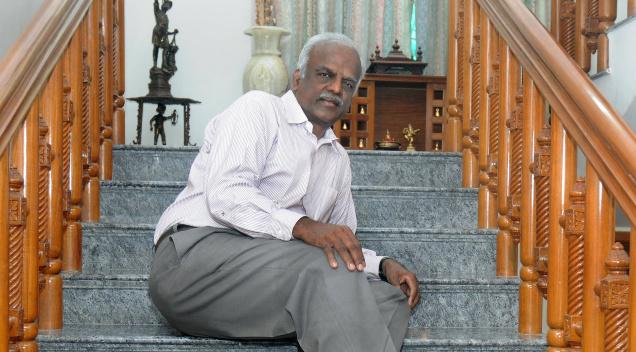
From the foyer a staircase leads up to the living room and library. At the stroke of 3 pm, I am let into the visitor’s room on the ground floor. Seshan, who will turn 80 next week, is dressed in a half-sleeve brown shirt and veshti, the kind of dhotiworn by Brahmins. He has put on weight since he was last in the news.

The room is serene; the only noise is the rumble of an old air-conditioner. Where he sits, within arm’s reach are two remote controls and a cordless phone. On display behind him, and also around the television set placed in front of him, are the various accolades and souvenirs he has received. In one corner is an idol of Ganesha; in another, an automatic foot massager. To one side is a shelf with audiocassettes and a cassette player. He offers a drink of buttermilk.

In spite of the repressive “advisory” of his office, Seshan speaks freely. He has aged since his government days, but still speaks with his famous conviction. Not once does his memory falter.

Tinnellai Narayana Iyer Seshan is best remembered as the man who cleaned up Indian elections. To the public he was a hero. And he revelled in that status. A Delhi journalist who watched Seshan conduct a “town hall” meeting in those days remembers that he handled the audience with great skill. Dressed in a loose kurta and pyjama, he was direct and crisp, and impatient with long-winded questions. His punch line for the evening was: “Tu cheez badi hai bhrasht bhrasht” (“You are very corrupt-corrupt,” a take on a then-popular film song).

Another journalist remembers Seshan’s informal monthly get-togethers when he was the cabinet secretary (the country’s top bureaucrat). He once asked a secretary to furnish some information to journalists the very next day, although it was a Sunday. He relented only when the secretary remonstrated. His detractors called him authoritarian, egotistic, eccentric and publicity-hungry.

Sixteen years after he left the Election Commission in 1996, Seshan lives a quiet life. He devotes most of his time to the Internet, and to his library of over 1,000 books. The library upstairs, which he invites me to see, contains an eclectic mix of books on philosophy, politics, history, economics and Shakespeare.

He says he is currently reading the Vivekachudamani, a long Sanskrit poem composed by Adi Shankar, founder of the Kanchi Mutt. The poem is in the form of dialogue between a master and his disciple, where the master explains nature and the atman (the self, in Hindu philosophy). It should be noted that Seshan was attached with the Mutt when it was run by Jagadguru Chandrasekharendra Saraswati Swamigal (1894-1994). He also follows Sri Sri Ravi Shankar, Sai Baba and Amritanandamayi Devi, though he says he is not “over-attached”.

Seshan is on the faculty of the Great Lakes Institute of Management in Chennai, where he teaches leadership. He had been asked to lecture bureaucrats-in-the-making at the Lal Bahadur Shastri Academy in Mussoorie, but his frankness ensured the stint was short. “When I took the first batch, my first remark for the students was, ‘A paanwala will earn more than what you earn.’ I was being both brutal and fair.” Seshan had, in the past, set up the Deshbhakt (Patriot) Trust with like-minded people for social reforms. Now, however, he “only spends time at the Great Lakes Institute and at home”.

On the hard disk of his computer rests Seshan’s autobiography. “I have written my autobiography and it is ready. But I am not planning to publish it since it will hurt many people. I wrote it just for my satisfaction,” he says.

* * *

Seshan was the youngest of six siblings in a middle-class family. His father was a lawyer in the district court. “My father came up the hard way,” he says. “During our childhood, we were not denied our needs, but we didn’t live in luxury.” His mother once beat him for spending 4 annas (25 paise) on food in a restaurant without permission. “There are certain lessons you learn from your childhood. It is not that we shouldn’t spend money, but that we shouldn’t spend blindly. This incident helped me to be a clean-handed person in my career. You will not find even one single wrong rupee in my account. Money was not wrongly spent, be it public or personal. I lived with the principle of integrity, absolutely fearless.”

Seshan went to school in Kerala, then studied science at Madras Christian College in Chennai, where he says he won a gold medal for outstanding performance — but at the cost of his social life. He was a bookworm, in the college “hostel morning, evening and night”.

With few job opportunities in the early 1950s for young scientists, Seshan became a lecturer in the same college at 19. He left in 1953 because the monthly salary was a paltry Rs 180. He decided to make a career in the civil services, and topped the police examination in 1953. “I did not take up police service,” he says, “because I would have had to deal with criminals all the time and eventually would have become hard-hearted.” In 1955, he topped the IAS entrance exam and began his long journey as a bureaucrat.

Seshan started in Tamil Nadu and then moved round the country before arriving in Delhi. Despite the prominence of his later positions, he counts his time as director of transport for Madras as one of his most memorable assignments. There he managed 3,000 buses and 40,000 staff. One of the bus drivers once asked Seshan how he would grasp drivers’ problems when he did not understood bus engines or know how to drive a bus. Seshan took this as a challenge and not only learnt to drive but also spent long hours at the workshop. “I could dismantle engines and put them back and drive the bus also,” he says. Once he stopped a driver in the middle of the road, took the wheel and drove the bus, full of passengers, for 80 km!

* * *

But the assignment most Indians will remember Seshan for is chief election commissioner. He was chosen by the then prime minister, Chandra Shekhar. According to Seshan, the then law minister, Janata Party leader Subramanian Swamy, played a vital role in the appointment, for which Seshan says he is still grateful. His association with Swamy goes back to Harvard University, where the government had sent Seshan to do a course in public administration, and Swamy was then teaching.

“I assumed the office when I didn’t know the rules and how the Election Commission operates,” says Seshan. “I had never conducted an election. I went with two principles: zero delay and zero deficiency.” During his early days on the job, Seshan identified over 100 common electoral malpractices, including the preparation of inaccurate election rolls, mistakes in setting up polling stations, coercive electioneering, spending more than the legal limit, using goons to snatch polling booths and general abuse of authority. The challenges were enormous, but Seshan says they didn’t intimidate him. “I am like a ball. The more you kick me, the more I will bounce back.” The cleanup began with his own office. Long lunch breaks were banned, and tennis and library during office hours was brought to an end.

It was Seshan who began issuing identity cards to voters. “We [the Election Commission] wanted to issue photo identification cards to all legal voters,” he says. “The politicians bitterly protested this move, claiming that it was unnecessary and expensive.” After waiting nearly 18 months for the government to act, Seshan announced that if voter identity cards were not issued, no elections would be held after January 1, 1995. A number of elections were, in fact, postponed for this reason. The Supreme Court eventually interceded and ruled that since voting was an inherent right of citizens, it could not be postponed indefinitely because voters lacked identity cards. Even so, Seshan’s insistence led the government to start issuing identity cards. By 1996, Seshan’s last year on the job, 2 million voters had ID cards.

The other reform related to election expenses, ostentatious campaign displays and residency requirements. Seshan instituted the practice of using election observers, who were senior officers of the National Tax Bureau. He also implemented Section 77 of the Representation of the People Act of 1951, which made it obligatory for candidates to keep an accurate account of their expenditure and set a ceiling on the amount they could spend on their campaign.

During the 1993 Lok Sabha elections, Seshan monitored electoral expenses round the clock from a control room at the Election Commission headquarters. One of his officers was assigned to each state. Altogether, according to reports, 1,488 candidates for Lok Sabha were disqualified for three years because they failed to submit an account of their expenses. It was reported that Seshan reviewed more than 40,000 alleged cases of false election returns and disqualified 14,000 potential candidates from public office. He was impervious to the demands of politicians; so much so that in 1992, when the Commission under him cancelled elections in Bihar and Punjab, some politicians tried to have him impeached.

“It was not that I introduced a new reform in the system,” says Seshan. “In fact, I didn’t even add one comma, semicolon or a full stop to the Act. Whatever was said in the Act, I implemented.”

Notwithstanding my original trepidation, and despite his fearsome reputation, Seshan is not curt, arrogant or bitter.

source: http://www.Business-Standard.com / Home> Life & Leisure / by T E Narashimhan / May 12th, 2012