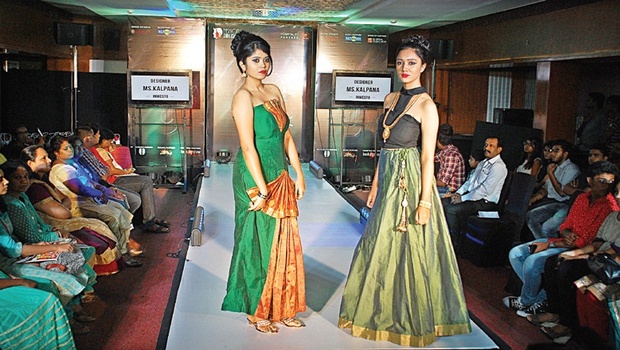
Over 200 creative designs were showcased on the ramp at Hotel Clarion recently. No heavy expenses, no competition and no over-the-top decor. This fashion show – Life is a Label — was all about giving a platform to student designers who may not have had the resources to showcase their designs on their own.
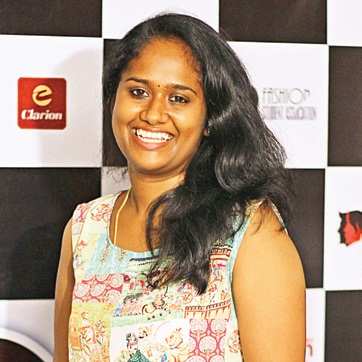
Taking this initiative forward was Fashion Students’ Association (FSA) president B Arul Mozhi who was a designer herself. After watching one session of avant garde on ramp, City Express had a chat with her in the green room, which was chaotic and energetic. “A year has passed since FSA was launched. This is the first time we have had sponsors for our second show. The first was held in a resort in ECR. There were only about 12 designers that time,” recalls Arul about the initial journey of FS
So, why did she decide to create a platform for young designers? “I’m a B Tech fashion graduate from Anna University. When I attended job interviews, they’d ask for my last collection and I hadn’t done any more after my college project. Many colleges don’t teach students about what should be done to flourish in this creative field. Moreover, designing new collections and putting up shows is very expensive. There are also those who don’t have a degree but still get into the industry because they can afford the entry fee of fashion shows,” she opines. This got her thinking and FSA was created.
A student designer, S Priyadarshini, who was a part of two fashion shows by FSA, chips in about her experience. “Last year’s show was my first and I struggled to come up with good theme and creative ideas. Though I chose nature as my theme, I was not happy. But I watched the other designers and learnt a lot by mere observation and further research. This time, I am pretty confident,” she smiles and continues to talk about her new cocktail collection.“Sometimes, designers do come out with their own collections, but then what? Hosting a show is expensive and the clothes end up collecting dust. Hence, we’ve decided to host four shows a year where designers can exhibit their latest works at an inexpensive entry fee,” informs Arul.
FSA vice-president R Kalpana who exhibited her silk-inspired outfits wants to design clothes for celebrities. “People who come in to watch us may go back and talk about it to people in the fashion or film industry. It would be a dream come true if I could design one for actor Trisha,” she says. The fashion show was an all-day event where Pradeesh Raj, actor and assistant director of film Visaranai was also present.
source: http://www.newindianexpress.com / The New Indian Express / Home> Cities> Chennai / by Express Features / April 21st, 2016
Meet 14-year-old Yamini Prashanth, the author of two novellas and a collection of short stories
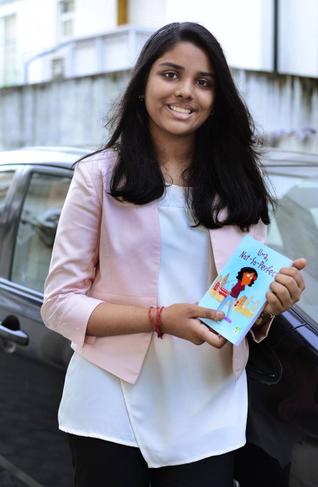
Yamini Prashanth speaks as though she’s given countless interviews. She breezes through, with no trace of self-consciousness. The 14-year-old author has two books to her credit, and speaks to us ahead of the launch of her third, Uma, Not-so-Perfect. “I just think I’m extremely lucky,” she says, seated amidst rows of plastic chairs that will seat the audience for her event.
Being a published author at a young age is an achievement, but Yamini takes it in her stride. “I’m not ecstatic or anything. I’m neutral,” she shrugs. “I don’t think I’m really that great.” But her third book found a publisher without much effort on her mother’s part, which speaks for her work.
Yamini started writing when she was seven. She wrote sequels to books she enjoyed, such asMalory Towers and St. Clare’s. Mishti, a novella she wrote during her class five summer holidays, went on to get published by Unicorn Books. The story is set in India of the Nineties, when children spent their evenings playing outside instead of staying indoors glued to gadgets. Yamini put together a world she heard of from conversations with her mother.
Her second book, Best of Granny’s Stories, is a collection of short stories. Uma, Not-so-Perfect, which is about a girl who moves to the U.K. from India, deals with finding one’s roots in a new place, “without compromising on who we are,” explains Yamini. Her love for writing comes from her love for reading, which was instilled in her by her father. “Reading is a very big part of who I am,” she says. “Even if I don’t carry water to a place, I don’t fail to take a book with me.”
Now that she’s in Class X, writing has taken a back seat; but she does write poems when she finds inspiration. Despite finding success with writing, Yamini is sure of one thing: that she’ll not take to writing full-time. For, “I want to write for the love of it. If I’m forced to do it, it’ll be under pressure,” she says.
source: http://www.thehindu.com / The Hindu / Home> Features> MetroPlus / by Akila Kannadasan / Chennai – April 20th, 2016
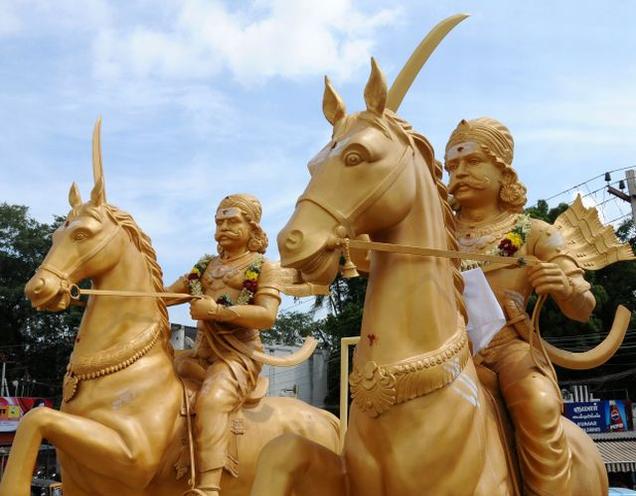
Statues of the Marudhu Pandiyar brothers — Periya Marudhu and Chinna Marudhu — who were hanged for their revolutionary acts, in Madurai. Photo: S. James / The Hindu
One of the freedom fighters, Puli Thevar, is considered the first south Indian to rebel against the British rule.
A documentary, commemorating the efforts of freedom fighters belonging to the Thevar community, was released on Sunday, the 15th anniversary of the Marathiya Manila Thevar Munnetra Peravai, an association of the community in Mumbai.
Titled ‘Contributions of the Thevar Community to the Indian Freedom Movement’, the 20-minute documentary gives a glimpse of the role the community played in the freedom struggle.
At a function in the Shanmukhananda auditorium, the contributions of five Thevar freedom fighters were commemorated in the presence of over 2,500 members from the community.
One of the freedom fighters, Puli Thevar, is considered the first south Indian to rebel against the British rule. He fought between the 1750s and late 1760s.
Varadarajan, founder president of Marathiya Manila Thevar Munnetra Peravai, said: “At a time when women were oppressed, Rani Velu Nachiyar valiantly fought in the 1740s, opposing the taxes levied by the British.”
The Marudhu Pandiyar brothers — Periya Marudhu and Chinna Marudhu — who were hanged for their revolutionary acts, issued a proclamation of independence from the British in 1801. Another freedom fighter, Pasumpon Muthuramalingam Thevar, was mentioned for the role he played in garnering support from south India for Subhash Chandra Bose.
source: http://www.thehindu.com / The Hindu / Home> News> Cities> Mumbai / Alakananda Chatterjee / Mumbai – April 19th, 2016
Sitting judge of the Madras High Court S. Vimala was awarded doctorate in law by Governor K. Rosaiah here on Monday.
Justice Vimala was one of the 5,397 candidates awarded their degrees at the 8th convocation of The Tamil Nadu Dr. Ambedkar Law University. Chief Justice Sanjay Kishan Kaul was the chief guest and Mr. Rosaiah presided in his capacity as the Chancellor.
Senior Civil Judge R. Sathya and N. Ramapiran Ranjith Singh, member of the Syndicate – the highest decision-making body of the TNDALU – were among the 103 who received their degrees from the Governor.
Dr. Singh is an Assistant Professor at the Government Law College, Tirunelveli. For her Doctor of Philosophy degree, Justice Vimala worked on juvenile justice and how it conflicts with laws in Tamil Nadu.
“One positive feature that has emerged not only in legal education, but also in other forms of education, is the steady increase in the number of female students. We now see a significant percentage of female students in legal education and this, in turn, reflects in a larger number of women entering the subordinate judiciary, teaching and in legal profession,” said the Chief Justice.
source: http://www.thehindu.com / The Hindu / Home> News> Cities> Chennai / by Special Correspondent / Chennai – April 19th, 2016
If you have ever been on a heritage walk, you may have wondered about the wealth of information that was shared with you about the city, its history, its people and institutions. Where does all of these come from? On World Heritage Day (April 18), we spoke to four people who conduct these walks to find out.
If you have ever been on a heritage walk in the city, you may have wondered about the wealth of information that was shared with you about Chennai, its history, its people, its institutions and its organisations.
Where does all of this come from? Where do those who conduct heritage walks discover interesting nuggets of information about the city’s streets? On World Heritage Day (April 18), we spoke to four people who conduct these walks to find out more.
Who: Sudha Umashankar and Padmapriya Baskaran. Contact: sudha.ganesha@gmail.com
What: Walk down Harrington Road
How: When Sudha Umashankar moved to Harrington Road in 1977, it bore no resemblance to the well laid-out street with coffee shops, a shopping mall and eateries that it is today. “It used to be deserted in the evenings and it was notorious for house break-ins,” she says. For the walk, which was held last month, Ms. Umashankar spoke to residents of the road, went to institutions to collect information and read a lot. “Books about Chennai, publications such as booklets or magazines brought out to commemorate milestones — these are all useful. I did get information online, but corroborated it first,” she says. The trick is to put the whole thing together in a digestible way, spiced with rumours or legends that people can identify with. Her next focus is Marshalls Road — choosing a street with history, a unique facet to it or landmark institutions helps, she says.
How: “One of the advantages of researching about an institution that has been there for so many years is that every development which has happened over the last century has been recorded in the form of letters, documents and books,” says N.L. Rajah, a senior advocate of the Madras High Court (HC).
Interactions with people who had worked at the High Court over the years and authoring a book, The Madras High Court: A 150-year Journey from Crown Court to People’s Court, also yielded a lot of information about the history surrounding the High Court; the legal history of the 150-year-old institution and the architectural value, all of which is explained during the walks. “Most of my walks are attended by architecture students wanting to learn about the sprawling premises, which will turn 125 years next year. As a part of the heritage committee of the HC, we speak about the ongoing renovation work and its importance for a structure with so much heritage value,” he says.
NICA IDs: 153220034/153220035/153220036
Who: V.S. Sukumar. Contact: 9840622611
What: Gandhi Nagar Heritage Walk
How: Having lived at Gandhi Nagar for 65 years, V.S. Sukumar, honorary secretary, Gandhi Nagar Cricket and Sports Club, knows the ins and outs of this area, which is one of the earliest planned layouts of Madras, built just after independence.
“Several of us have studied in the schools here, played cricket at the cricket club and even gone to the same nursery,” he says. Land documents, publications of the government from the time of the inauguration of the colony, the book South of the Adyar River and information from organisations are all sources of information, he says.
“There are also old institutions such as Theosophical Society and Kalakshetra nearby which are resources,” he says. Senior citizens apart, residents who have moved in to live in many of Gandhi Nagar’s bungalows-converted-to-apartment-complexes are interested in these 131 acres. The walk is held in December every year, he said.
Pics:
Who: Kombai S. Anwar. Contact: anvars@gmail.com
What: Nawab of Arcot: Walajah Trail
How: Kombai S. Anwar, who has previously hosted the ‘Nawab of Arcot: Walajah Trail’ and a walk focussing on the Islamic heritage on Mount Road says that he likes to focus on heritage which had been overlooked.
“We are inundated with heritage structures and monuments in Chennai so much so that many remain unaware of their value. I had a fair idea about these structures but information from books available at the Connemera, Madras University and Mohammeden Public Libraries in Chennai about Muslim monuments as well as the general literature of that period serve as great pointers towards how many of these heritage structures came to be,” he says.
He recalls that his initial tryst with research into the city’s heritage was as part of the Madras Gazetteers Project. “Visiting the many heritage structures in the city yielded so much information,” Mr. Anwar says.
Pics: In NICA today
source: http://www.thehindu.com / The Hindu / Home> News> Cities> Chennai / by Zubeda Hamid & S. Poorvaja / Chennai – April 19th, 2016
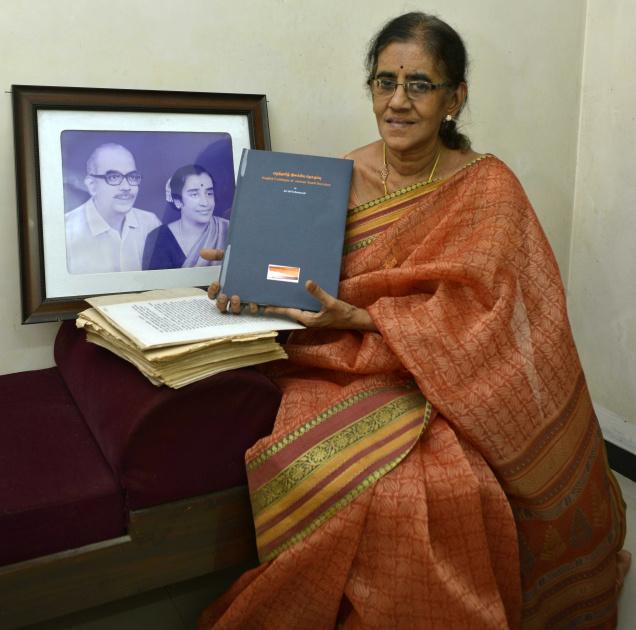
Sivasundari Bose with the original manuscript and published version of her father M.V.S. Ratnavale’s catalogue of ancient Tamil poetry. Photo: M. Moorthy
M.V.S. Ratnavale’s catalogue of classical Tamil works is a worthy tribute to the language
Though technology has made it easier to research ideas and let the mind wander down the lanes of a world where the writer is God, it has become harder to write prose or poetry that could be called a timeless classic.
At a time when nearly every word has a loaded significance due to the polarisation of discourse, lovers of classical writing can welcome a compendium titled English Catalogue of Ancient Tamil Literature (Palantamizh Ilakkiya Thoguppu).
The editor of the tome is M.V.S. Ratnavale, (1915-1994), who has meticulously recorded 687 works of Tamil poets from 1000 BC (pre- to post-Sangam period). “My father had no reason to write his book except for his love of Tamil language,” says Sivasundari Bose, who finally put together the tome as a souvenir to celebrate Mr. Ratnavale’s birth centenary on December 25, 2015.
Bringing the 600 loose typewritten sheets into a modern book format was in itself a challenging task, says Ms. Sivasundari, a Tiruchi-based author who writes in English and Tamil.
“Outsourcing the typing work to data entry operators was not a good idea, because those who know accurate Tamil typing are hard to find,” says Ms. Sivasundari.
Born in Tuticorin into a family of 11 children, Mr. Ratnavale was the seventh child of M. V. Shanmugavel Nadar, the founder-chairman of Tamilnad Mercantile Bank. “His father died young, but my grandmother made sure that all the children were educated,” recalls Ms. Sivasundari. Mr. Ratnavale studied History in Presidency College, Chennai and American College in Madurai.
“He was always interested in doing something more than just earning a living,” says Ms. Sivasundari.
It was this desire to live differently that led him to start cultivating cardamom on the wild forest slopes of the Western Ghats in his estate ‘Kaantha Paarai.’
Besides collecting books in English and Tamil, his days were consumed by a passion for numismatics, philately and photography.
He won a national-level bronze medal for his extensive collection of Indian and British Commonwealth stamps.
After a peripatetic life, and the marriages of his four children, Mr. Ratnavale chose to settle down in Kallidaikurichi, Tirunelveli district, near the foothills of his estate. “Though my father wasn’t from a literary family, he had developed a taste for Tamil literature, and was equally fluent in English. He used to buy a lot of old books which he thought had to be shared with the world. And he felt the sharing would be best done in English, to reach out to a wider audience,” says Ms. Sivasundari. “That’s when he started taking notes.”
For over 20 years, Mr. Ratnavale tracked down the works for his catalogue, and kept saving his work on loose sheets of translucent paper.
“He had time, but he also worked very hard,” says Ms. Sivasundari. “He’d be at his writing desk at 9 a.m. and work till lunch. There’d be a short break, and he’d go back to the manuscript in the evening,” she adds.
Operating in a pre-internet era in a village where there was nobody he could share his work with or seek assistance from, Mr. Ratnavale’s catalogue, which begins at Aadai Nool and ends at Yellathi, is an example of meticulous research and physical effort.
“Each entry had to be typed correctly, and corrections had to be made immediately. It is so easy to delete or correct sentences on the computer. But I didn’t realise then what he was doing. Now I see the manual and intellectual effort he had put in to compile the book,” says Ms. Sivasundari.
After he completed his manuscript, Mr. Ratnavale faced the hurdle common to most first-time authors: finding a publisher. “Up until his 80s, he used to visit me in Tiruchi and go looking for publishers, but nobody was interested,” says Ms. Sivasundari.
The catalogue has managed to unearth works of greater literary and thematic depth than the ones that have held sway over popular imagination. “We all know Silapathigaram, or Thirukkural or Kamba Ramayanam, but there are others that we haven’t even heard of which are listed in this catalogue,” says Ms. Sivasundari. “Perhaps the lack of annotated texts or ‘urai’ to explain the lingo prevalent at that time could be a reason why they are forgotten now,” she adds.
Treatises on the need for harmony in music (Isai Nunukkam by Sihandi, 6th century), geriatric medicine (Moopu Choothiram composed by Ambihaananthar, 8th century) and an exhaustive Tamil Thesaurus (Pingala Nigandu by Pingala Muniver, 8th century) are among the little-known texts that are listed out in the catalogue.
Mr. Ratnavale has also added his own notes on various works to make it more reader-friendly.
Information from palm-leaf scripts suggests that the poetry of this era was not just about divinity or royalty, but also accounts of daily life, the performing arts, and mercantile activity that saw Tamil traders sailing to ancient Ur and Rome.
Publishing the book posthumously has made his family happy, but the book deserves to be more widely read, feels Ms. Sivasundari. “Ideally it should be available in university libraries as a key reference work. Tamil is like a treasure chest to some of us. It has a history going back thousands of years, and we should hold on to it because it is a way of life,” she says.
* * *
A life less ordinary
“My father was very liberal with me,” says Ms. Sivasundari Bose, an attitude she attributes to Mr. M.V.S. Ratnavale’s own childhood spent in an extended family that included not just his 11 siblings, but also cousins and relatives. “Children growing up in big families don’t judge others harshly,” she reasons.
Her own upbringing was marked by open style of parenting, says Ms. Sivasundari. “I was taught everything that my three brothers were taught,” she says. “My father never said ‘you are a girl and you shouldn’t do this.’ So I used to cycle to school, which was considered radical in those days. And because of the wild animals on the estate, I was also taught how to use a gun.”
Her mother introduced her to lessons in music and dance. “Nothing was forced on us, but we were always told where the limits lay.”
Ms. Sivasundari is the author of Golden Stag, a trans-generational saga about a community in Tamil Nadu that was published in 2006. In addition to this, she has translated Sangam-era love poems, and also written books in Tamil on more contemporary themes.
* * *
Gems from the catalogue
Some of the rare works listed by Mr. Ratnavale:
– Koothu Nool by Cheyitriyanaar, 6th century, explains theory of dance and drama
– Manthira Nool by Putkaranaar, 6th century, on mystic theology
– Thaala Samuthiram by Bharata Choodamani, 8th century, on the importance of beat in music
– Kaasiyappa Silpam by Pattinathu Adigal highlights excellence in sculpture in 10th century
– Thiraavaaham Ennooru by Macha Muni, 14th century, about science of metallurgy and alchemy
source: http://www.thehindu.com / The Hindu / Home> Features> MetroPlus / Nahla Nainar / April 15th, 2016
First Indian woman jockey crosses social barriers to carve a niche for herself.
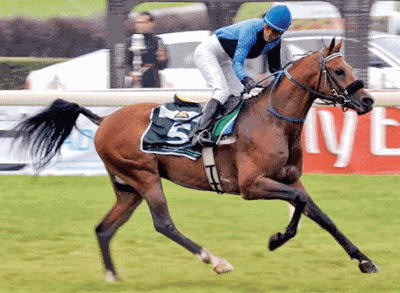
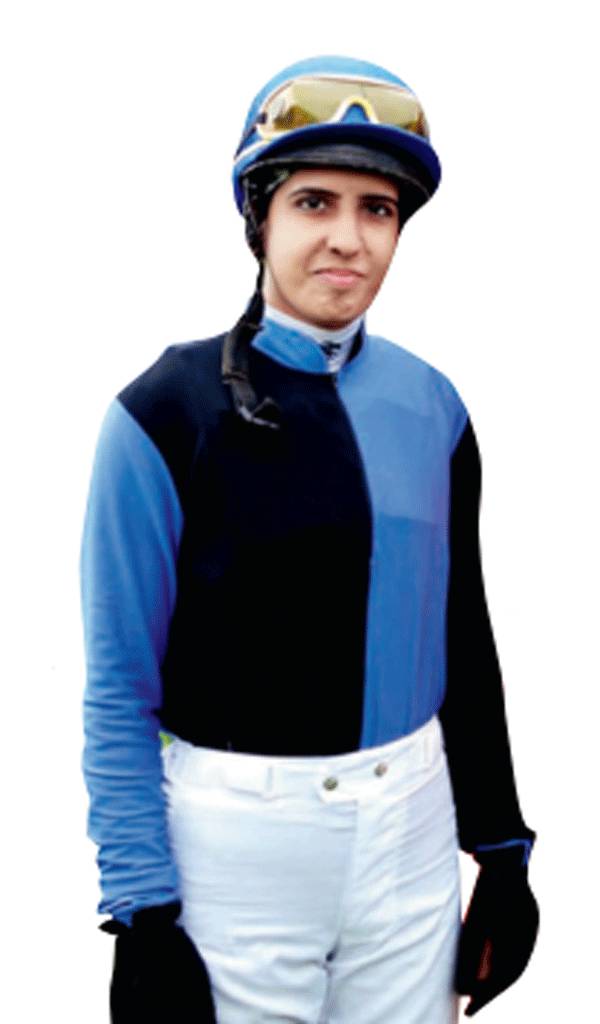
When Rupa Singh won the Annamalai Plate in the Ooty races on Thursday, it wasn’t her first. Rupa has done it many times before, but every time the city-based jockey wins a race, she feels like crossing an obstacle that society has put in front of her. The 33-year-old, from Velachery, is the only woman jockey in the country and she has won 720 races and seven championships. But it was never an easy road to glory for her. “I suffered a lot of rejection initially because I am a woman. I raced with ordinary and average horses for almost three years.It was only after I won 50 races with average horses that I could ride favourites,” Rupa said.
For a long time, the owners and trainers did not show confidence in her skill. “My horse kept getting poor odds. The chances were few and it was demoralizing at times,” Rupa said, recollecting her difficult days. The champion jockey, however, concedes that men get an advantage in this sport, because riding a horse demands a lot of strength. “We don’t have the stamina and physical strength that our male counterparts have.We can get the strategy right but it takes immense strength to control a horse and a race. It is only through rigorous training that I have increased my stamina. I have always undergone the same training as the male jockeys,” Rupa, who is a Rajput by birth, pointed out.
Her family has a history of dealing with horses and Rupa got hooked to it pretty early on in her life.
“My grandfather Ugam Singh used to train the British Army horses here. My father Narpat and brother Ravinder have both been jockey and trainer. So I used to ride from my school days,” she said.
The first woman to make a name in the Indian horse racing circuit was Silva Storai, an Italian. It was Rupa’s father’s wish to see his daughter as the first Indian woman jockey . “Riding a horse is risky and I broke my collar bone and ankle after I had taken up racing as a profession. But in my childhood, I was more scared of my father than the horse,” Rupa laughed. Narpat was like a coach and he told her that she can give up racing after she had done it successfully . “But once I started racing, my passion for the sport grew. As I won a few races, I wanted to show the world that women can be as good as men.”
Rupa rose to prominence in 2010 when she toppled the favourite in the A-Class race in one of the Madras Classics. “It was special because I was riding an average horse. So when I won the race, even MAM Ramaswamy came to meet me and encouraged me,” said Rupa. But the icing on the cake was the Shikha Fatima Bint Mubarak Championship Cup, which she won in Poland in 2014. “I had raced in Germany , Abu Dhabi and the Netherlands but the Poland race was really special. I never thought I would win riding against famous jockeys of the world,” said Rupa.
Despite all the success, there’s a tinge of sadness that she hasn’t been able to inspire any other Indian woman to become a jockey . “I feel proud and sad at the same time for my achievements. I am perhaps living with a false hope that I can inspire at least one girl to take up the sport. The family has to be supportive and the girl needs to have a lot of mental toughness to go through the physical grind,” Rupa said, hoping for brighter days.
source: http://www.timesofindia.indiatimes.com / The Times of India/ News Home> City> Chennai / by Shilarze Saharoy / TNN / April 16th, 2016
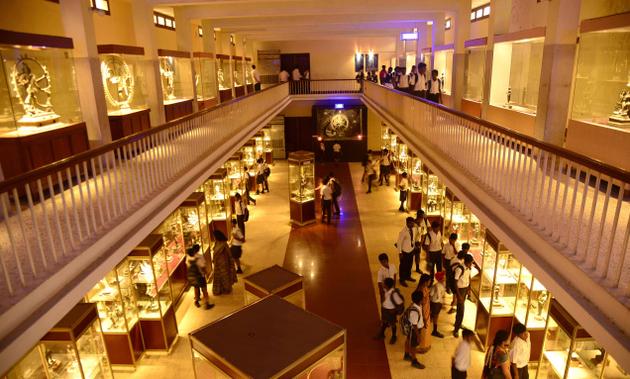
The Bronze Gallery at Government Museum, Egmore Photo: R. Ravindran. / The Hindu
Come summer, and museums are spruced up to receive visitors ready to dip into a treasure trove of artefacts. But, museum-visiting must be made part of popular culture to create a generation familiar with its roots, writes SUBHA J RAO
It’s a searing 39 degrees and Anand Gopinathan’s T-shirt is plastered to his back. But, there’s a smile on his face as he walks from gallery to gallery at the Government Museum, Egmore, water bottle in hand. Kochi-based Anand, 45, is a compulsive museum-goer. He loves history, travels widely and makes it a point to visit the local museum, however small it may be. But, he has his favourites. “The Tower of London… I’ve visited it many, many times,” he says.
Elsewhere, reluctant children are being dragged from exhibit to exhibit by eager parents and patient teachers, as if to tick something off the bucket list. The children file past objects of exceptional beauty, little registering their historical worth.
So, how does one get children interested in museums? Or, even still, why must one visit museums? A senior Government employee, who’s served for a while in museums, puts it simply. “Museums are repositories of our history and culture. They bring alive a period that we can’t visit again. More importantly, at a time when the nuclear family has come to stay, oral retelling of history has taken a backseat. You need a museum to put facts in context for children. How else will they know where they come from?”
Another history-loving official says that museums also help put things in perspective. “We’ve learnt so little of our kings and kingdoms in history books. We call Samudragupta of the Gupta Empire the Napoleon of India. That’s terrible and a disservice, because he lived from 335-380 C.E., while Napoleon (1769-1821) came in much later. Samudragupta was the pioneer. And that’s something a museum will reveal with great clarity,” he says. Similarly, an entire generation looks up to the West for everything, little knowing the treasure trove of talent that we possess from the Indus Valley Civilisation.
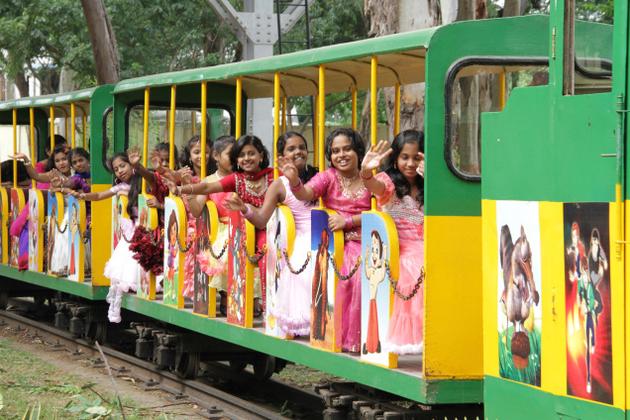
Children enjoy a ride at the toy train at the Regional Rail Museum PHOTO: SPECIAL ARRANGEMENT
Part of the problem why museums have become distant spaces, says Arun Devraj, Curator, Regional Rail Museum (RRM), Chennai, is because we have so many restrictions — Don’t touch this. Don’t walk on the grass. Don’t enter this place… Arun’s done away with all of them at the RRM. Children, who usually hold a deep fascination for trains, walk on the tender grass, at least whatever remains of it after being scorched by the summer sun, walk into the bogies in the bogie park, touch and feel the seats and upholstery and come out beaming. They then take a ride in a toy train, passing a park where the attractions are erstwhile coaches, including the iconic blue-white railbus that used to chug along on the Shimoga-Talaguppa section in Karnataka, covering 82 km in a leisurely three hours and 45 minutes.
Inside the museum are models of bogies on the floor, so that children can sit around them and peer into them as much, instead of being forced to bend down to see the models. When we visited, a group of children from Ambattur had come in, sweaty and tired. But all that seemed to vanish as they gathered around the model trains, moving away from them with great reluctance.
Museums must be interactive spaces to strike a chord with visitors believes Neeti Anil Kumar, Curator, Fort Museum at Fort St. George. The museum is currently hosting Kesh Vinyasa, an interesting exhibition that showcases hair dressing down the ages. Dreadlocks, Asha Parekh-style top buns, hair parted on the side and decorated with beads… all of them seem familiar, and then Neeti reveals their origin — the Gupta period. She then points out to a Vijayanagar-era sculpture from Srimushnam, a lady with plaited, long hair decorated with flowers — the traditional poo jadai that a South Indian bride still wears. “But, this alone won’t do to bring in people. And so, to move with the times, we’ve put in two selfie booths,” she says. A majestic Samrat Asoka and a decked-up Begum Hazrat Mahal have been placed in the centre of the gallery. Place your face in the gap provided, and click away.
In the coins’ gallery, innovation rules. The museum offers an augmented-reality experience. Children and adults stand in front of a screen and hold a cardboard sheet. Suddenly, a coin zooms into view, and turns around slowly to show you its intricate beauty. This is a huge hit among kids, says the person manning this section. “Earlier, these exhibits were only under lock and key, ensconced in glass shelves. You could never see them up close and personal,” says Neeti. Likewise, at the entrance of the museum, there’s a talking cannon. In a seven-odd-minute speech, it speaks about how it came into being, where it was used, and why it went out of favour. And then, it goes on to promote peace and ahimsa. Children listen spellbound, because it is self-explanatory and in lucid language.
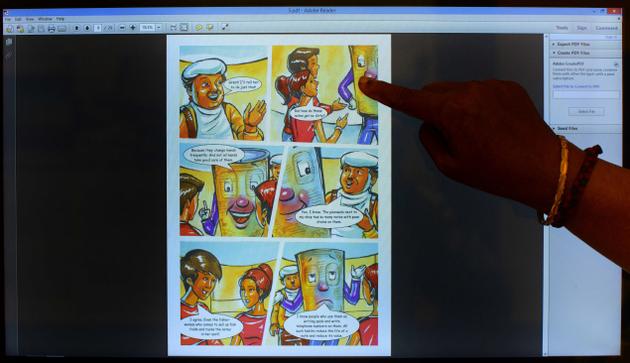
A touch screen features a comic at the Reserve Bank of India Financial Gallery. Photo: V. Ganesan. / The Hindu
A touch screen with games and puzzles and financial comics such as Raju and the Money Tree make the experience worthwhile at the Financial Gallery of the Reserve Bank of India. It is a space that promotes financial literacy, financial inclusion and customer protection. This place is an eye-opener for children and adults alike. The audio-visual section plays a selection of videos, including an interesting one on how mutilated and unusable rupee notes are destroyed. And, making the experience come alive, D. Vinothini, Assistant Manager, who looks after the gallery, shows us a briquette — a cylindrical brick made of shredded rupee notes! Every child leaving the museum is also given a small pouch with shredded notes.
A view of the Museum at Officers Training Academy in Chennai. Photo: K.V. Srinivasan / The Hindu
If all these museums promote a sense of enquiry, the one at the Officers Training Academy (OTA) inspires. It is a wonderful showcase of what the OTA, founded in 1963, stands for, and has a gem of a collection of weapons used in warfare. As you file past panels listing the achievements of the Academy, your heart swells with pride, and then almost immediately, turns sombre as you go through the list of Param Vir Chakra and Ashok Chakra awardees from the Academy. As you read the plaques detailing the bravery of every awardee, especially those awarded posthumously, your eyes mist over and you’re consumed by a fierce sense of devotion towards the country.
In a sense, that’s the purpose of the museum — it must inspire both officers in the making and those visiting, says Major Avinash Rawal, Officer-in-Charge. As he walks you around, he points out with pride the officers who’ve passed out of the OTA and proved their mettle in various theatres of war. This is, in effect, modern history. And, the museum places it in great perspective for future generations.
source: http://www.thehindu.com / The Hindu / Home> Features> MetroPlus / by Subha J. Rao / Chennai – April 15th, 2016
For P Valarmathi and other residents of Kasuva village in Thiruvallur district, whose lives revolve around brick kilns and agricultural fields, it took a while for them to realise the importance of educating their children.
Due to the dire situation these families were in, kids were often compelled to take up work at the cost of their education. But, today, what was once considered an unaffordable luxury is no longer out of reach for them, thanks to the free quality education provided by Sevalaya, an NGO.
The school run by the NGO began in 1988 and provides education to over 2,000 students catering to 40 villages around Kasuva. The school has grown from its initial days with just a handful of students under a single hut — a stage where Sevalaya has become synonymous with Kasuva village.
Says Valarmathi, who has four school children, “This is a boon for daily wage earners like us struggling to find our next meal. If not for this initiative, it would have been difficult for us to think of educating our kids.” Having scored 464 marks in Class 10 two years ago and awaiting the Class 12 board exam results, Valarmathi’s eldest daughter hopes to pursue nursing from CMC Vellore.
The school is dependent on funding received from various sources, including from corporate houses and individuals. It also benefits from services by volunteers, including from aboard, who offer to take classes or teach children life skills.
A standout feature that makes the school special is the strong bond it shares with its alumni. Every Sunday, a bunch of alumni visit the campus and can be seen cleaning the classes or volunteering to help children staying in hostels with their classes.
In fact, as many as 10 old students are currently on the staff roster. Says, S Muruganandham, a 2005 pass out, “During my days, Sevalaya was the only school in the area to offer Class 12. The only other option was to travel over 5 km to Thiruninravur. After graduating from college, I realised that I could set an example to Sevalaya students, as they could relate to someone from a similar background who came up the hard way.”
But for the man behind Sevalaya, the challenge is not so much as enrolling children into schools, but to prepare them for jobs. Says V Muralidharan, who founded Sevalaya back in 1988, “It’s not enrolment that should occupy our thoughts. We have to focus on tackling the dropout rates and the rising unemployment levels. The rural youth, in particular, are being misled and wasting their life as they don’t have the required skills to get employed.” As for the future, Muralidharan hopes to set up community colleges in and around the area to equip youngsters with skills that could fetch them regular incomes.
Alumnus Who Worked in the UK
The story of G Ilaiyaraja is a classic which continues to inspire students of Sevalaya. Back in 1993, when he was in Class 6 in a Thiruninravur government school, his father passed away. His brother had discontinued studies and joined a mechanic-shed to support the family.
His sister also dropped out after Class 10. Just when it seemed that the doors of education would close on him, he heard about Sevalaya. “I was the 34th hostel student, and after completing Class 10, I enrolled in a diploma course in computer technology. I then did BCA and MCA,” says Illaiyaraja, who works for Maverick Systems, after a brief stint in the UK. Illaiyaraja was appointed to Sevalaya’s board of trustees by his alma-mater.
As the president of the alumnus association, he is a regular visitor to school. “All the students are from poor families, if you ask them what they want to become, they won’t answer. But that’s when I share my life story, which is very similar to theirs.”
Painting a Great Picture
More often than not, schools are where young minds first exhibit talent. The same proved true in the case of 24-year old P Abhirami. Having been associated with Sevalaya for the last 16 years, Abhirami owes her interest in caricature and painting to the school’s encouragement.
On festive days like Deepavali, Pongal or Christmas, Abhirami would make hand-drawn cards for Muralidharan and the donors. “On one such occasion, I drew a portrait of Lord Krishna and Radha, which Murali sir liked so much that he hung it in Sevalaya’s guest room.
He would proudly tell all visitors about my handiwork and that motivated me.” Realising her gift, Sevalaya then bore all expenses as Abhirami studied in a fine arts college. Her determination to pay back the institution with gratitude saw Abhirami returning to Kasuva. “While I am unable to contribute monetarily, I am delighted to use my artistic talent to groom students here,” she smiles.
source: http://www.newindianexpress.com / The New Indian Express / Home> Cities> Chennai / by Venkatesan Parthasarathy / April 11th, 2016
More than 6,000 specimens at the 105-year-old herbarium in the Institute of Forest Genetics and Tree Breeding (IFGTB) can now be accessed by the click of a mouse, as the institute plans to digitise it.
The digitisation will help preserve the fragile specimens, prone to damage due to constant physical handling.
The Fischer Herbarium, which was started in the year 1911 on the Forest Campus in R S Puram, was created as a repository to house the many collections made by British forest officer Cecil Ernest Claude Fischer. He had an extensive collection of specimens from the Nilgiris, Palanis, Coimbatore forest divisions, Seshachalam Hills and Ganjam District of Andhra Pradesh. The herbarium also houses century old collections by forest officers,T F Bourdillon and M Rama Rao from the Travancore presidency. The herbarium was brought under IFGTB’s control in 1988.
The herbarium, considered a national repository by the National Biodiversity Authority (NBA), contains 2,954 species, 254 families of plants and 1,257 genera, some of them as rare as the one by forest officer J R Drummond in 1879.
“The herbarium is visited by a lot of taxonomists and botanists. So, when they discover a unique species but have heard of similar looking species being present in a herbarium in another part of the country or world, they often have to physically visit the herbarium to cross check the facts,” said IFGTB director R S Prashanth. “But now they can cross-check with the image and data available online,” he said.
The digital herbarium, which can be accessed through the website www.frcherbarium.org, currently contains 6,231 of the total 23,000 specimens available with the IFGTB. “This digitisation was done by former librarian at the Kerala Forest and Research Institute K H Hussain,” said the head of the biodiversity division at IFGTB C Kunhikannan about the project which cost Rs 6 lakh.
“The website has uploaded the herbarium’s sheets and allows people to zoom into the image to take a closer look at the specimen and the officer’s own writings,” said Hussain. “We will be shortly applying for more funds to digitize the rest of the herbarium’s data,” said the director. The institute, however, admitted that they were yet to review all the data on the website and eliminate spelling errors that might have occurred since the data entry personnel were not taxonomists.
source: http://www.timesofindia.indiatimes.com / The Times of India / News Home> City> Coimbatore / TNN / April 13th, 2016