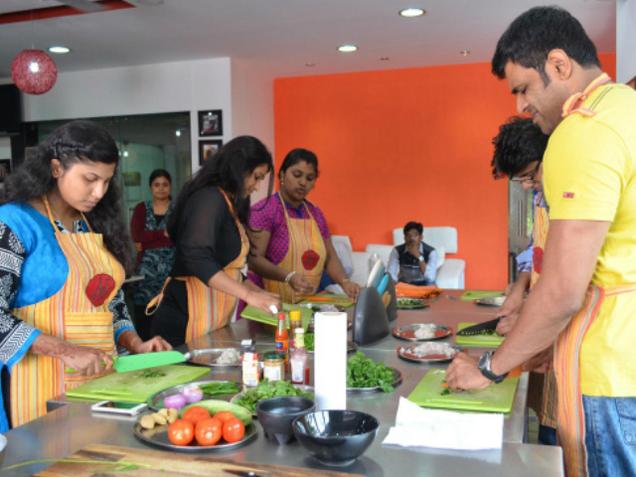
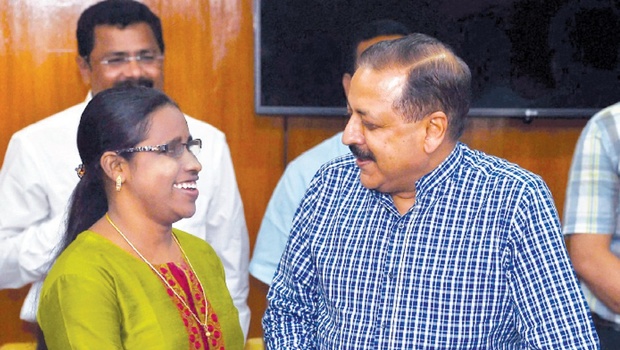
WHAT’S COOKING? Couples and cookery enthusiasts get busy at the workshop.
Foodology organises culinary workshops for brides and grooms- to-be
“Ayyo, why are you stuffing chopped coriander into the cutter? You use that to carve out vegetables into different shapes.” laughs one of the participants as she directs her husband during the Bridal Cooking workshop held over the weekend.
Fresh vegetables, spoons and ladles, a variety of spices, colourful aprons and a smiling chef waits for the participants as they get ready to cook the ‘healthy’ menu for the day — watermelon and barley salad, Caesar salad, burgers with rajma patties and sweet potato fries. It takes them two hours, a few mishaps and some cheering to get their dishes ready, before sitting down to taste and enjoy it for themselves.
“I am trying something like this this for the first time. I never knew we can actually make rajma patties for a burger” says Kala Pillai who’s been married for nine months now. “Yes, we do a lot of fun things together but cooking is a first” adds her husband, Natraj Pillai.
The chef for the workshop, Neelima Sriram glides in with her batch of dishes as we speak. She’s been busy plating them meticulously, not a leaf out of place. “You eat through your eyes. The moment you see beautiful food, you want to try it” she smiles. Ask her about the advantage of such a workshop and she says “Getting to know your fiancé or your partner closely is very important. And I think cooking is a great way to connect. You discover each other’s likes and dislikes and learn to communicate effectively.”
There are also a few college students in the cooking group but they are quick to ward off the ‘are you getting married?” questions shot at them. “We are just here to have some fun. I enjoy cooking and thus joined the workshop to pass the time during vacations” says Sruthi Ganesh, a fourth year architecture student.
Organised by recreational culinary studio, Foodology, the workshop will be held over five long weekends with menus covering various cuisines, including Punjabi, Mexican, Italian, healthy diet and indulgence. “The statistics say that out of five dishes, people definitely go back home and try to make three. So when we decide on the menus, we try to come out with different and unique items” says Neelima.
The concept of a ‘Bridal Cooking workshop’ has certainly piqued a lot of interest in the city. Shree Periakaruppan, founder of Foodology, believes that instead of going out to restaurants on dates, couples should try cooking together. “You get so much more time to bond. Besides, when you use the term ‘Bridal package’ it usually means a visit to the parlour. However, I wanted to change that concept. A cooking workshop is a lot more fun and lets you a learn a life skill.” she adds.
(The workshop will be on for one more weekend at the Foodology centre, 3 A, Second Main Road, Kasturba Nagar, Adyar. For details, log on to www.foodology.in)
source: http://www.thehindu.com / The Hindu / Home> Features> MetroPlus> Society / by Priyanka Parthasarthy / June 22nd, 2015
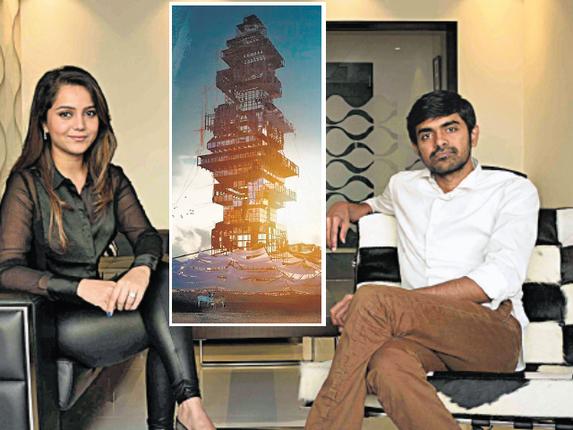
Suraksha Bhatla and Sharan Sundar. Inset shows their model for the ‘shanty scraper’. — PHOTO: R. RAVINDRAN
Winning a competition for their vertical living design is a boost for architects Suraksha Bhatla and Sharan Sundar.
High rises are the future. Growing population, limited land area and talented architects will ensure that. This is probably why the eVolo Skyscraper competition to acknowledge outstanding ideas for vertical living is conducted in New York every year. “The brief encourages designers to come up with digital submissions of new urban vertical living proposals using advances in technology, new architectural methods and sustainable ideas,” explains Chennai-based Suraksha Bhatla, who, along with Sharan Sundar, won the second place in the competition. Out of the 500 entries from around the world, 100 are shortlisted to be published every year.
“We thought of how slums aren’t visible in the city’s skyline,” says Suraksha. Their proposal was for a ‘shanty scraper’, to address the problem of growing slums in the county. They believe that one of the reasons their proposal won is because the jury wanted to bring the issue of slums to the forefront to drive discussion.
“Usually with slums, the Government response is to relocate the dwellers. This doesn’t work because most of them end-up sub-letting their houses to move back to the slums, which is closer to their job,” says Suraksha, a sustainability consultant and freelance architect.
“Currently, vertical living is only for people who are from a high-income bracket, so we explored something different,” explains Sharan, who works as an architect for Zaha Hadid in London. The winning Polish entry proposed the idea for a utopian skyscraper in the middle of New York City, interwoven with nature, as a means to relieve one from city life. A Malaysian team proposed an idea for a limestone scraper, China, a tower of refuge and Russia presented Cybertopia.
The duo studied together in Anna University’s School of Architecture and Planning, and graduated from the Architectural Association in London. “We wanted to create something that’s aesthetically appealing and yet made of recyclable material,” says Sharan, while Suraksha adds that the materials used — post construction debris like pipes and reinforcement bars, timber and thatch — give the structure a post apocalyptic feel.
Although theirs is only a conceptual design, they say that it is feasible to execute.
source: http://www.thehindu.com / The Hindu / Home> Features> MetroPlus> Society / by Raveena Joseph / June 22nd, 2015
A biography of Dr Sanjaya Rajaram, who developed 58% of all wheat varieties that exist now, was released in Chennai on Sunday.
The book, “Mr Golden Grain, the Life and Work of the Maharaja of Wheat,” traces the humble beginning of Rajaram and his success.
The book highlights Rajaram’s sheer grit and determination that took him from a humble wheat researcher to a global leader in research arena.
The book, written by agriculture communications specialist G Venkataramani, was released at the MS Swaminathan Research Foundation. M S Swaminathan, founder of MSSRF, released the book and applauded it for being one of the best biographies on scientists.
“Dr Rajaram has shown single-minded devotion and desire not only for knowledge but to work towards public good, bringing him awards cutting across national boundaries,” he said.
“The book not only delves on not only on the humanistic aspects of the person but also on the scientific strength of Dr Rajaram,” he added.
Rajaram — who is the recipient of the 2014 World Food Prize for his scientific research that lead to an increase in wheat production by more than the 200 million tonne — expressed his concern over the growing population and the need to strengthen a holistic approach to agriculture especially related to soils and seeds.
“Wheat is a great programme on paper. However, the quality of seeds is a great concern where different varieties are being mixed and sold. Although it is distributed by the public sector, if farmers don’t get good seed, they won’t get good crops. We can look at public-private or public – NGO supported models for better seeds,” he said.
source: http://www.timesofindia.indiatimes.com / The Times of India / Home> City> Chennai / by Karthikeyan Hemalatha, TNN / June 21st, 2015
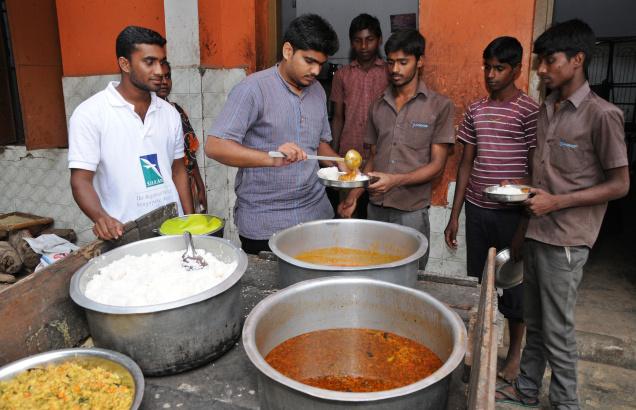
Padmanabhan serves excess food from weddings and parties to poor students in Coimbatore. Photo: M. Periasamy
Padmanaban Gopalan is on a crusade to stop the colossal amounts of food people throw away every day
A determined young face stares back at me from the Pollination Project website and that is how I first learnt of Padmanaban Gopalan.
Earlier, a whatsapp forward had caught my attention with the words “no food waste” and a link. Young Padmanaban, I learnt, has been nominated as a visionary for 2015 by “Pollination Project”, California. The project gives seed grants to those who make a difference in their community.
On the 29th July 2015, Padmanaban Gopalan will be awarded the 1000th grant in appreciation for his work in providing food to those in need of it.
His name was proposed by Poornima Bhavesh, who has herself won the grant, when she was witness to his social service.
Padmanaban Gopalan’s motto is “Be the change that I want to see in the world”. In his 2nd year at college, he co-founded the green club at GCT.
After graduation, in 2014, he along with a few friends set up S.P.I.C.E (Society Promoting Innovation Creativity & Entrepreneurship).
Their objective was to encourage children to think out-of-the-box for a greener world. Padmanaban interacted with many schools in and around Coimbatore and it was then that he saw how much food children wasted. Tiffins were emptied into dustbins, food was flung at each other playfully or just left around carelessly.
He found out that each day 12 to 18 kgs of food were thrown into the garbage truck along with other school waste which made it almost impossible to segregate. He figured that one school with 1200 children had an average waste of 3875 kgs of ‘edible’ food in one year.
On World Food Day, Padmanaban decided to put his food management plan into action and registered the domain nofoodwaste.in.
His first awareness campaign was conducted at Carmel Garden School. The message was to try and make the school a ‘zero food waste campus’. He did a survey and conducted an audit.
Many other schools invited him to conduct similar audits.
Padmanaban soon noticed results. He knew for sure now that student-involved movement was definitely the way forward. Next, Padmanaban began to look at leftovers at hotels. He packed the uneaten food and gave it to the homeless. Then he turned his attention to the colossal waste at weddings.
In November 2014, he conducted an Awareness Marathon. He shared his mobile number and people were encouraged to call him in the event of excess leftovers. His first call to pick up food was at a reception at a private home. He carried three shopping bags full of food and distributed them to slum dwellers near the Government Hospital. As calls became more frequent, he and his friends Dinesh and Sudhakaran packed up food from kalayana mandapams.
When the numbers increased from 50 packets to 400, they had to figure out a different way of doing things. Volunteers were dwindling, packing leftovers was tiresome and they were unable to find enough homeless people to give 400 packets of food. They approached orphanages and ashrams, and finally, Fr. Xavier, at St. Joseph’s ITI Ashram, happily accepted the food procured by such hard work and dedication.
The team decided to borrow utensils from people in that area for easy distribution of food. This is the practice they follow today.
Padmanaban neighbours and many others generously lend him their vessels. They now supply frequently to 15 ashrams or orphanages. They carry out all this work on a two wheeler.
In order to streamline the work they are doing, Padmanaban has all the statistics on his computer and makes daily logs. Mid afternoon is usually when he gets calls about the availability of food. Anandhi bakery at SIDCO provides him with food regularly. Caterers from Perur, Mr. Hariharan and Mr. Suresh also help and put him in touch with many functions and happenings in the city. “Helping hands” at Kovaipudur also encourage his work. Padmanaban was invited to attend a leadership summit where he put down his vision on paper.
He thanks people such as Shobhana Kumar and Shankar Vanavarayar for encouraging him to read motivational pieces that helped him see his chosen path with clarity. Opportunities began to present themselves.
He met people who were eager to help with filming a documentary and formulating a web design. These were just what he needed to cement his vision.
Padmanaban Gopalan’s vision for 2015 is an India with zero food wastage. He wants to set up ‘Last minute shops’, where people who have excess food in their homes can sell it.
Padmanaban’s advice to reduce food waste could not be more simple:
There is only so much one can eat, so buy just what you require.
Look around your locality and share excess food with those who need it.
If you think you cannot use up food that is approaching its expiry date in time, give it to someone who will.
If you are eating out and there are leftovers, pack it up and give it to someone who is hungry.
Get children involved
Select five no-food waste ambassadors in each school
Get them to check the dustbin and send him a daily report
Suggest ways to bring down wastage. (Bring just what you can eat. If you have more share it with others. Keep dry food and wet food separately. Take leftovers back home.)
Get the kids to pledge: “In our school we have wasted 3500 kgs of food this year. I alone am responsible for 15 kgs. I promise to reduce, reuse and recycle.”
* PSG primary and nursery school set up three daily dumps to throw daily food waste. This was turned into compost by adding dry leaves and letting it decompose naturally.
* ABC Matric School at Avarampalayam uses grow bags into which they discard their food waste. They sprinkle it with compost accelerator to let it become manure.
“No food waste” needs volunteers. You can volunteer at 9629334185
No Food waste helpline is 90877 90877
Follow Padmanaban on http://www.facebook.com/agpadmanaban
source: http://www.thehindu.com / The Hindu / Home> Features> MetroPlus / by Shanthini Rajkumar / June 21st, 2015
B Jayant Baliga, a US-based Indian-origin scientist, is being awarded Russia’s top technology award in recognition of his work as a major development in energy management which brought about huge increase in efficiency and major savings.
B Jayant Baliga, a US-based Indian-origin scientist, is being awarded Russia’s top technology award. (Representative image)
The award will presented to Professor Baliga and Shuji Nakamura on Friday by Russian President Vladimir Putin at a ceremony here.
Nakamura, a Nobel Laureate, is being recognised for his work on blue light emitting diodes (LEDs). In Russia, the Global Energy Prize is known as the electronics equivalent of the Nobel Prize.
Professor Baliga invented the digital switch or the insulated gate bipolar transistor (IGBT) while working at General Electrical research & development centre in New York state in the US in 1983. The IGBT switches energy hundreds of thousands of times a second, raising the efficiency of any equipment manifold.
“Every equipment from your refrigerator to lights to motor vehicles has the need to use energy efficiently. If you take away the IGBT today, almost everything will come to a standstill,” Baliga told a visiting IANS correspondent on the eve of receiving the award.
Scientific American magazine called him among the ‘eight heroes of the semiconductor revolution’, and President Barack Obama awarded him the highest American technology prize last year and he is the 2014 recipient of the IEEE Medal of Honour, a rare distinction.
Professor Baliga, who now teaches to the North Carolina university as ‘distinguished university professor’, said that the IGBT that his invention combines two streams of electronics and electrical engineering and has possibly saved the world around $24 trillion dollars by raising efficiency, according to one detailed calculation.
“I got zero out of it. But then I did it all for humanity.”
Of course, says Prof Baliga, that he did make some money when he started three companies, but these were financed by venture capitalists who exited with enormous profits at the right time.
He says every motor today is at least 40 percent more efficient, the light bulb like the CFL better by almost 75 percent and a motor vehicle saves over 10 percent fuel because of his invention. He has written 19 books and over 500 papers in peer-reviewed journals.
Baliga passed out of IIT Madras before going to the US for his MS and PhD after electrical engineering after which he joined GE where he spent over 15 years.
After his ‘switch’ was invented, several of his colleagues told him that it would not work, and many scientists said he would fall “flat on his face”. But he said it stood the test of time.
The chairman of GE at that time, Jack Welch flew down especially to meet him when he heard what it could do. GE used the switch in the several of the equipments it sold, including medical devices.
A US citizen since 2000, he now has very little connection with India and does not travel to his home country much, especially after his parents and parents of his wife passed away. But, says Prof Baliga, an invention like his is unlikely in India, because it needs huge research infrastructure to be in place from universities to industries.
He feels, that India has a potential which has not been fully used, although in software “it has made great strides”.
Could a Nobel be on its way in the future? “I used to say no way,” but with so many recognitions and this “global prize where I am being feted with a Nobel Laureate, who knows”, he says. His regret though is that India does not know much about him.
“Top scientists that I meet always ask me, why has India not recognised your achievement?” And with characteristic modesty, Baliga told IANS, “I tell them that perhaps my country does not know about what I did.”
source: http://www.timesofindia.indiatimes.com / The Times of India / Home> NRI / IANS / June 18th, 2015
The 104th death anniversary of veteran freedom fighter R Vanchinathan was observed at his birthplace Sengottai in Tirunelveli district and at Vanchi Maniyachchi Junction railway station in Tuticorin district, where he shot a British official dead before killing himself.
Vanchinathan, son of a forest officer, killed Robert William D’ Escourt Ashe, the British-government appointed Tirunelveli collector, at Maniyachchi before shooting himself dead.
“Several factors forced Vanchinathan to open fire on Ashe. Ashe took measures to curb Swadeshi movements in Tirunelveli. Besides, he ordered that Indians should not take bath in the Courtallam falls for two hours in the morning when the English were bathing,” said writer Ilasai Manian while speaking at a function held Vanchi Maniyachchi Junction.
Manian reiterated his demand for setting up a memorial at Vanchi Maniyachchi. “It is sad that the state government has not come forward to conduct the anniversary of Vanchinathan,” he said.
Tuticorin collector M Ravi garlanded Vanchi’s photo that was temporarily placed on a platform at the railway station.
Meanwhile, municipal chairman A Mohanakrishnan and commissioner P Ponnambalam garlanded Vanchi’s statue at Vanchi Manimandapam in Sengottai.
source: http://www.timesofindia.indiatimes.com / The Times of India / Home> City> Chennai / by L. Saravanan, TNN / June 17th, 2015
Tamil Nadu chief minister J Jayalalithaa on Friday inaugurated a memorial of freedom fighter Veerapandiya Kattabomman in Kayathar in Tuticorin district.
The memorial that costs 1.2 crore was opened through video conferencing from Secretariat, an official release said. In 2013, Jayalalithaa announced that the state government would build a memorial for the patriot who was hanged by the British.
She also inaugurated a memorial of freedom fighter Sankaralingam in Virudhunagar district.
Sangaralingam died while staging a hunger strike to rename Madras Presidency into Tamil Nadu. The memorial cost 1.2 crore
source: http://www.timesofindia.indiatimes.com / The Times of India / Home> City> Chennai / TNN / June 20th, 2015
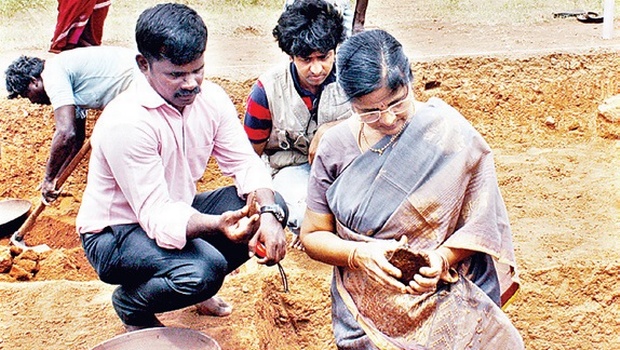
S Vasanthi, deputy superintendent, Tamil Nadu Archaeology Department, inspecting the site on Wednesday | P Justine
Tirunelveli :
A sleepy village now, Ukkirankottai in the district was a bustling centre of trade and commerce till the reign of the Pandiyas. The ongoing excavations here has thrown new light on human settlement and trade during the period.
Remnants of ancient temples besides tiles, terracotta figurines, decorated pot shards, Chinese pots, beads and bangles have been found so far at the place located between Azhagiya Pandiyapuram and Alankulam.
Briefing the media about the excavation, going on for more than 10 days, S Vasanthi, Deputy Superintendent of Archeology said, “The site was selected on the basis of available historical records such as stone and copper inscriptions which establish the early and later Pandiya connections to Ukkirankottai. Besides, there were also remains of a Pandiya fort and temples. Hence, our present excavation focuses on the human settlement, trade and cultural materials of the Pandiya rule.”
Pandiyan era objects, including a terracotta sculpture (middle) found in Ukkirankottai
The excavations are being carried out at five places in the farmlands. “The team has identified the remains of a temple of early Pandiyas. We are not able to identify the deity. Based on the architectural design of the basement and other remains such as tower, we assume that it belongs to early Pandiya rule, but renovated later,” she said. Elaborating on other materials unearthed from the trenches, J Ranjith, Excavation director, said “We have so far unearthed ammikal (grinding stone), pot shards, bangles, beads, tiles, roofs, iron logs and terracotta sculptures belonging to early Pandiyas. At the same time, we have also identified Chinese pots belonging to later Pandiya rule – 13th to 16th century. This reveals the trade links of Ukkirankottai.”
“While the wheel made pots are fine products, hand made pots are decorated with either coir or nail impressions,” he added.
Stressing the historical and political importance of this place during the Pandiya rule, former senior Epigraphist V Vedhachalam told Express that Ukkirankottai was an important military base for the early Pandiya kings (from 600 AD to 1000 AD). Ukkirankottai was earlier called as Karagiri or Karakondapuram. During 9th century, a military leader named Ukkiran resisted Pandiya supremacy following which Paranthaka Veeranarayanan invaded Karakondapuram and defeated Ukkiran, he pointed out.
source: http://www.newindianexpress.com / The New Indian Express / Home> States> Tamil Nadu / by Express News Service / June 18th, 2015
A jamun tree more than 250 years old and a 200-year-old fig tree have been identified in Salem district. They were identified during a research study conducted by retired IFS officer V Sundararaju recently. After retiring from the service, he took on the post of president, Society for Conservation of Nature (SOFCON), Trichy.
According to him, he identified the age of the trees based on the aesthetic, botanical, horticultural, ecological, social, cultural and historical values. “The main criteria for considering a tree as heritage tree are its size, form, shape, age, colour and rarity,” said Sundararaju.
The largest fig tree is found on the western foothills of Yercaud on the river bank of Sarabanga in Denishpet forest range of Salem district. “Its girth is measured at 7.94m and is 28m in height. The wood is not durable, but is said to last well under water and good for well frames. The figs are edible but are usually found with insects,” he said.
The team of researchers also found a jamun tree with a girth of 8.52m and a height of 22m. They found the tree in Kadukkamarathur, a tribal village of Yercaud hills. The researchers calculated its age to be more than 250 years. “There are several jamun trees in Yercaud hills but this tree is the largest of them all. Fortunately, it has managed to escape the axe of wood choppers,” he said.
Sundararaju said that both trees could be classified as heritage trees. These kinds of trees are generally large individual trees with unique value which is considered irreplaceable. These trees take decades and centuries to mature.
“We have many interesting trees across the state. But, no systematic study has been undertaken to identify and prepare a catalogue of these giant trees. Besides the study, awareness programmes must be conducted for villagers, school and college students. Committees must be formed to protect these sacred heritage trees,” he said.
source: http://www.timesofindia.indiatimes.com / Times of India / Home> City> Coimbatore / by V. Senthil Kumaran, TNN / June 19th, 2015