Driven by passion

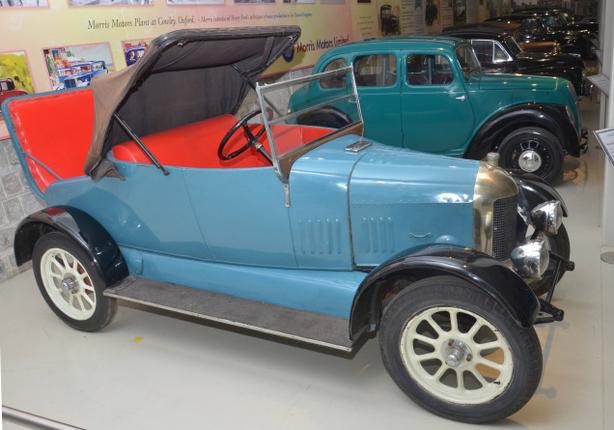
Vintage Treasures: the car collection at Gedee Car Museum Photo: S. Siva Saravanan / The Hindu

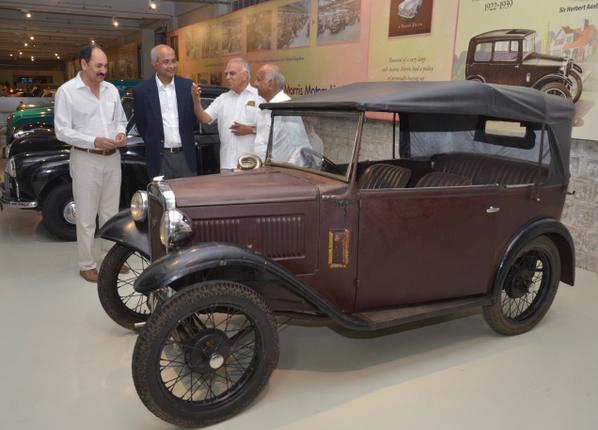
G.D. Naidu’s love for automobiles is well documented at the Gedee Car Museum in the city.

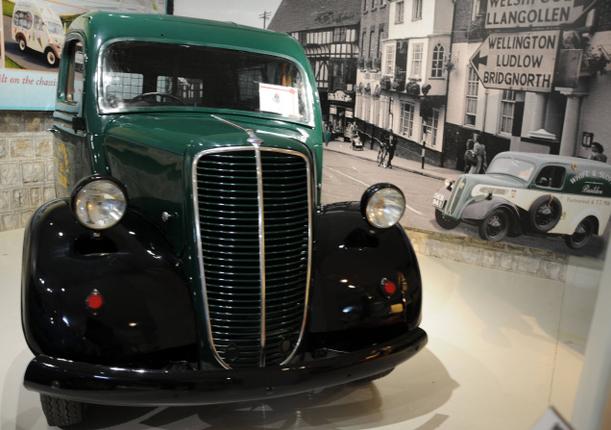
So, this is how it feels to sit in Hitler’s favourite car. The bug-shaped vehicle has four seats. It is a so small that I have to duck my head while stepping out of the car. Yet, it is cosy and warm and just right for a family to enjoy a drive. At the GeDee Car Museum, the Volkswagen Beetle occupies pride of place. It is said the Fuhrer loved this car and urged his people to buy it as an investment. Called “the car at the price of a motorcycle”, it cost around Rs.850, those days. At the newly opened museum set up by G.D. Naidu Charities, I am tempted to hop into all the cars (there are 55 of them) – Chevrolet, Rolls Royce, Mercedes Benz, Porsche from the collection of the renowned industrialist G.D. Naidu. Some of them are Hollywood stars! For instance, the Love Bug has featured in almost six movies! The collection also includes rugged-looking vans of Fordson and Thames which were used as ice cream vehicles and carrier vans.
Vintage Treasures: the car collection at Gedee Car Museum Photo: S. Siva Saravanan / The Hindu

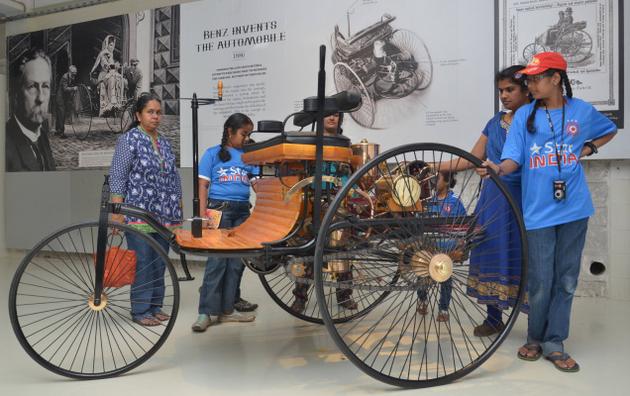
Automobile history unfolds before you as you walk down the curving hallway. There are interesting bits of information and stories wherever you turn like how Tutankhamun used the wheel in ancient Egypt. There are also pictures of steam engines and electric cars that were in vogue in Victorian England. “We are planning to extend the space. There are also workshops for restoration inside this campus,” explains Prem Saravanakumar, the museum guide.
Vintage Treasures: the car collection at Gedee Car Museum Photo: S. Siva Saravanan / The Hindu

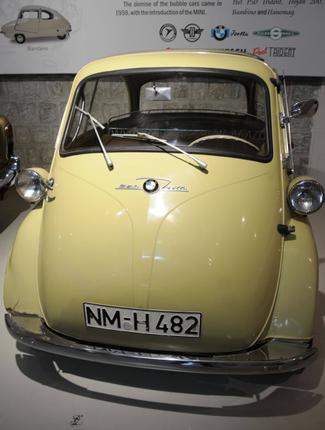
Each car has a story to tell and is linked to world history. For instance the Bubble Car of the 50s and 60s was designed for the common man to commute during World War II in Europe. It can seat only the driver and a passenger. There are no doors on the side and the windshield of the car doubles up as the exit. These micro cars were manufactured for cheap transport for the locals.
Vintage Treasures: the car collection at Gedee Car Museum Photo: S. Siva Saravanan / The Hindu

The Rolls Royces tell a love story. The bonnet ornament has a lady leaning forward with her arms outstretched behind her. The emblem is called the “Spirit of Ecstasy”. The billowing robes of the lady stream past her like wings. According to legend, the bonnet ornament commemorated a secret love affair of John Montague, a pioneer of the automobile movement and Eleanor, the model for the emblem.
Vintage Treasures: the car collection at Gedee Car Museum Photo: S. Siva Saravanan / The Hindu

There is also a tribute to the good old ambassador. Cartoon strips show how the car has become indispensable to the Indian way of life. Caricatures show the car being used to bear the bride and groom at their wedding, hang out laundry and so on. Of course, it is also the status symbol for politicians and gangsters. Don’t miss the luxurious black limousine. “You can even host birthday parties here,” says Saravanakumar in all earnestness. I realise he is not exaggerating when I peep inside.

Vintage Treasures: the car collection at Gedee Car Museum Photo: S. Siva Saravanan / The Hindu

Inside there is a fridge, shining glassware, a television set and a phone for the passenger to talk to the chauffeur! At the end of the hall, a young man on a bike surveys you from a black and white photograph. G.D. Naidu looks happy riding a Rudge Multi, a vintage bike made in 1912. Saravanakumar tells me why he looks so happy in the photo.

Vintage Treasures: the Rudge Multi used by G.D. Naidu Photo: S. Siva Saravanan / The Hindu

While working in his father’s farm, G.D saw a British officer zipping past him in what he thought as a ‘strange looking vehicle having two wheels creating a funny noise’. It was love at first sight. He tracked down the officer, helped him clean the vehicle and service it. He vowed to save up enough money to buy a similar bike for himself some day. He did not have to wait long as the officer was so taken with his passion that he sold it to him for Rs. 300. There are other black and white photographs of G.D. Naidu taking classes, holding workshops and shaking hands with other automobile tycoons. The museum is indeed a tribute to this man of humble beginnings, who emerged to become one of the biggest automobile entrepreneurs in the world.

(The museum is open from 9 a.m. to 5 p.m. The museum is closed on Mondays. The fee is Rs.50. For details, call 0422-2222548.)

source: http://www.thehindu.com / The Hindu / Home> Features> MetroPlus / by Parshathy J. Nath / June 11th, 2015
Beauty is Back, Scalp Torn off by Machine Gets Re-attached

Coimbatore :

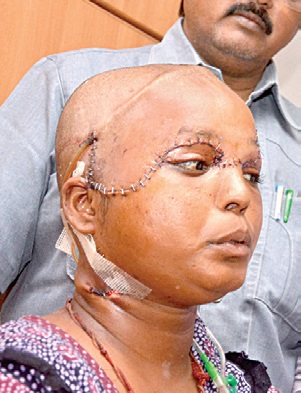
A 26-year old woman, who had her scalp torn off by a machine in a gold jewellery making firm, had a surgery done at Coimbatore Medical College and returned home with her face intact.

Ashwini, wife of Senthilkumar from Selvapuram, walked out of the hospital two days after surgery. She spoke to the media freely thanking the doctors who stitched her scalp back on her head.

“The incident happened on May 8 at 6 pm when I was working in the factory and there was no one else. During my work an ornament fell from my hand and I just bent down to get it. All of a sudden my long hair was caught in the machine and got wrapped round the drill,” said Ashwini.

Ashwini
Ashwini

She said she still remembered everything and she shivered each time she recalled what had happened.

“I was pulled out of the machine. I tried to run but I saw my scalp with hair lying next to me. I screamed and someone came running to the spot. They stopped the machine and took me to hospital,” added Ashwini.

She is all smiles now and she thanks God and the doctors in CMCH. She reached the hospital soon after the accident and the surgery brought her “back to life”.

“With high BP and heavy blood loss the patient was in a critical state and her pulse rate was low. So we immediately resuscitated her with three units of blood and intravenous fluid transfusion. Once her condition was stabilized we took her to the operation theatre for an emergency plastic surgery,” said B Asokan, professor and head of Plastic Surgery Department, who led the surgery with doctors Siva Kumar and Senthil Kumar.

The operation lasted three hours. The doctors said similar cases were increasing. “Necessary safety measures must be taken at the work place to prevent accidents and immediate care must be provided in case of accidents,” added Asokan.

What the doctors called ‘fortunate’ was even though the scalp was torn off there were not much damage to the tissue or vessels and it was easy for the doctors to do the surgery without transplanting tissues from other parts of her body.

source: http://www.newindianexpress.com / The New Indian Express / Home> States> Tamil Nadu / by Express News Service / June 11th, 2015

Bringing the past to the present

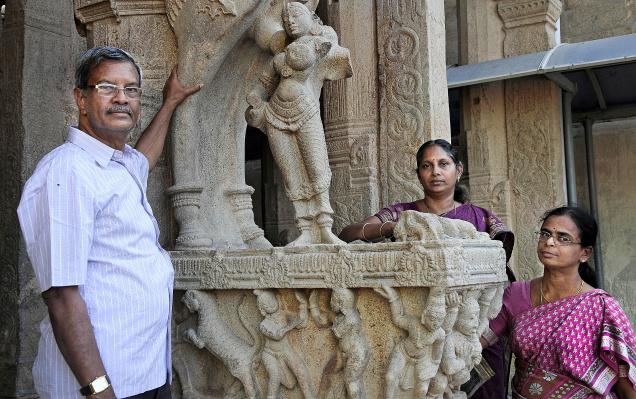
Dr. R. Kalaikovan with Dr. M. Nalini and Dr. R. Akila at the Sri Ranganatha Swamy temple in Srirangam. Photo: M. Srinath

This trio of scholars has been steadily working to chronicle the temple heritage of southern India

“The history that has survived for so long surely knows how to take care of itself,” says Dr. R. Kalaikovan, an ophthalmologist who balances his medical practice with his ardent love for researching the state’s past, particularly through its temples.

Assisted by his former students and now experts in their own right, professors M. Nalini and A. Akila, Dr. Kalaikovan has been the brain behind the Tiruchi-based Dr. M. Rajamanikkanar Centre for Historical Research Centre, named after his father, the outstanding scholar and Reader of Tamil at the Madras University.

A distinction student at school-level history, the young Kalaikovan opted to study Medicine at the Madras Medical College, and followed it up with a Diploma in Ophthalmology. He shifted to Tiruchi after marriage in the 1970s. “From 1975-80, I was strictly an ophthalmologist. I had no knowledge of history but for what I had learned in my school days,” he recalls.

In 1980, the priest of Woraiyur’s Panchavarna Swamy temple invited Dr. Kalaikovan for a prayer of thanksgiving after the successful cataract operation that he had done on him.

“After the prayer, while taking a look around, I came across the carving of a bicycle on a pillar behind the Amman temple,” says Dr. Kalaikovan. “It was so funny and intriguing to see the picture of a cycle in an ancient temple. But neither the officials nor the scholar who wrote its history, were able to explain how it came there. I started researching this fact.”

Through multiple forays into the history of the bicycle (which was invented in Germany in 1800s), and the Chola-era Woraiyur temple, he theorised that the vehicle was possibly a novelty in Tiruchi of the 1920s, when the temple had been renovated. “Perhaps the sculptor had seen someone on a cycle, was impressed by it and had recorded it forever on stone,” says Dr. Kalaikovan. “After this I got so interested in temple history, that I could no longer leave it.

“The builder of the temple, Kochengannan Chozhan, was the first to develop the typical temple complex in the 5th century. He premiered the concept of building temples on a maada (raised platform), followed by the Vimana (tower above the sanctum-sanctorum), to protect the structure from the flooding of the Cauvery.”

The centre has since found 34 such temples in the State.

Detailed projects

Among the many achievements of this trio of scholars is a district-wise directory of all the 105 cave temples of the State, a seven-volume magnum opus that took ten years to complete. “There is a line of thought among English-language historians that cave temple architecture doesn’t belong to Tamil Nadu, and was an idea copied from Maharashtra or the Kalinga empire. We have only 20 large cave temples, but the sculptures are excellent. And there is a difference in style and presentation, which we want to prove conclusively in our next publication,” says Dr. Kalaikovan.

The other major work of archival value that the team has undertaken is a detailed exploration of the nine monoliths of Mamallapuram.

With a sense of a teacher’s pride in his brilliant students, Dr. Kalaikovan credits Nalini and Akila for their dedication in highlighting temples as centres of history. “Around 1000 inscriptions have been found by these two scholars,” he says. “There are a lot of people, but few with dedication in historical research. Of the 60 students I have coached, 50 are women, but they have disappeared after graduation, due to domestic constraints. I request more women to come forward to work in archaeology, history and temple study, because they have a sense of devotion and attention to detail that is missing in men.”

Epigraphic snapshots

Dr. Nalini, associate professor of history at the Seethalakshmi Ramaswami College, describes the cave temple directory as her best work to date. She was drawn towards epigraphy as a specialisation in her Ph.D, when she compared temple inscriptions between a fertile and barren area of Perambalur. “We were able to discover many details about the life and agricultural output of the villages through these inscriptions,” she says.

“When we discover an inscription, we inform the print media first and then the government authorities, so that they can copy it when they are on a tour here. Even though the Tamil alphabet has evolved, most of the meanings are to be interpreted through palaeographic study and through the historical references of the period,” she adds.

“Inscription study gives real history,” says Dr. Kalaikovan. “An inscription is like a register of events, showing the connections of the temple to society and political authorities. For example in Thirumayam, there is a Perumal temple and Sivan temple in the same campus. At the end of the 13th century, it was separated for worship. The details of this partition were decided by a committee of villagers, scholars and outside observers. The treaty discusses how the two temples would be separated, and also how the common areas would be used. It really surprised us to see the amount of balance and objectivity despite the quarrel behind the issue,” says Dr. Kalaikovan.

Guiding youngsters

Dr. Akila, who is an assistant professor of history at Arignar Anna Government Arts and Science College, Musiri, joined the centre as a student in 1989. Unable to secure a place in M.Phil after her Masters degree, she was advised by Dr. Kalaikovan to apply directly for her Ph.D at Bharathidasan University instead. Her highly-commended thesis on the Pazhuvur temple was the first to be written in Tamil.

Her work on the Mamallapuram monoliths, which included identifying the builder and recording the epigraphy, is perhaps the most detailed project of its kind on the historical relic.

“Since I’m now in the field, and want to improve, I try to guide the students in temple study, in its architecture and inscriptions,” says Dr. Akila. “Recently, a third-year student told us about a slab with an inscription at the Thirukameswar Temple, Vellore, which Nalini was able to identify and decipher. We usually give the credit to the students who spot the inscriptions, to help them with their projects.”

Save the legacy

Some facts may never emerge from the veil of times past, concedes Dr. Kalaikovan. “There is no doubt at all that our temple builders had real scientific knowledge. But unfortunately they have not recorded it in either literary or epigraphic form,” he says. “The temple builders never cared for their names, they only wanted to leave the structures behind as their legacy.”

Which makes it all the more important for the succeeding generations to take care of them, says Dr. Kalaikovan. “Temples should be treated as sacred history spaces, and maintained by the community. We must teach the people how to enjoy the temple and keep it clean for worship.”

***

Fact file

Dr. M. Rajamanikkanar Centre for Historical Research was established in 1982 by his son Dr. R. Kalaikovan, an ophthalmologist. Dr. M. Nalini and Dr. R. Akila are its honorary assistant-directors.

The centre publishes an annual magazine called Varalaaru. Its monthly web-zine titled varalaaru.com is run by five software professionals with an interest in history, and has 109 issues online so far.

Besides a vast database of research material generated by its own scholars, the centre also periodically guides students and holds awareness programmes on temple preservation.

Dr. Kalaikovan may be emailed at kalaikkovanr@yahoo.com

source: http://www.thehindu.com / The Hindu / Home> Features> MetroPlus / by Nahla Nainar / June 12th, 2015

Madurai grandma who fed poor and needy is no more

Madurai :

Amma canteens may have been a recent phenomenon because of its low-cost food, but for many residents and passengers arriving at the Anna Bus Terminal in the city it has always been R Pooranathammal and her husband who have been running a non-profit canteen for over five decades. On Wednesday, a pall of gloom descended in the locality after Pooranathammal, 73, died of age-related ailment. The love and affection the couple commanded was visible when many youths and other thronged their residence to mourn her death. Her husband, S Ramu, 79, was inconsolable at the passing away of his wife.

Pooranathammal and Ramu were running their non-profit canteen especially for the poor and needy for the past 50 years. The elderly couple serve one full meal for just Rs 10. In fact, till a few months back, they served meals at just Rs 6. Many people from Madurai and its surrounding areas like Theni, Dindigul, Virudhunagar and Sivaganga who arrive at the bus terminal used to have food at their canteen. The couple, hailing from T Kallikudi near Tirumangalam in Madurai shifted to the city in search of livelihood and started the canteen.

Their canteen was a favourite for hungry students including those from the Madurai Medical College, which is situated very close by.

Pooranathammal and Ramu’s bonding with the students was such that once they pass out from the portals of the medical college many of them call on the elderly couple and present them with clothes.

“She used to scold me if I insist on taking money. She will always smile and serve even if people do not have the nominal amount to pay. It was because of her support we were able to serve people for so many year. At times, if I do not wake up on time due to tiredness, she would not expect me. She will open the canteen and start preparing the food. That was the commitment she had,” he said breaking out into tears.

“We used to have food at the canteen. It is cheap but the quality used to be good. We recently appreciated their service by handing over mementos at a function,” said R Stalin from Padikattugal, a youth organization into public service.

Breakfast and lunch is being served in the canteen. The daily limited meals include sambar, rasam and butter milk accompanied by one vegetable koottu and it was served for just Rs 10. Even idly and dosa were served at the cost of Rs 10. One can get four idlis or two dosas for just Rs 10.

source: http://www.timesofindia.indiatimes.com / The Times of India / Home> City> Madura / TNN / June 1th, 2015

HIDDEN HISTORIES – Lord of the Cooum

Was Cooum originally Komaleeswaram?

There is a theory that Cooum, a polluted river in Chennai is a corruption of Komaleeswaram.

In South India, any spot where a river suddenly turns north is considered particularly holy. A temple usually comes up at this bend. Our polluted Cooum River is no different. After flowing placidly west to east, it takes a turn northwards at Egmore, forms an oxbow around Chintadripet and then flows east to the sea. The little hamlet that nestles in this bend is Komaleeswaranpet.

The village takes its name from its Shiva temple where the Lord is Komaleeswarar and his consort, Komalambika. There is also a theory that Cooum is a corruption of Komaleeswaram. This must have been a sylvan locality around 400 years ago, the river sending wafts of cool breeze. It became an urban settlement in the 1730s when Chintadripet on the opposite bank developed. The main thoroughfare of the village led from the temple and came to be known as Pagoda Street, after the British term for any Hindu place of worship.

This street, backing as it did on to the river, became the place of residence of the well-to-do. Chief among these was Dubash Pachayappa Mudaliar, who in a short lifespan of 40 years (1754 to 1794), earned an enormous fortune, most of which is today used for running educational institutions. Srinivasa Pillai, who wrote Mudaliar’s biography in the 1840s, has it that Pachayappa built his house “at the hermitage like Komaleeswaranpet which takes its name from Lord Shiva.”

Pachayappa’s neighbours on Pagoda Street were Muniappa Pillai, a wealthy businessman and Swami Naick, a Native Dresser in the Army. All three have streets commemorating them in Komaleeswaranpet. Swami Naick is also remembered in a small monument set within a triangular park. Pagoda Street is now Harris (Adithanar) Road, a broad thoroughfare.

Local tradition has it that all the aristocrats of the village worshipped Komaleeswarar. Pachayappa’s will, however, does not mention any donation to it. The temple had a unique festival when flowers would be brought in coracles along the river. Today, this can only be imagined. The flourishing grey market for automobile parts that constitutes Pudupet has cut off the Cooum from Komaleeswarar. Sailing in the Cooum would be impossible anyway.

When you enter Temple Street, you are transported back to the 1800s. Old houses line the sides. The temple has acquired a tower in recent years. A broad courtyard leads to the small sanctum, which has sadly been modernised with polished granite and vitrified tiles. But the pillars and ceiling of the pavilion fronting it retain their antiquity with carved figures on them. A stone slab in the kitchen records a renovation done in 1818 by one Kuppammal, wife of Triplicane-based Baba Sah, a cloth merchant of the Saurashtra community. Donors of this century have not been as aesthetic as her in recording their munificence. Huge black granite slabs set out their deeds in gaudy gold lettering.

Komaleeswaranpet brings a whiff of old Madras, and sadly, a lot of the Cooum.

(Sriram is passionate about Chennai history and Carnatic music, and has several books to his credit)

source: http://www.thehindu.com / The Hindu / Home> Features> MetroPlus / by Sriram V / June 12th, 2015

Ancient royal ring found in Karur riverbed

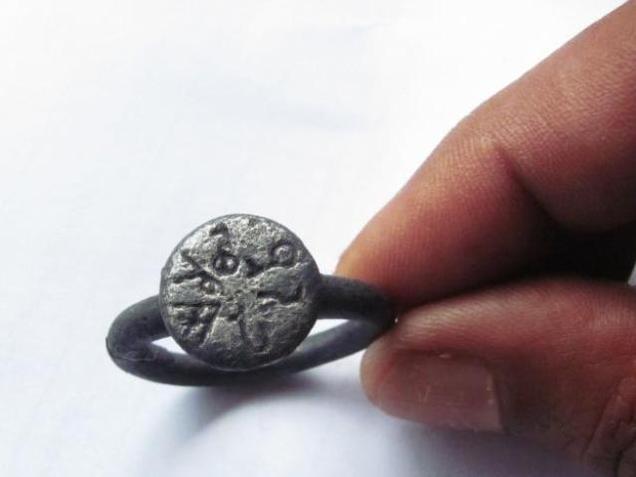
The silver ring with the emblem of a fish found on the Amaravathi riverbed. Photo: Special Arrangement

A silver ring with an inscription in the ancient Tamil Brahmi script has been found reportedly from the Amaravathi riverbed at Karur in Tamil Nadu. The highly stylised script depicts the punctuated Pandya fish emblem.

Ms Beena Sarasan, an expert in numismatics, who purchased the ring from an antique dealer, suggested that the script reads “peruvazhuthi.”

Peruvazhuti is the name of a Pandya king who, according to the Tamil sangam tradition, has performed several vedic yagas and rituals . The letters are engraved in bold and legible characters.

The full name of this Pandya king was Palyagasalai Mutukutumi Peruvazhuthi who finds mention in several early Tamil sangam songs.

Dr. M.R. Raghava Varier, former Professor of Epigraphy, Calicut University said the letters on the ring can be attributed to an early stage of evolution of the Tamil Brahmi characters on the basis of the palaeographical features of the script.

Dr. Varier observed that the characters representing the peculiar Dravidian sound “Zha” show the earliest form of the letter found in the cave labels of Arittappatti- Mangulam group of inscriptions of the 3rd or 2nd century BCE.

The characteristic rightward stroke of the Tamil Brahmi letters as suggested by earlier scholars are also present in the third letter “Va”. The artefact is a valuable find in the historical and epigraphical studies of ancient Tamilakam, Dr. Raghava Varier added.

source: http://www.thehindu.com / The Hindu / Home> News> National> Kerala / by E. M. Manoj / Kalpetta (Kerala) – June 01st, 2015

Chunkath’s scrabble journey: From kitchen table to top prize

Chennai :

Growing up in Delhi, Mohan Verghese Chunkath used to play ‘kitchen table scrabble’ with his siblings and parents. What started out as a pastime became a passion and today, despite a demanding career, the senior bureaucrat is a force to reckon with in the war of words. Chunkath recently won the Bayer National Scrabble Championship 2015 held in Mumbai from May 29 to 31.

“I have been playing scrabble since my childhood, but it was a family game and never played one on one, there were always three of four of us playing together,” says Chunkath, who began playing competitive scrabble in the 1990s.

“I had gone to the US on study leave, and began going to the local club to play. I got interested in competitive scrabble and went from rookie to expert level while I was there,” says Chunkath, director, Anna Institute of Management, and additional chief secretary and director general of training, Tamil Nadu.

He became the first person to represent India in the world scrabble championship held in Melbourne in 1999. “I also participated in the world championships in 2001 and 2007 but work pressure was building up,” says Chunkath. The demands of his growing career meant that he couldn’t devote as much time for competitive scrabble though he did play on the net or sometimes with friends. “I almost drifted out of competitive scrabble, but after my change of job in December 2014, I came back to the scrabble scene,” he says. In January 2015, he participated in iGate International Scrabble Tournament held in Bangalore.

For the voracious reader, scrabble is chess with words. “There is a lot of strategy involved, and a lot of nuances to the game — you track tiles that are played, work with probability, know what is in your bag, what your opponent is likely to have in his bag, how to maximize your offence and defence. It is an interesting hybrid between skill and luck,” says Chunkath.

The championship he recently won saw him pitted against the best. “Indian scrabble players have become very strong and the games were fought very keenly,” says Chunkath. “Younger players have an advantage as don’t get fatigued easily. We played a fairly gruelling number of games – on the first day we played eight games, nine on the second day and though I was supposed to play eight games on the third day, I was able to wrap up after playing just seven,” says the 59-year-old, who beat Sherwin Rodrigues, a player in his mid-20s.

According to him, the future of scrabble in India is very bright. “With the stellar spelling bee performances by Indians in the last decade, scrabble is just waiting to explode in India,” he says. “There is tremendous potential.”

source: http://www.timesofindia.indiatimes.com / The Times of India / Home> City> Chennai / by Priya M. Menon, TNN / June 04th, 2015

Coimbatore first in Tamil Nadu to get BRTS

Coimbatore :

If all goes well, Coimbatore will be the first city in Tamil Nadu to get a Bus Rapid Transport System (BRTS). The final City Mobility Plan report submitted to the commissioner of municipal administration in Chennai on June 8 found that this system was feasible for Coimbatore.

The civic body is discussing the project with a government agency from Germany for funds. “We have sought 853crore for the first phase of BRTS and the delegation has responded positively. Soon after funds are allocated, the city corporation will lay a separate road for BRTS on Avinashi Road and Mettupalayam Road,” a senior corporation official said. Officials also plan to look at other avenues of funding including the World Bank.

To begin with 90 AC buses will be purchased to ply on the route. The BRTS envisages two dedicated lanes for buses to ply at high frequency. “As of now, more than 42% of residents use some form of public transport in the city. This will only increase in future. Thus, the ideal solution is BRTS,” the officer said.

The corporation had come up with the proposal to introduce BRTS, aimed at improving the public transport system and decongesting roads, last February. Soon after an announcement to this effect by former mayor SM Velusamy, commissionerate of municipal administration ordered a feasibility study by ICRA Management Consulting Services Limited.

Subsequently, ICRA picked Avinashi Road and Mettupalayam Road and conducted a detailed study. “The final city mobility plan was submitted a few days ago. We discussed the plan regarding the first phase, with officials in Chennai,” said the officer.

The civic body is now awaiting approval from the state government. Once the approval comes, the corporation will acquire land from Ukkadam to Thudiyalur on Mettupalayam road and from Ukkadam to Chinniyampalayam on Avinashi Road.

A few people are however skeptical about the project. “Mass Rapid Transport Systems have not yielded desired results in several cities in India. In Coimbatore, land acquisition poses a major hurdle. We need at least 30m of land along the entire stretch to implement BRTS. Besides, there are several connecting roads on either side of Avinashi and Mettupalayam Roads. The BRTS should not block these roads,” said D Nandakumar, president of Indian Chamber of Commerce and Industry, Coimbatore chapter.

At a meeting called recently by collector Archana Patnaik and corporation commissioner K Vijayakarthikeyan with stakeholders to discuss the mobility plan, questions about land acquisition and compensation for land owners were raised. For now, the authorities seem confident that land acquisition would go smoothly.

source: http://www.timesofindia.indiatimes.com / The Times of India / Home> City> Coimbatore / by A. Subburaj, TNN / June 12th, 2015

Trichy student bags bronze medal at international archery event

Trichy :

Coming from a humble peasant family, it was indeed a bold decision for him to take up training in the not-so-famous archery during his school days. The wise decision not only fetched him a gold medal in the national level meet but also bag a bronze medal in the international level tournament proving his mettle. Both he achieved in just a couple of years of practice.

A first year bio-tech student of Sri Math Andavar Arts and Science College, N Elango, 19, bagged bronze medal in the recently concluded first ever Student Olympic South Asian Games held at Thimpu in Bhutan.

Hailing from Sholanganallur village in Nachikurichi panchayat in Trichy, his father Nagarajan is a farmer. However, it was his uncle R Natarajan who noticed his talent and helped him with the basic training and equipment.

“My aspiration to join the police force from my childhood led to develop my interest towards guns and firing. But I was attracted towards archery while watching it in TV,” he said.

Elango, who aspires to become an IPS officer, feels that there is very less awareness about archery among the public. All this two years he had to practice alone as no one in his age group was really interested in the game. “This has never demoralized me. But I realized that I have a responsibility to take up this sport and make it popular by winning Olympic medal for the country,” Elango said.

“The state level archery meet held about six months ago gave me the required confidence to move ahead. I won silver medal in the tournament. Though the competition was intense at the national level meet held in February near Mumbai, I could manage to bag gold medal in the under 19 category. Bagging the first ever national gold gave me recognition in the college, which also sponsored my trip to the First Students Olympic South Asian Games,” he said.

All the three rounds were highly competitive, especially from those who were from Bhutan as it was their national game. But I managed to win the bronze medal, he added. Principal of the Sri Math Andavar Arts and Science College J Radhika credited the achievement to the hard work of Elango and said the college would help more students to take part in such tournaments.

M Rajadurai, national level archer and assistant professor at a city college, trained Elango. He credited Elango’s achievement to his two years of hard work. “There are only five students who get training for archery from me,” he added.

source: http://www.timesofindia.indiatimes.com / The Times of India / Home> City> Trichy / by K. Sambath Kumar, TNN / July 09th, 2015

Once a housemaid, now a proud topper

Trichy :

Twelve-year-old V Mahalakshmi was working as a housemaid in Sembattu in 2009 when members of the Child Labour Effective Elimination and Rehabilitation Society (CHEERS) in Trichy found her and rescued her. She was shifted to a special training centre and later got admission into a school in Namakkal which provided her free education for two years.

When the Plus Two results were announced on Thursday, it was a vindicating moment for Mahalakshmi and the people who stood by her. She had scored 1,142 out of 1,200 and a cut-off mark of 192.25. She was one among the seven child labourers rescued by CHEERS who appeared for the Plus Two examination this year.

“After my husband Venkatapathy’s death in 2009 due to health problems, I had to discontinue my daughter’s education due to financial constraints. I never thought my daughter will reach such a good position,” said Mahalakshmi’s mother V Kalaivani, who is a construction worker. “Hard work and the motivation I received from my school teachers helped me realise my dream of scoring good marks in Plus Two examinations. I am confident that I will get admission to pursue MBBS in a government medical college and be able to serve the people. I sincerely thank all the people who acted behind my success,” Mahalakshmi told TOI.

source: http://www.timesofindia.indiatimes.com / The Times of India / Home> City> Trichy / TNN /May 28th, 2015