The institute has sought 10 acres of land on the outskirts of Chennai to build its own campus for a satellite centre.
Chennai :
Indian Institute of Management, Tiruchi has launched a Centre for Corporate Governance to conduct and promote research in the area of corporate governance.
Initiate projects
Announcing the launch at a press conference here, Prafulla Agnihotri, Director, IIM-Trichy, said the centre would initiate research projects, organise seminars and workshops on corporate governance. “The idea is to spread awareness about good corporate governance practices,” he said.
The institution believes that an interaction between academia and industry will help to understand the challenges in corporate governance better, and this centre will provide a platform for that.
According to him, this centre of excellence is the brainchild of Bipin K Dixit and Narahari Hansoge, young professors of the institute. “Our ultimate goal is to offer inputs to various corporates, act as a think-tank and play an advocacy role,” he added.
To a question on how different would this centre be from various other research centres, Dixit, who is the Assistant Professor (Finance and Accounting), said as this centre is not sponsored by any corporate, it can remain neutral. He said it will be open to industry consultancy and joint projects with any corporate.
Satellite centre
IIM-Tiruchi has also sought 10 acres of land on the outskirts of Chennai to build its own campus for a satellite centre. “We are hopeful that it would materialise soon,” said Agnihotri.
source: http://www.thehindubusinessline.com / Business Line / Home> News> Education / by The Hindu Bureau / Chennai – June 15th, 2014
The 226th birth anniversary of John Sullivan, founder of the famous hill station of Udhagamandalam, better known as Ooty, which falls today, will henceforth be celebrated as ‘Ootacamund day,’ a top official of the Nilgiris Documentation centre said.
“The credit for finding Ooty was given to John Sullivan, who was appointed the Coimbatore Collector by British East Indian Company in 1817. As a mark of respect, it has been decided to celebrate June 15, his birthday as Ootacamund day,” D Venugopal, Director of Nilgiris Documentation Centre said.
An announcement to this effect was made by him today at a function in front of twin oak trees planted by Sullivan at Government Arts College.
Venugopal said one has to reflect that when Tamil Nadu, Kerala and Karnataka are locked in disputes over sharing river waters, Ooty has been attracting more visitors from these states. The Nilgiri mountains have been donating most of its
waters to the surrounding plains even while there is widespread water scarcity on the hills, he said.
John Sullivan, who was appointed the Coimbatore Collector by British East Indian Company in 1817.
This co-existence was the guiding spirit for declaring the day to be celebrated after Sullivan’s birthday, Venugopal said.
source: http://www.ibnlive.in.com / IBN Live / Home / by Press Trust of India / June 15th, 2014
A shop in the region with Pennycuick’s face on its hoarding.
With a fan club, several memorials and induction into the local Hindu pantheon, the legend of John Pennycuick, British engineer and chief architect of the disputed Periyar waterworks, lives on in southern Tamil Nadu
The fabled rice paddies of the Cumbum valley in Theni district, one of the most fertile belts in south India lying west of Madurai in southern Tamil Nadu, are girded by dense canopies of banana, grape and coconut. Here and there, Jersey cows look up from patches of serrated foliage, and rows of onion and beet saplings dance like so many chiffon-clad starlets before them in these bucolic uplands beloved of Tamil filmmakers. The road to Kumili, on the Kerala border, is a ribbon unspooling atop this parcel of green and surging towards the Cardamom Hills, wherein lies the fount of all this bounty: the 119-year-old Mullaperiyar dam, the source of a long-standing conflict between Tamil Nadu, which wants more of its water, and Kerala, which is concerned about the dam’s safety.
Last month, in a major victory for Tamil Nadu, a five-judge bench of the Supreme Court upheld a 2006 judgment on the height and safety of the dam and allowed the water level to be raised to 142 ft. The move could mean that farmers in the state, who had settled into a bi-annual cropping pattern and suffered crop losses after the reduction in the height of the dam to 136 ft in 1979, may go back to raising three crops a year. It was amid this wave of hope that we visited Theni, one of five districts — including Madurai, Sivaganga, Ramanathapuram and Dindigul — in the barren rain shadow region of Tamil Nadu that sprang to life with the opening of the 155 ft-high masonry dam in Kerala’s Idukki district in 1895. The spirit of the ruddy, mustachioed Colonel John Pennycuick (January 15, 1841 to March 9, 1911), the British chief engineer of the Periyar Waterworks, bestrides the low hills of Cumbum, which he is said to have surveyed on horseback over a century ago with his local aides, Aanaiviratti (tamer of elephants) Aanaithevar and Kaduvetti (clearer of forests) Karuputhevar. Over the years, legend of his largesse has snowballed and he has been assimilated into the local Hindu pantheon, with farming families offering the first harvest of the year in the form of pongal to a kumkum-anointed portrait of Pennycuick — a balding man in a white collared shirt and a dark jacket, his white-flecked moustache carelessly framing thin lips.
The legacy of a man who changed the course of the Periyar river, and the lives of millions of people, with the gravity of his actions and his sheer strength of purpose looms large over Theni. “If it wasn’t for Pennycuick, our fields would be fallow. Over 2.17 lakh acres of paddy, cultivated by 32,000 small farmers, are impacted by the dam. Every day, a crore or more people drink from its waters,” says KM Abbas, president of a farmers’ forum in Cumbum and author of a book on Pennycuick. In Cumbum, says Abbas, children know him as Pennycuick thatha (Tamil for grandfather) and are often named after his associates, a popular name being Logandurai, for ER Logan, who oversaw tunnelling works for the Periyar project.
For most of its 300-km length, the Periyar, literally, the Big River, flows through Kerala before emptying — wastefully, according to Tamil Nadu — into the Arabian Sea. Pennycuick’s great ingenuity was that he dammed the river at its confluence with the smaller Mullaiyar river, and diverted the water from the reservoir through a 1.6-km-long tunnel to Tamil Nadu, where it goes on to feed the Suruliyar river and the Vaigai dam. This water then passes through a grid of canals to irrigate vast tracts of land in the state. It would seem that the man who diverted a river from west to east for the first time in India’s history, charted a similar course for himself as he settled down to work at his modest cottage on the dam site at Idukki. Locals say he spoke fluent Tamil, relished biryani and made sure his workers never wanted for food or liquor. When torrents of rain washed away his labour of love three years into its construction, around the year 1890, he is said to have wept and struggled to gather funds for rebuilding the masonry dam in the face of scepticism from the British government.
In Palani Chettipatti, a small town near Theni through which a canal of the Mullaiyar flows, a legend reverberates with variations: the Chettiars from the area, locals say, donated liberally to the cause and Pennycuick gave them free access to the waters as a token of his gratitude. In yet another elision between fact and fable, solid gold offerings are said to have been consigned to the river at the behest of Pennycuick ahead of the opening of the sluice gates. We find a scant bit of history in Cumbum at the house of the descendants of Angur Rawther, Pennycuick’s contractor and supplier of labour and provisions. Rawther’s grandson, silver-haired Jafferulla, has preserved records of his family’s association with Pennycuick, including a note of thanks from the Government of Travancore for hosting dignitaries on their visits to the Periyar project.
In Thekkady, on the inter-state border, where the language changes abruptly to Malayalam as though we flicked a switch, the Rawthers still grow cardamom on lush slopes dotted with resorts. This side of the border, Pennycuick’s bust is the centrepiece of a well-tended garden facing the PWD bungalow at the Periyar Wildlife Sanctuary, where the artificial lake formed by the damming of the river is an important habitat for elephants and other wildlife. The 777-sq-km area was declared a sanctuary in 1934 and by 1978, it had become Kerala’s only tiger reserve. “All this tourism here is because of Pennycuick and the dam. But Kerala will never acknowledge him,” says a PWD worker, on condition of anonymity.
In Tamil Nadu, Pennycuick is both hero and victim. His face has became a trope for the troubled history of Mullaperiyar and a receptacle for political interests after the two states came to a head in the late 1970s. Photoshopped posters of chief minister Jayalalithaa and MDMK’s Vaiko sharing the stage with Pennycuick’s likeness are now plastered on public walls across the Cumbum valley. The Colonel even has his own fanclub, the Pennycuick Rejuvenation Forum led by O Andi of Palarpatti, a village near Thevaram in the Cumbum valley that hosted Pennycuick’s grandson in 2003. In December 2011, Andi led an agitation by over 1,200 farmers against Kerala’s stance on the dam. “We used Pennycuick’s posters to communicate our point of view — that the dam, after it has been strengthened, poses no threat to Kerala,” says Andi, in his dimly-lit home where a wall with a large, garlanded poster of the Englishman is the first thing that meets the eye. “We have been working for a decade to raise awareness about the great man,” says Andi, who began printing and distributing pamphlets on Pennycuick while still in college. “Not many people had heard of him before the Mullaperiyar issue became a movement in these parts. Now he is the face of the movement,” he says.
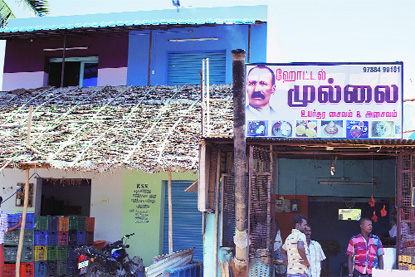
The largest and the latest of memorials to Pennycuick, with a giant bronze statue and black-and-white photographs of the dam, was inaugurated at Lower Camp near Gudalur in Theni last year by Jayalalithaa. It is here that Sanjeevi, 65, and her cousin Maragadham, 57, have come to pay their respects to a man who, they say, “did more than anyone ever could for Tamil Nadu”. “When we heard about the Supreme Court verdict, we set out on this pilgrimage,” says Sanjeevi, who spent her youth gathering forest produce near Gudalur before moving to Coimbatore to find work as a cook. In two days, Sanjeevi will leave for the city, but not before casting a final glance at Pennycuick at the Theni bus stand, which bears his name like so many restaurants, salons and cabs do in the region. “It is believed that his picture brings good luck,” says Rafiq Raja, of Hotel Mullai, a restaurant on the Theni-Kollam highway near Chinnamannur. “He gave us life. This is the least we can do to remember him,” Raja says.
Upon retiring from the PWD, Pennycuick returned to England to serve as president of the Royal Indian Engineering College, an institution on Cooper’s Hill near Egham, Surrey, that trained civil engineers to work in India. But for the people of the Cumbum-Theni region, Pennycuick is forever sutured into their consciousness, a flame of aspiration glowing through their darkest and driest years.
source: http://www.financialexpress.com / The Financial Express / Home> Economy / by V. Shoba / June 15th, 2014
It is a double delight for Sundar Natesh of Chennai who topped the engineering counselling rank list released by Anna University on Monday.
Sundar, 18, also topped the MBBS rank list released by the Directorate of Medical Education on Saturday. “Medicine is my obvious choice, and I will opt to study in Madras Medical College,” said Sundar, who was a student of DAV Higher Secondary School, Gopalapuram.
“I expected to score centum in all subjects but I didn’t think I’ll come first in the MBBS ranking because so many of them have scored full marks in all subjects,” he said. “So, I’m surprised and excited that I topped both medicine and engineering counselling lists.”
Sunder wants to specialise on cardiology.
The chances of the names of toppers appearing on the rank lists of both streams of study is high this year as the top 132 students had scored full 200 marks in physics, chemistry, biology and math on the MBBS/ BDS rank list.
Counselling for engineering seats will begin on June 27.
source: http://www.timesofindia.indiatimes.com / The Times of India / Home> Education> News / by Divya Chandrababu, TNN / June 16th, 2014
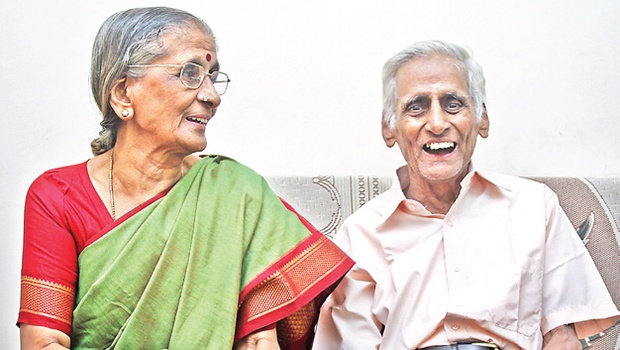
Sethuraman Panchanathan’s father R Sethuraman and mother Saraswathy at their residence, in the city on Sunday | martin louis
Chennai :
For Sethuraman Panchanathan, who was appointed member of US’ prestigious National Science Board of the National Science Foundation by President Barack Obama on Friday, the foundation for his spectacular career was laid while pursuing higher education in India. The scientist with roots in the Chennai, did his schooling and spent and much of his college days in the city.
After passing out of the Madras Christian College School here, he went to Vivekananda College, then the Indian Institute of Science (IISc), Bangalore and finally IIT Madras before he left for Ottawa, Canada for his doctorate. “When I went to Canada I could easily cope with my research since my professors at the IIT and IISc had motivated and engaged me in research,“ he informed Express in a telephonic conversation from the US.
He fondly recalls many of the professors who guided him to reach that stage. “My professor at the Vivekananda College, Professor Shankar was a tremendous inspiration for me. He was an amazing teacher, the commitment that he brought into teaching and the kind of care that he gave to his students inspired me much,” says Panchanathan.
This is the first time that someone of Indian origin has been appointed to the prestigious body, which guides the science and technology policies in the US. Speaking about research in India, Panchanathan, called Panch by peers, says there is a need to find ways to make a career in research exciting.
“There is some good work being done in the IITs and IISc. But as a whole the training and emphasis is not as much on research as for jobs in information technology or other areas. Research needs to be scaled up and intensified if India needs to compete globally. As of now the research in the country is not level with its position globally,” he says.
He points to the number of options students in the US have when they take up research, including starting their own entrepreneurial ventures, being hired into research wings of companies or as faculty in research positions.
“How to promote interest in research in undergraduate students, increase interest in science among students, how to promote curiosity driven creative research, how to make use of basic research to create innovations that can help society – these are certain questions that needs to be answered,” he says.
Giving a sense of how intense research projects ought to be pursued, Panchanathan’s dad Sethuraman recalls how he had to call off a marriage proposal for his son to enable him to continue his research project in Canada.
“When he was in Canada working on his research, we had this proposal and called him to India. But his professor there, one Mr Goldberg, wrote a long letter to me. He said, ‘no wedding when the research is going on, I will not leave him from here unless he completes his project.’ With that we dropped the plan straight away,” he says with a laugh.
source: http://www.newindianexpress.com / The New Indian Express / Home> Cities> Chennai / by Amritha K R / June 16th, 2014
Scholarships distributed the Carnatic Family Association (CFA) founded by the Nawabs of the Carnatic, distributed the annual educational scholarships to deserving students of the Carnatic Family, at its general body meeting held at Amir Mahal.
The Association distributed scholarships to 92 school students and college students, ranging up to `10,000, for different courses.
The Prince Of Arcot, Nawab Mohammed Abdul Ali, is the head of the Carnatic Family and patron-in-chief of CFA. A large number of members from the Carnatic Family attended the function.
The Association also organises socio-cultural activities to promote communal harmony and national integration and also celebrates major religious festivals. It also conducts games and sports for its members periodically.
source: http://www.newindianexpress.com / The New Indian Express / Home> Cities> Chennai / by Express News Service / June 16th, 2014
Orthopaedic surgeon Mayil Vahanan Natarajan has taken the technology of custom-made prostheses across the country
In 1996, when Keshava Raghunathan was 12, he was diagnosed with a bone tumour.
“My parents were terrified that I would lose my leg. The surgeon we consulted, asked us to see Dr. Mayil Vahanan Natarajan,” he said.
The first thing eminent orthopaedic surgeon Dr. Natarajan said, according to Mr. Raghunathan, was, “This boy can walk.” And, after a limb salvage surgery using a custom-made prostheses, Mr. Raghunathan had 15 glorious years of walking, running, trekking and mountain-climbing. “It is only because I have grown taller that I now need a surgery again,” he said.
Mr. Raghunathan was one of several patients who spoke at a ceremony held to mark Dr. Natarajan’s completion of 2,000 limb salvage surgeries using custom mega prostheses, held on Saturday.
Eleven-year-old Subbaiah M. Nuchimanyanda, another patient, who underwent the surgery in 2009, said he was now writing a book.
“When I started out as a young doctor 25 years ago, we would come across case after case of patients with malignant bone tumours at the general hospital or Cancer Institute, Adyar. Back then, the only option was amputation of the limb, which would leave both patients and their families shattered. Also, imported prostheses were very expensive. It made me determined to come up with an alternative,” Dr. Natarajan said.
And thus, in 1988, began an indigenous design-and-manufacturing process for the development of custom-made prostheses. These, since they did not involve amputation and were considerably cheaper than the imported ones, soon became popular. “After 10 years of studying the effects on patients, I took the technology across the country, encouraging doctors to use it, and training them,” Dr. Natarajan said.
About 15 States have now adopted this methodology and the limbs of thousands of patients have been saved thanks to them, he said.
source: http://www.thehindu.com / The Hindu / Home> News> Cities> Chennai> Health / by Staff Reporter / Chennai – June 16th, 2014
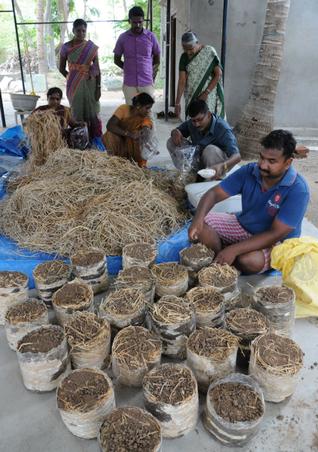
K. Manoj Kumar (right) at work with his team members in his mushroom farm near Kadachanenthal in Madurai./ Photo: R. Ashok / The Hindu
Besides running mushroom farms, Manoj imparts training too
K. Manoj Kumar, who was born with hearing and speech impairment, never let his disability deter his dreams and success.
A B.Com graduate with gold medal from St. Louis College for Hearing Impaired in Chennai, Mr. Manoj’s entry into the league of achievers is motivating.
Seven years ago, Mr. Manoj and his wife M. Krishna Kumari, a microbiology graduate, started a small scale mushroom farm at Pudhupatti.
Ever since, there is no looking back for the couple, who run ‘Udayan Mushroom Farm,’ which now exports oyster and milky mushroom to Kerala, Hyderabad and Maharashtra.
“We had to shift our farm to Kadachanenthal because the environment at Pudhupatti was not conducive. Initially, when we started farming, we found it difficult to sell even one kilogram of mushroom,” says Mrs. Krishna Kumari.
Today, Mr. Manoj’s enterprise has 25 small scale mushroom farms functioning under it and he has trained around 500 persons in the past two years on mushroom cultivation.
His team of support staff in the farm include three hearing impaired persons and four persons who underwent rehabilitation for mental disabilities.
“I started my own mushroom farm inspired by their success and with the help of their encouragement. The business is quite profitable,” says Shantha Devi Akilan Davis, an elderly neighbour of the couple. She is also involved in the training activities undertaken by Udayan Farm.
J. S. Gopinath, who underwent rehabilitation at M.S. Chellamuthu Trust and Research Foundation, says he enjoys working under Mr. Manoj.
“He has taught me how to cultivate mushrooms. I also learned to rear ornamental fish,” he says. Mr. Manoj also rears “fighter fish” for his father’s farm.
According to P. Moorthy, co-ordinator of the training programme, a large number of differently abled people have benefitted from the training.
“There is a high demand for mushrooms in the market. Most of the people who underwent training here had physical disabilities or were from an economically backward background. This has helped them sustain their livelihood,” Mr. Moorthy says.
The simple person that he is, Mr. Manoj attributes his success to his wife, who has been his major support all along.
“People with hearing impairment generally tend to depend on others for income. We wanted to be self-reliant. We are also happy to support others in need,” signs off Mrs. Krishna Kumari.
source: http://www.thehindu.com / The Hindu / Home> News> Cities> Madurai / by M. Vandhana / Madurai – June 17th, 2014
A 100-member delegation visits America to study business opportunities and improve bilateral trade
If the delegation of Young Entrepreneur School (YES), a youth development programme of the Tamil Nadu Chamber Foundation, signs a trade contract during their visit to the popular brand’s Visitors’ Centre in San Francisco, Madurai can expect a Levi’s jeans manufacturing unit.
“It is part of our plan,” says V. Neethi Mohan, Chairman, YES. “The Visitors’ Centre is a permanent installation in commemoration of the 150th anniversary of Levi Strauss and Co. showcasing the company’s history and business. We will be visiting the Levi’s facility on June 23.”
The 17-day trip is titled as ‘Bizcover America’. Members drawn from various YES centres such as Chennai, Dindigul, Ramanathapuram, Karur and Sivakasi leave on June 8. The delegation will also visit US India Business Council, a premier business organisation representing America’s top companies investing in India. They have planned to visit New York, Washington, Niagara, Orlando, Miami, Las Vegas, Los Angeles and San Francisco.
“We have also planned to visit ZAPPOS.com, a popular online store for shoes and clothes based in Las Vegas, Nevada. The store is presently owned by Amazon.com. We will be there to study their business culture and understand their core values,” he says. The team’s prime focus is to improve trade links in food processing and garment industries.
According to Neethi Mohan, e-commerce is a rapidly growing business in the country as the total business done through online shops in the country at present stands at around one billion dollars and it is expected to grow up to 76 billion dollars by 2020. “Already showrooms are being converted into warehouses and businessmen are showing keen interest in e-commerce,” he says.
“The team will study the business models, tools for business development and their best practices. The key objective is to increase volume of bilateral trade and promote industrial investments,” says S. Rethinavelu, chairman of the foundation.
The group will also be at the Infocomm 2014, one of the largest professional AV shows in the world with more than 950 exhibitors from over 110 countries attending.
source: http://www.thehindu.com / The Hindu / Home> Features> MetroPlus / by T. Saravanan / Madurai – June 05th, 2014
The DGP office near Marina beach would have been razed around 20 years ago but for the efforts of a group of heritage lovers. The police department wanted to demolish the building and erect a modern skyscraper that would house all its offices. The local chapter of Indian National Trust for Art and Cultural Heritage (Intach) filed a case against the demolition in the Madras high court, which ruled in favour of its preservation.
The judgment is widely hailed as a landmark in the heritage preservation movement in India. It is one of the earliest instances, in the entire country, when a voluntary agency successfully fought a legal battle against a government department for the cause of heritage.
The case inspired voluntary groups in other cities to fight for local historic structures. In recent years, Intach has approached the courts to save Chennai’s other historic landmarks such as Bharat Insurance Building on Anna Salai.
Although India is rich in historic buildings, there are hardly any laws to preserve them. The archaeology department protects a limited number of structures. It is in this scenario that the role of volunteers in heritage conservation becomes crucial.
For centuries, the task of conserving historic sites and monuments was the prerogative of the government. In the nineteenth century, people around the world realized the need for voluntary organizations for heritage preservation. These organizations, called National Trusts, were intended to supplement the role of the state and also question government action (or inaction!) in the field. Intach is India’s National Trust, started in 1984 and modeled on the English National Trust.
Throughout the world, National Trusts have been fighting court cases to save historic properties. Since 1970, the American National Trust has been involved in over 130 court cases including the most well-known Penn Central Transportation Co vs City of New York, 1978. In this case, the US Supreme Court prevented the erection of a 55-storey office tower atop New York’s Grand Central Rail Station.
Voluntary efforts need not always be channeled through the courts. Appeals and non-violent agitations can sometimes have the same effect. Right on Marina, Queen Mary’s College, next to the DGP Office, was slated to be demolished in 2003 for building a new state secretariat. But protests by citizens compelled the government to give up the plan. In 2012, the highways department, acting on appeal from Intach, changed the alignment of a proposed road near Villupuram to save a 1,000-year-old temple.
There’s a lot that people can do to stand up for heritage and it starts with just wanting to keep history alive.
(The writer is Tamil Nadu convener, Intach. As a Fulbright scholar, he earlier worked in American National Trust in Washington DC)
source: http://www.timesofindia.indiatimes.com / The Times of India / Home> City> Chennai / TNN / June 06th, 2014