Viswanathan Anand chases glory in the relative comfort of Sachin Tendulkar’s shadows

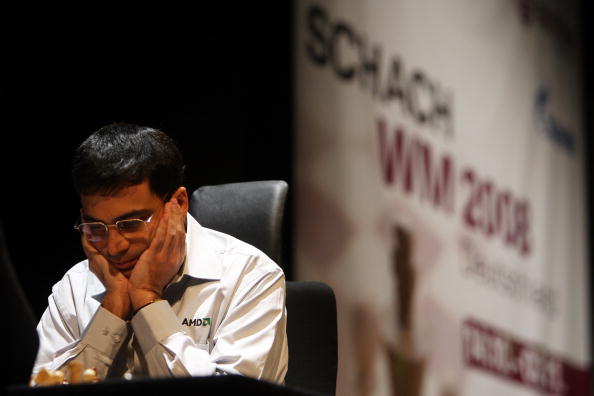
BONN, GERMANY - OCTOBER 17:  Indian chess world champion Viswanathan Anand concentrates during his match against the Russian chess grandmaster Vladimir Kramnik  on October 17, 2008 in Bonn, Germany.  (Photo by Patrik Stollarz/Getty Images)
BONN, GERMANY – OCTOBER 17: Indian chess world champion Viswanathan Anand concentrates during his match against the Russian chess grandmaster Vladimir Kramnik on October 17, 2008 in Bonn, Germany. (Photo by Patrik Stollarz/Getty Images)

Even as one great man’s epic is about to draw to a weary ending, another man is preparing vigorously to sheath his story with one more epochal battle. Somewhere inside an elegantly dressed home in Chennai, Viswanathan Anand  might be laughing in irony at the brouhaha that surrounds the departure of  Sachin Tendulkar . The self-effacing genius enjoys living in the shade, long used to the skewed ways of the large masses of this nation.

As ironic as it might be, the World Championship of Chess, being held in India for only the second time ever is faced with the daunting task of competing with the farewell party of India’s foremost sporting icon. Not that Anand will be too fazed.

The modest man from Chennai has built a monumental career around his ability to navigate expertly around a complex maze of 64 squares. Matters of perception and market dynamics have rarely, if at all, bothered him or affected his love and hunger for mastering his craft.

Chess struggles for attention as it is and the hyperbole around the little maestro’s departure is only going to make matters worse. Anand might even afford a rueful smile in a private conversation with his confidant and spouse.

But under the glare of lights, he can be expected to deal with it in the most dignified manner possible. Their careers have run almost parallel and both men have shown exemplary character to enjoy an almost blemish-free run under intense public glare.

The similarities end right there though. An insanely cricket mad India cheered every run from the blade of the great cricketer. However, Anand had to satisfy himself with only fleeting acknowledgement every time he won a World Championship.

Breaking new ground is a refined habit with both these gentlemen. Sachin has collected more centuries and runs than was ever imagined possible. Anand, the country’s first chess grandmaster, usurped power from the customary champions of the Soviet bloc.

Sachin has been first among equals because his zeal for accumulation was unmatched. Anand was the first man from a famished third world country to usher in a new era, by winning the FIDE World Championships in 2000.

It was a victory that broadened the appeal of chess in Asia and expanded its market beyond the conventional hunting grounds around Europe. In a country abundant with patience even under duress, the success of chess isn’t entirely an anomaly. But it took the genius of Anand to pave the path for others to follow.

Thousands of other players have paraded their talent, but not one player has come close to emulating the greatest chess player India has ever known. He has been feted by the government – the Rajiv Khel Ratna and the Padma Vibhushan sit proudly in his overflowing cabinet of honours.

Ironically though, the unparalleled success of Anand is still not enough to excite nearly as much attention as anything to do with cricket might. Sample this – in 2010, a bevy of leading sportspersons donated their prized possessions to The Foundation, a charity run by actor Rahul Bose. A bat with which Sachin scored an obscure one-day international century in New Zealand fetched a whopping 42 lakhs. Even the racket with which Leander Paes  won the 2010 Wimbledon mixed doubles title managed to get a bid for 7 lakh. In stark contrast, the 2008 World Championship medal of Anand managed a number that wasn’t worth a mention in the media around the time.

Anand has learnt well enough that his is a pursuit in solitude, only occasionally acknowledged even by his ardent fans. As polite and polished as Anand might be to his fans, he is a chess player driven by the quest for a place in the history of the game. It is this focus on his goals that lead Anand and his wife Aruna to find home in Spain.

The relocation helped Anand avoid even the limited attention in India and allowed him to pursue his ambition without the distractions that surrounded his time in India. The reigning champion has since moved back to India and was all set to celebrate a grand event of unmatched scale on his home soil. As fate would have it, Sachin’s plans intervened with the harvest plans of chess.

Anand is the only chess player to have won the World Chess Championships in all three formats – knock-out (2000), tournament (2007) and classical (2008 – current). While people close to the game of chess might rue the likely travesty in November, Vishy may be secretly enjoying the fact that all the attention will be on Sachin.

Even at his tender age of 22,  Magnus Carlsen  is a once in a generation talent in the opinion of experts as well as his opponents. Anand will need his sharpest skills to overcome the challenge from the charismatic Norwegian, who is nearly half the champion’s age. It might help ease the pressure on Anand just a tad that the event itself might escape the intense glare of the media.

Anand may have sincerely hoped for a big boost for the game of chess in India, riding on the back of an exuberant campaign ahead of the World Championships. But considering the enormity of the occasion, the world No. 7 will be happy to hunt his young opponent down in a quiet room inside the Hyatt Regency in Chennai between the 9th and 28th of November.

source: http://www.sportskeeda.com / SportsKeeda / Home> Chess – World Chess Championship 2013 / by Anand Datla, Tennis Expert (Featured Writer) / October 21st, 2013

Vivekananda’s steno remains unsung

Chennai :

As the nation celebrates the 150th birth anniversary of Swami Vivekananda, his faithful stenographer who took the speeches of the celebrated monk to the world, remains unhonoured and unsung.

Josiah Goodwin, an Englishman, followed Swami Vivekananada  from London and documented his speeches in UK, Sri Lanka and India before he died in 1898 in Ooty following illness. He was buried near a church in Ooty.

“In his death I have lost a friend as true as steel, a disciple of never-failing devotion,” said Swami Vivekananda from Almora (UP) on receiving word about Goodwin’s demise.

Born to an English couple at Yorkshire in 1870, Goodwin came in contact with Swami Vivekananda during his second visit to the United States in 1895. “Followers of Swami Vivekananda placed an advertisement for a stenographer and Goodwin, who had come to the US in search of job, was chosen. From then, Goodwin travelled with Swamiji recording his speeches,” said a senior monk at the Ramakrishna Mutt, Chennai.

Vivekananda had such immense faith in Goodwin’s work that he started calling him ‘My faithful Goodwin’. “Though Goodwin was chosen to record Swamiji’s speeches for a salary, he refused to take money after a while,” said the monk. Goodwin travelled along with Vivekananda to the UK and India. “In 1897 when Swamiji reached Colombo, apart from the speeches delivered by him, Goodwin also recorded the reception given to the spiritual master at various places including the mammoth rally from Egmore to Vivekananda House in Madras,” said the monk.

After accompanying Vivekananda through his tour to Almora, Goodwin was sent back to Madras by the Swamiji with a plan to start a newspaper in English with Goodwin as its editor. But the newspaper plan did not materialise and Goodwin was involved in bringing out an English monthly journal of the ‘Mutt’ called Brahmavadin, which is now called the Vedanta Kesari.

“The Englishman could not withstand the heat of Madras and migrated to the cooler climes of Ooty but hardly took care of his health and finally died in 1898,” the monk narrated.

On hearing about Goodwin’s death, Vivekananda wrote a small poem to his mother called ‘Requiescat in Pace’ (Rest in peace). This poem is inscribed in Goodwin’s grave at the cemetery at St Thomas Church, Ooty.

source: http://www.articles.timesofindia.indiatimes.com / The Times of India / Home> City> Chennai> Swami Vivekananada / by B  SivaKumar, TNN / October 21st, 2013

City fusion band heads to IIT madras ‘Saarang’ finale

City-based fusion music band e-Swara Project on Sunday secured its place in the finale of ‘Saarang’, the annual cultural festival of Indian Institute of Technology, Madras, scheduled in the first week of January.

e-Swara Project, a progressive fusion rock group that started playing in February this year, competed against 11 other college bands in the city in the ‘Saarang Band Hunt’ competition held at Dayanand Sagar College of Engineering on Sunday. The band will now compete at a national stage in the light music finals at ‘Saarang’.

“It means a lot to us to have qualified for a national event in the first place. It will be a great platform for us to showcase our talent and also learn,” said Dinushan Shanmuganathan, the band’s percussionist. The band recently released a single ‘Vande Mataram’ which garnered over 2 lakh views on YouTube.

e-Swara Project comprises Yogeendra Hariprasad (vocals, keyboards), Anirban Sengupta (lead guitar), Dinushan (percussions), Raynol D’Souza (bass guitar), Nitesh Iyer (drums), V Noel Aiyar (keys) and Kantick Bannerjee and Aishwarya Rangarajan on vocals.

Sunday’s event was IIT Madras’ first outreach programme in an attempt to ensure more participation, said Ravi Gondalia, final year aeronautical engineering student and head of IIM Madras’ publicity team. “We have had similar band hunts in Pune and Bhopal. Now, we head to Kochi and Hyderabad. Earlier, we invited entries through video links that was adjudged by experts. But our judges complained that it was not the right way to judge light music groups,” Ravi explained.

source: http://www.newindianexpress.com / The New Indian Express / Home> Cities> Bangalore /  by Express News Service – Bangalore / October 21st, 2013

Tamil society yet to emerge from 19th century, scholar

Madurai :

Nineteenth century marked the growth of atheist movement in Tamil Nadu, emergence of caste identity and politics, participation of middle and lower middle class people in freedom movement, emergence of Tamil press and modern literature. Hence, learning about that period is essential to understand various social issues confronting Tamil Nadu now, said scholars at a seminar on ‘Tamil society and 19th century’ held in the city on Thursday.

“Though the Tamil society achieved significant growth during the 19{+t}{+h} century, it is yet to emerge out of the century,” said A R Venkatachalapathy, professor from Madras Institute of Development Studies.

Addressing the gathering at the seminar organised by the department of  Journalism and Science Communication of Madurai Kamaraj University in association with Kalachuvadu publishers, Venkatachalapathy said that 19th century brought modernisation of the society across the country. The railways, telegraph, ports and photography evolved in the country during that time with a significant impact on the society. Moreover the ‘rule of law’ and the constitution also came up in this period. Modern thinking evolved with the growth of printing, intellectual discussions, public speaking and journalism. The very concept of census, numbers and geographical maps also evolved during this period, he said.

The influence of Christianity also played a crucial role in the country as well as on the state. While the Catholic church started its influence in the country by 16th century itself, mainly among the affluent of the society,

the Protestant church influenced the lower strata of society. Both played a crucial role in modern thought and philosophy of the country especially in the state, Venkatachalapathy explained. “However the 19th century is yet to end in the state and we are left to wonder when the change over to next century will happen,” he said.

S Kannan, publisher of Kalachuvadu said that our perspective towards the past keeps changing with new information emerging about the past. The two-day seminar will discuss the key topics like public sphere and private sphere in colonial Tamil Nadu, cultural discussion in Tamil society, translating native scholarship on 19th century and enhancing orientalism, emergence of dalit print in colonial Tamil Nadu.

source: http://www.articles.timesofindia.indiatimes.com / The Times of India / Home> City> Madurai> Tamil Nadu / TNN / September 27th, 2013

Mahabs shell museum houses 40,000 varieties

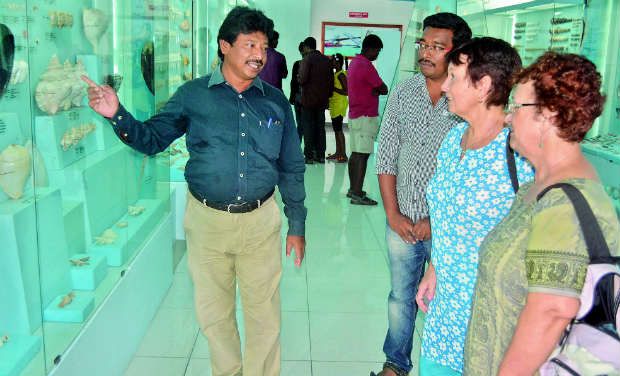
K Raja Mohamed explains his collection of seashells to two tourists from UK at his India seashell museum at Mahabalipuram on Sunday. An avid collector of seashells, his find of 40,000 shells is on display at the museum all round the week. —DC

Mahabalipuram:

For the first time in the country, an exclusive museum has been set up in the coastal town of Mahaba­lipuram to conserve and document marine life, particularly seashells and their biodiversity.

The museum is a now home to about 40,000 types of shells collected over a period of 33 years from different seabeds of Indonesia, Philippines, Australia and Japan. The rib cages of whales and teeth fossils of sharks have also been preserved in the museum which is now a hit with foreigners.

“Since my childhood, I have been collecting shells as a passion. It all started from the coastal waters of Cuddalore and then extended to the shallow waters of Kasimedu and Rames­waram coast,” says a beaming Raja Mohammad, founder of India Seashell Museum.

“There have been days when I had to cough up my day’s food expense to buy a shell or a marine fossil that cost several lakhs. The museum is now open to the public at a nominal charge and we have approached former president A.P.J. Abdul Kalam, seeking his expertise on converting the museum into an interpretation centre for children and a place for studies on seashells and marine organisms. He has responded positively and will soon visit the centre.”

“The shell museum is a dream come true and I want to convert the centre into a resource place for those who want to explore marine shells and their anatomy and biology. This is the biggest museum in south Asia for shells and the process of collecting more specimens is under way,” says Mohammad who is a school dropout and depends on marine biologists for technically supplementing his museum.

“The collections are amazing. I never thought that seashells were so rich in colour. It is a beautiful experience to gaze at the specimens collected from the seabed,” says foreign tourist Anne Hallam from the UK.

“The museum with expensive pearl varieties and rare exhibits from different parts of the world is highly informative,” says another foreign tourist, Meryl Prothero.

source: http://www.deccanchronicle.com / Deccan Chronicle / Home> News> Current Affairs / DC / by C.S. Koteswaran / October 28th, 2013

A basket of 12,000 surprises

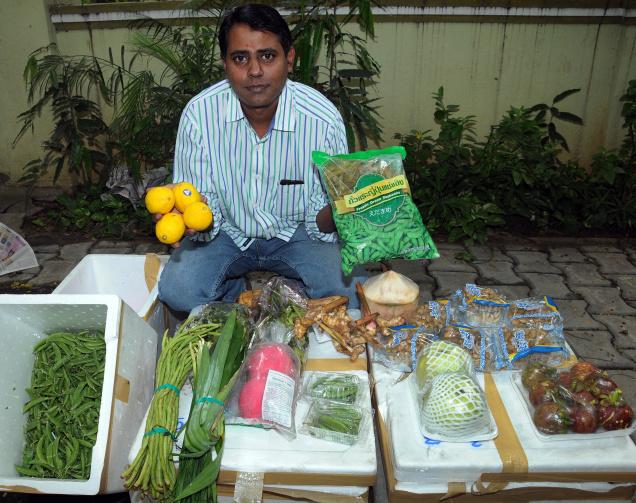
Sathya Narayanan sells exotic vegetables and fruits at Anna Nagar. /. Photo: K. Pichumani / The Hindu

Sathya Narayanan imports a bewildering array of exotic fruits and vegetables. Vipasha Sinha does a quick count

It always happens to cooking enthusiasts. They keenly watch the master class of Master Chef Australia and drop the pen the moment they hear about the ingredients. The problem: half the ingredients they use are not available here and often, they have no substitutes. Here is where Sathya Narayanan chips in.

His basket of surprises are 12,000 exotic fruits and vegetables from across the world that include artichokes, all kinds of avocados, baby leeks, baby patty pan, berries of all kinds, kiwis, kohlrabi, kumquats, laos, leeks, shimiji mushroom, eryngi/king oyster mushroom, enoki mushroom, portebello, chive flowers and the list continues.

Sathya has been importing international fruits and vegetables for a year now. “I realised that there is a niche market for exquisite fruits and vegetables. I supply appropriate ingredients for international menu to several five-star hotels,” says Sathya.

He says, “For those who live abroad, the very name of an Indian vegetable or ingredient makes them excited. Likewise, the expats here long for ingredients from their country. There is a considerable amount of Korean people living here and I supply them necessary ingredients.”

As these fruits and vegetables are imported, quality is an important concern. “Fresh stock arrives every week and are kept in cold storage under hygienic condition and they are supplied immediately, therefore preventing wastage,” he says.

Sathya has plans to supply items to two hypermarkets in Chennai.

He also says these ingredients can change the taste of the regular food.

“Many of these produce can be used instead of the regular vegetables and the taste changes completely,” he says.

You can get in touch with Sathya at fruitmarx@gmail.com or call 24798385.

source: http://www.thehindu.com / The Hindu / Home> News> Cities> Chennai> DownTown / by Vipasha Sinha / Chennai – October 26th, 2013

TN allocates Rs 150 cr for developing Anna University infrastructure

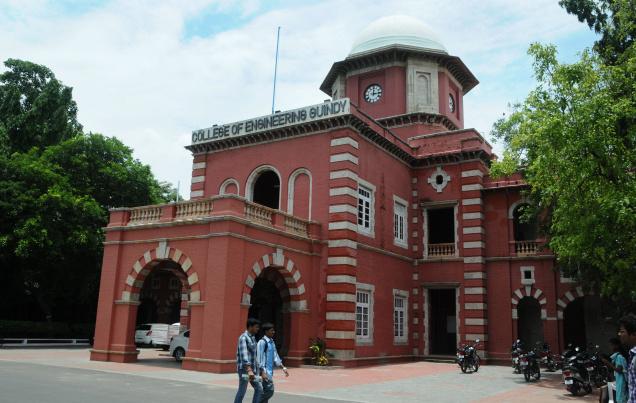
While Rs 30 crore has been allocated for construction of buildings in the regional offices in Madurai and Coimbatore, another Rs 30 crore would be spent on hostels in Madurai, Coimbatore and Tirunelveli. (Above) A shot of the front building of the College of Engineering, Guindy, in the Anna University campus in Chennai.

Chennai :

Tamil Nadu Chief Minister J. Jayalalithaa has allocated Rs 150 crore towards developing infrastructure in the regional offices and constituent colleges functioning under Anna University across the State.

While Rs 30 crore has been allocated for each of the regional offices in Madurai and Coimbatore to construct buildings, another Rs 30 crore would be spent for hostels in Madurai, Coimbatore and Tirunelveli, a State Government press release said.

The allocation would also cover construction of hostels in Dindugal, Ramanathapuram, Tuticorin and Nagercoil, Pattukottai and Panruti, it said.

Basic amenities in 12 university constituent colleges would be developed at a cost of Rs 10 crore, it added.

source: http://www.thehindubusinessline.com / Business Line / Home> Industry> Education / by PTI / Chennai – October 19th, 2013

Statue of 17th century Nayak Queen found near temple

A statue of Rani Mangamma, a Nayak queen of the 17th century who undertook major irrigation and flood management projects and was well known for her administrative acumen has been found near a temple built in that era, a statement of a research body said.

The idol with a crown is seen with folded-hands, carrying a sword in her hip and a saree covering the ankles, a press release from the Pandiyan Historical Research Centre said.

The statue found chiselled onto a pillar opposite the temple.

The Centre’s secretary S Santhalingam said stone inscriptions in the temple revealed the queen had built it in 1693 in memory of her late father.

The athitana (standing place) mandapam of the temple was found damaged. The temple’s name was mentioned as “Hanuman, Azhwar”.

Though the inscription mentioned a temple of Lord Ganesha near the area, it could not be traced, the release said.

source: http://www.newindianexpress.com / The New Indian Express / Home> States> Tamil Nadu / by PTI – Madurai / October 20th, 2013

Minister inaugurates cane grinding works

With three months to go for the Pongal festival, known for sweet Pongal,  the sugarcane grinding season has commenced in the district.

Rural Industries Minister Mohan initiated  the sugarcane grinding process here on Friday in Periyasevalai Sengalvarayan Sugar  Mill. The function was presided over by Villupuram Collector Sampath and joint chairman Gnanamurthi.

During the function, the Rural Inustries Minister said, starting on Friday, the sugarcane grinding process would continue till March 15, in Periyasevalai Corporation Sugar Mill. The sugarcane cultivated in the regions of Thiruvannainellur,  Sithalingamadam, Ulundurpet, Arasur, Enadhimangalam and Pillayarkuppam, which has been partitioned as  mill site-I and mill site-II, is ground in Periyasevalai Corporation Sugar Mill .

As many as 4,14,995 metric tonne of sugarcane which has been cultivated on 15,030 hectares is to be ground in the Sengalvarayan Sugar Mill. The minister affirmed that the 9,000 villagers in these regions would be benefited by this process of grinding sugarcane.

Executive director of the Corporation Sugar Anbarasu presided over the function and he was accompanied by other officials.

source: http://www.newindianexpress.com / The New Indian Express / Home> States> Tamil Nadu / Express News Service – Villipuram / October 19th, 2013

Two carom champs make Vellore district proud

For the first time, two students from the district would be taking part in the national-level carom championship in the sub-junior and junior categories.

R Devadarshan, a class VI student of Vallal Krishnaswamy Mudaliar School, emerged winner in the sub-junior level while Sneha Prabha, a Class VIII student of the Sri Narayani Vidyalaya came first in the junior category at the state-level carom competition, organised by the Tamil Nadu State Carom Association, in Dindigul this week. The event is recognised by the Tamil Nadu Sports Development Authority.

Both students met Collector Sankar on Saturday and sought his blessings to win medals in the national championship that is likely to be held either in Assam or Goa later this year.

Devadarshan said he was able to complete the board in 20 minutes flat in the finals, thanks to his eight-hour practice sessions at home. The winner said he was motivated by his father Raviraj, presently the joint secretary of the district carom association, who himself was a player in his times.

Dr Rajagopal, District Carom Association president, said more youngsters had been attracted to playing carom in the past four years. The association, started around 30 years ago, faced certain setbacks for a while but it was revived recently. “We are planning to train more school and college students,” he said.

He stressed the need for an indoor stadium for the district, which would help youngsters practise caroms in a more professional manner as currently they were practising at a cramped privatly-owned place. “The district administration should help in getting an indoor stadium, not only for carom but also for other indoor games,” Rajagopal said.

“Now that carom has been recognised in the Olympics, I see a good future for our kids to excel in this game and if we promote it in the right manner, we can be among the medals winner in Olympics,” he said, adding that he believed the game helps one improve memory and concentration and that students who practised carom were found to be doing good in the studies as well.

E M Asif, one of the coaches who has been training school kids for the past eight years, said around 500 students have shown interest in the game in the past two years. ‘Around one hundred of them have been groomed to be good players,’ he said. While around 10 of them have won district and state level competitions, this is the first time two of our students make it to the national level, he said with pride.

source: http://www.newindianexpress.com / The New Indian Express / Home> States> TamilNadu / by V. NarayanaMurthi / ENS – Vellore / October 20th, 2013