A Peaceful Stroll Along the Secular Trail of Chennai

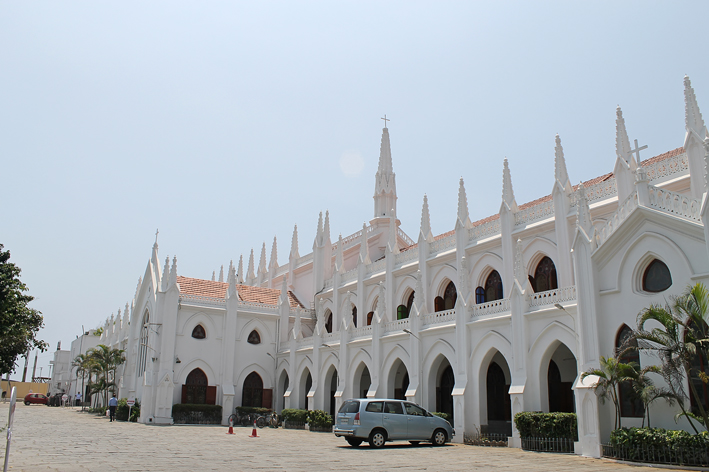
The St. Thomas Basilica in Mylapore, in the city of Chennai, India, is one of only three church in the world to have been built over the tomb of an apostle of Jesus. (JG Photo/Wahyuni Kamah)

It was a hot and clear day when a friend of mine dropped me off nearby St. Thomas Basilica in Mylapore, an old district in Chennai, India.

“This is a neighborhood where you can see different houses of worship, churches, mosques and temples,” she explained.

In ancient times, Mylapore engaged in active trading with the Roman Empire. The settlement of Santhome in Mylapore was mentioned by merchants from Arab when they came to the area in the 9th and 10th centuries.

When I was entering the huge compound of the white cathedral, it was hard to believe I was in India, a country where Hinduism is the major religion and Hindu temples are ubiquitous.

In Chennai itself, Catholics make up about 5 percent of the population and the cathedral was built by the Portuguese after they arrived in the 16th century with no local influence.

The St. Thomas Basilica is the mother church of the Roman Catholic Archdiocese of Madras and Mylapore, and the complex houses some other buildings. One of the newer additions houses a museum and an underground tomb chapel. Pilgrims are allowed to pray in an underground tomb chapel without disturbing the sacred functions in the church.

There were only four other foreign tourists during my visit, while a mass was being held in Tamil.

Upstairs, a simple museum exhibits artifacts and the history of St. Thomas and the basilica, including how Christianity dispersed in India.

According to the tradition of the Christian church in Kerala on the south west coast of India, St. Thomas, one of Jesus’s apostles, arrived around 52 A.D. from Judea. He died as a martyr in 72 A.D. in the outskirts of Chennai, which is now known as St. Thomas Mount. The body of St. Thomas was buried on the spot where the basilica was later built.

In the 19th century, when the British colonized India, they rebuilt it as a church with a cathedral status.

Pope Pius XII increased the status of the cathedral into minor basilica in 1956, and it has become a popular destination for Christian Indians since. The St. Thomas Basilica in Chennai is allegedly one of the three churches in the world that was built over the tomb of the 12 apostles of Jesus.

Stained-glass windows show images of St. Thomas inside.

Back outside on Kutchery Road in the Santhome neighborhood, many of Santhome’s buildings are related to Catholicism, such as the college, pastoral center and school, I also passed a Hindu quarter with shops selling goods needed for services and ceremonies in Hindu temples.

Just a few meters across, I spotted a small Jain temple. Jainism is one of the oldest religions in the world with most of its followers hailing from India.

By the end of my temple trail in Santhome, I was almost overwhelmed by the great diversity of faith, but at the same time, it was a relief to see that people of different religions can live peacefully side by side.

source: http://www.thejakartaglobe.com / Jakarta Globe / Home> Category: Features, Travel / by Wahyuni Kamah / October 20th, 2013
Twin books penned by Vimala released

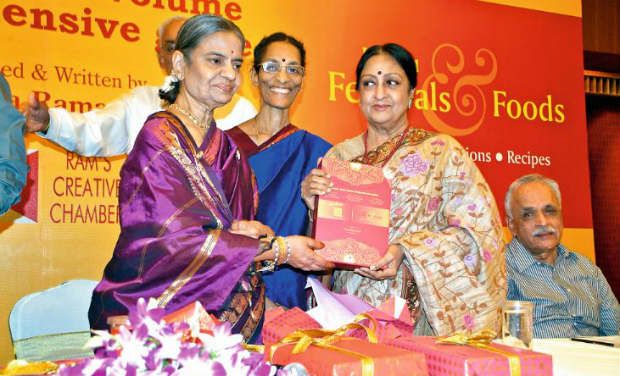
Vimala Ramani’s books being released by Mathioli Saraswathy (left). Dance exponent Padma Subrahmanyam receives the first copies. — DC

Chennai:

A twin book release came on a note of appropriate reverence on Tuesday evening as the subjects dealt with are Shlokas and the Hindu Festivals & Food. Beyond the mouth watering recipes for special occasions that are spelt out in great detail, there is a good reason for GenNext to take particular interest in the book on festivals as it explains a great deal about the culture and customs. There is also no better or quicker guide to the legends behind the festivals.

With her vast experience as the producer of popular television serials, the author of the two volumes, Vimala Ramani, narrates in a nutshell the tradition behind festivals, when they are held and how they are to be celebrated and what food is to be cooked to mark them. Coming so soon in the wake of Prema Srinivasan’s Pure Vegetarian, Vimala’s exposition on the stories, celebrations and recipes of the naivedyam to be offered to the gods before we gorge on the sweets and the savouries is bound to add to the rich cultural and gastronomic legacy of the state.

The Tamil calendar is spelt out in great detail so the uninitiated may grasp why our festivals tend to fall on different dates in the calendar each year. The notes explaining the puranas and the history behind the festivals make the book a pleasurable read that is enlightening.

If we have been celebrating without knowing much more than the fact that most festivals portray the victory of good over evil, Hindu Festivals & Food (Ram’s Creative Chamber, `900) represents the best way to gain some knowledge.

source: http://www.deccanchronicle.com / Deccan Chronicle / Home> News> Current Affairs / DC / September 11th, 2013

Get set for golu galatta this season

Try stepping in to North Mada Street at Mylapore, and you’ll hear lines like this every nook and corner. Truly, Navarathri fever is in the air.

goluCF23oct2013

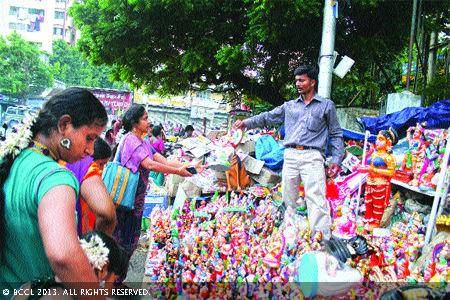
It’s that time of the year when you have to bring out all those carefully stored dolls from your attic, dust them, and strategically place them so that they adorn the golu padis in your house. The eternal favourites among kids and youngsters remain the park setting and the cricket set.

The dolls, which are usually made in Cuddalore and Panruti, are in different sizes and prices. “This year, there’s a 30 per cent increase in prices of dolls, mainly due to the increase in transportation charges,” says Veeramani, a shopkeeper. While the dolls of gods and goddesses are hot favourites, leaders like Gandhi and Nehru have a lot of takers as well.

Theme-based golus, which have been in vogue for the past few years, are the flavour of the Navarathri season. Manohari R, a homemaker, is collecting the right kind of dolls to spruce up her theme-based golu on wildlife in the country. “We see so much of talk on conserving wildlife,” she says, “So, during this season, I’d like to create awareness among people who visit my house to see the golu about this burning issue.”

Buying two of the same dolls is also in fashion. And the reason is simple: they are kept either facing each other, or at the two ends of the golu padis, to provide, what people call, a thematic balance.

No festival is complete without food, and with Navarathri, sundals and payasams are all set to make an entry into your everyday cuisine.

So, what are you waiting for? It’s time you decked up your golu padi.

How to create a cricket golu
– Get a complete cricket set from the neighbourhood cricket shop. Check each player before you buy; some of the pieces come with defects such as a missing hand.

– Spread the players so that you have ample space for everyone. While the batsman, bowler and umpire are a constant, you can change the other fielders every day to give it a ‘new match’ feel.

– You could ask your friends  to create a new field and have a competition to decide which is the best.

How to create a park golu
– For a park, you need grass, trees — lots of it. They’re available in a heap, in your neighbourhood market. Pick as many as you want.

– Don’t forget to throw in some chairs, merry-go-round and park benches. Also, buy a few birds and parrots. They add variety.

– Get a lot of mud. Add water and then dry it under the sun. Once done, spread it across the ‘golu park’.

source: http://www.articles.timesofindia.indiatimes.com / The Times of India / Home> Life & Style> People> Cricket / by Srinivasa Ramanujam, TNN / October 06th, 2013

Food processing research centre to be set up in Tamil Nadu’s Sivaganga district

Chennai :

Aimed at benefitting the farming community, Tamil Nadu Chief Minister Jayalalithaa has issued orders to set up a food processing research and training institute in Sivaganga district.

The Tamil Nadu Agricultural University would set up the institute in the  Manavari Agriculture Centre , Chettinad, Sivaganga district, an official release here said.

(The Tamil Nadu Agricultural…)

For the construction of the buildings and purchase of equipment, Jayalalithaa has alloted Rs 49.32 lakh, it said.

The institute will train emerging enterpreneurs and self-help groups on various issues including enhancing the quality and life of vegetables and fruits, reducing the manual work in food processing through the use of machines and developing value added products from farm wastes,among others.

With the setting up of the institute, there would be an opportunity for the generation of self-employment in the villages located in the area, the release added.

source: http://www.articles.economictimes.indiatimes.com / The Economic Times / Home> News> Infrastructure /  by PTI / October 08th, 2013

MEALS THAT HEAL : The healthy sweetener

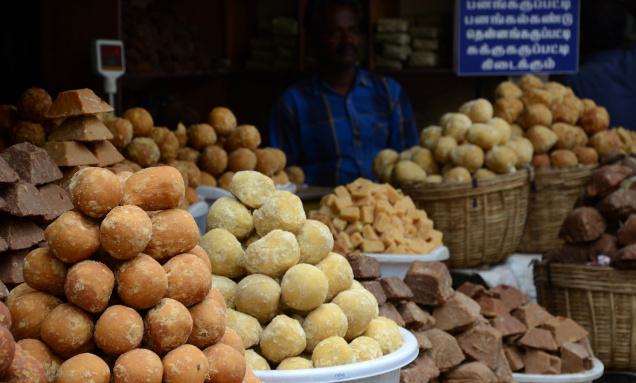
Jaggery effectively cleans the respiratory tract, food pipe, lungs, stomach and intestines. /  Photo: S. Siva Saravanan / The Hindu
Jaggery effectively cleans the respiratory tract, food pipe, lungs, stomach and intestines. / Photo: S. Siva Saravanan / The Hindu

A traditional south Indian jaggery-based drink

Jaggery is a common sweetener used in the preparation of various dishes. It is a traditional type of amorphous, unrefined and non-distilled sugar. Although jaggery and sugar are prepared from the same source, the two are different in appearance, properties and benefits. Jaggery is prepared from the sap or juice of plants such as sugarcane and date palm. Jaggery prepared from palm trees is known as palm jaggery and the benefits are similar to the benefits of jaggery prepared from sugarcane.

It is used to make candies, toffees, jaggery cakes and many sweets. Jaggery is a healthy alternative to white sugar and is known as ‘medicinal sugar’ because of its various health benefits.

The process of making jaggery from plant sources does not involve chemical agents, and hence all the natural mineral salts are retained in it. Jaggery is known to have various medicinal properties and health benefits. It effectively cleans the respiratory tract, food pipe, lungs, stomach and intestines. It helps the body to get rid of unwanted matter andprovides relief from constipation. It is a digestive aid. It is considered a storehouse of important minerals such as iron, magnesium, phosphorus, potassium, etc.

Now, for a recipe.

Panakam

Ingredients:

Grated jaggery: 2 tbsp

Water: 400 ml

Dry ginger: A pinch

Crush cardamom: 2 pieces

Crushed pepper corn: 6-7 pieces

Method:

Mix the grated jaggery in water and let it dissolve completely. Filter the jaggery water.

Add dried ginger powder, crushed cardamom and crushed pepper.

Mix well and serve it at room temperature or chilled.

source: http://www.thehindu.com / The Hindu / Home> Features> MetroPlus> Food /by MuthuKumar D / Chennai – October 06th, 2013

From paddy fields to colonial houses

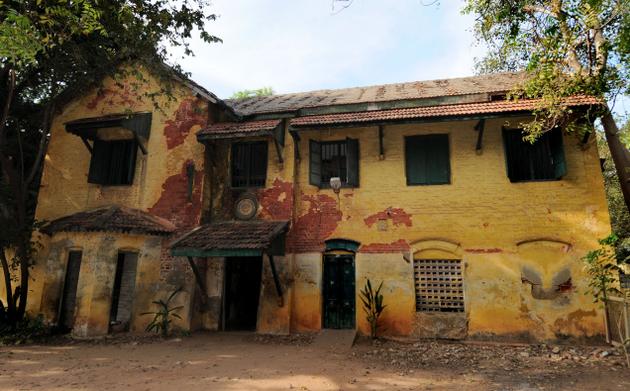
The city police commissioner’s office in Egmore that is being vacated was, for long, a bungalow in a paddy field.

At one point, the police department functioned from the above building on Police Commissioner Office Road in Egmore. It is not known why and when the office moved from Pantheon Road to here and then back — Photo: M. Vedhan / The Hindu

According to historians, the property was bought by Arunagiri Mudaliar for Rs. 36,000. On May 1, 1842, the police moved into the bungalow from their headquarters in Vepery for a monthly rent of Rs. 165.

“In 1856, when Lt. Col. J.C. Boulderson, 35 regiment of Native infantry, took charge as the first police commissioner of Chennai, the land and bungalow were purchased by the police for Rs. 21,000 and till date, the office is situated on the same land,” said historian V. Sriram. “The building is a classic colonial bungalow with two storeys. It has Doric columns with Madras terrace.”

After 170 years, the police are all set to move lock, stock and barrel to the same locality — Vepery — where they were headquartered earlier.

A close study of the building’s history raises certain questions. “There is another building on Police Commissioner Office Road which houses the police photographer’s department currently. It has a circular plaque with the inscription — Colonel W.S. Drever CSI Commissioner of Police, R.F. Chisholm, architect. The year inscribed on the plaque is 1882,” said Mr. Sriram. Why and when did the office move from Pantheon Road to Police Commissioner Office Road and then back, he wondered.

The current move to Vepery seems to have left senior police officers with a heavy heart.

“Ours is a very old police force that has been functioning from this building for over a century. This is like second home for many of us,” said a senior police officer.

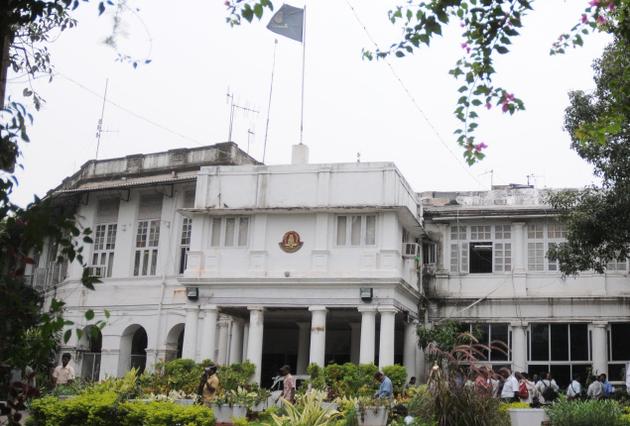
The commissioner’s office on Pantheon Road may gradually be converted into a police museum — Photo: M. Vedhan / The Hindu

The commissioner’s office on Pantheon Road will be temporarily used as the offices of the joint commissioner of police (east), deputy commissioner (security), armed reserve administration office and a few other wings of the police.

After these sections are shifted to the new building, the commissioner office in Egmore may be converted into a police museum.

source: http://www.thehindu.com / The Hindu / Home> News> Cities> Chennai / byu Vivek Narayanan / Chennai – October 11th, 2013

TVS launches Jupiter in Madurai

 Madurai :

Strengthening its presence in the rapidly growing scooter segment, TVS Motor Company, one of India’s largest two wheeler manufacturers, launched its new scooter TVS Jupiter in Madurai.

P.G. Sathiskumar, General Manager (Sales), TVS, said that the new scooter offered greater comfort, convenience and first time features, powered by a next generation noise-free, all-aluminium, low-friction engine that delivers an amazing mix of power, superior acceleration and best in class fuel efficiency and a metal body, styled to enthuse the male consumer.

source: http://www.thehindubusinessline.com / Business Line / Home> Industry / by The Hindu Correspondent /Madurai – October 11th, 2013

No babies born since decades in this village

Madurai :

The custom in this village too is that the first delivery of a woman has to be at her parent’s place and the second delivery at her in-law’s place. But Meenakshipuram, a village in Sirumalai Hills, broke with custom a long time ago. For years, no babies have been delivered in this village. Pregnant women leave their hill home for the plains after the bangle ceremony in the seventh month of pregnancy and return only after the delivery.

This breakdown of custom is no act of rebellion. With no clinics around and, worse, no road to reach a hospital in the event of an emergency, villagers have been left with no choice but to leave their homes in the otherwise pretty and pleasant hill country for the heat and dust of the plains. Lakshmi, a 45-year-old resident, says she can’t remember when a baby was born in Meenakshipuram last. Women are taken to downhill for delivery. “It is normal tradition for the first delivery to be at the parent’s home and the second baby to be at the in-laws’ house, but Meenakshipuram women have to go down for all deliveries,” she says.

The primary health care centre at Katchaikatti near Vadipatti, a village at the foot of Sirumalai Hills, is where most villagers head in times of a health issue. Most of the villagers in Meenakshipuram migrated up the hill from villagers in the plains. So, most of them have relatives in the plains and the women go and reside in their houses. Or else, they rent a house in Vadipatti for a couple of months.

“We either stay in our relatives’ house or take up a house on rent. We return to Meenakshipuram a month after delivery,” says Murugeswari, another young mother in the village. While the daughter in-laws of the households naturally go to stay in their mother’s house for delivery, the daughters of the village don’t have the fortune of returning to their mother’s home. “Our daughters don’t come back here for the last month of pregnancy and we accommodate them downhill itself,” says Sundarambal, an elderly woman.

In case of emergencies, the women are taken in mini-trucks kept to ferry agricultural produces to a nearby village, Sirumalai Pudur, from where they are transported to the PHC in an ambulance, villagers say. The health staff at Katchaikatti PHC also confirms that all the deliveries in Meenakshipuram are done in the PHC itself. “We monitor their pregnancy during our field trips. They are brought down for the last month and the baby is delivered in the PHC,” a health staff adds.

A village health nurse from Vadipatti frequents the village every week to monitor the health of the villagers.

source: http://www.articles.timesofindia.indiatimes.com / The Times of India / Home> City> Madurai / by J. Arockiaraj, TNN / October 12th, 2013

Tuticorin port to resume cracker exports after a hiatus

Madurai : 

The export of crackers made in Sivakasi is set to get a fillip after Tuticorin VOC port authorities agreeing to resume the service. The decision was taken at a meeting convened by the E M Sudarsana Natchiappan, Union minister of state for industries, on Friday in Madurai. Officials from the Tuticorin port and the Petroleum and Explosives Safety Organisation attended the meeting along with cracker  manufactures from Sivakasi.

Crackers from Sivakasi were mainly exported to destinations in Africa and Europe. In fact, sea-borne cracker trade to these continents was active between 1994 and 1997, though the consignments from Tuticorin port were routed through the Colombo port. Then, crackers were taken in small boats from Tuticorin to Colombo, from where the consignments were sent in ships to various ports in Africa and Europe. However, the trade came to a standstill when the Sri Lankan government stopped the practice when the internal war escalated there, said the exporters.

Natchiappan urged the port officials led by deputy chairman S Natarajan to take steps to restart the export. He suggested exporting crackers directly from Tuticorin in ships, instead of routing through Colombo. The port officials have accepted the suggestion. They have also promised to carry out further processes involved, said R Venugopal, the deputy chief controller of explosives (in-charge), Sivakasi.

The cracker manufacturers of Sivakasi have welcomed the move, saying the export would get a boost. “The export opportunity would double the cracker unit industry in Sivakasi. India’s share in cracker trade will increase. It would also augment the job opportunity in the industry,” AMSV Asokan of We Two crackers remarked. Raja Singh Chelladurai of Jumbo fireworks also hailed the initiative. “It is a good move and would provide the necessary boost for the industry. However, the cracker industry has to improve the quality of the products. The US and European countries follow stringent pollution norms. We should reduce the polluting content in the crackers,” Chelladurai said.

Cracker industry owners claimed there is good demand for crackers among people of Indian origin in Kenya, Ghana, Uganda and other African countries. A huge market exists in European countries too. Around 3,200 tonnes of crackers were exported annually in the 1990s. The Rs 1,600 crore fireworks industry exported products worth only Rs 2 crore last year. As manufacturers have to use the Mumbai port for export, incurring high transportation charges, export is rarely attempted these days, the cracker makers said.

At present China has the largest share of world cracker trade, cornering 90% of global exports.

source: http://www.articles.timesofindia.com / The Times of India / Home> City> Madurai> Industry / TNN / October 19th, 2013

MOP honours 45 top alumni

S. Parthasarthy (right), governing board member of MOP Vaishnav College, receives memento from Prof. K. Aludiapillai, ex-vice-chancellor of Madurai Kamaraj University, in Chennai on Monday. UGC vice-chairman H. Devraj (extreme right) is also seen. — DC

Chennai:

In 20 years, MOP Vais­hnav College for Women has come a long way in producing women with entrepreneur skills and social commitment.

With an emphasis on academics and sports, the college has been among the top colleges of the city. On the bi-decennial celebration on Monday,  the college awarded 45 of its alumni who have made a mark in various fields. They were lauded for their efforts by UGC vice-chairman H. Devraj.

The college established in 1992 with three courses now has 13 undergraduate courses and six PG courses. And in sports it has excelled with 74 international and 374 national sportswomen.

Speaking at the function, Bharathi Bha­sker, a parent said, “The three years spent by my daughter in the college were the best of her life.  The college taught her to work as a team has bec­ome imperative in professional life today.”

The college’s community radio programme fou­nd a special mention. K. Saraswathi, secretary general of Madras Cha­mbers of Commerce and In­d­ustry, said, “The college has produced students who had excelled in corporates. We have hea­rd of industry-academic-gap but MOP students’ knowledge received ku­dos from industrialists.”

Devraj added, “Of the 450 colleges with autonomy, TN has 150 of them. Autonomy in MOP has yielded good results. Institutions need to build brand equity and make students strong in their academic fundamentals.”

source: http://www.deccanchronicle.com / Deccan Chronicle / Home> News> Current Affairs / DC / September 15th, 2013