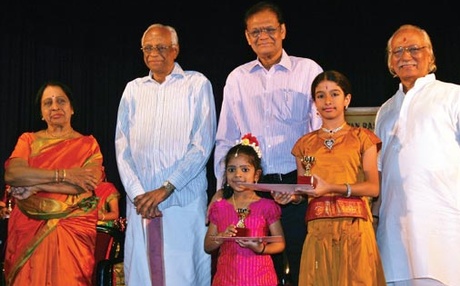
Winners of various competitions with the dignitaries present on the occasion | P Ravikumar
Keeping the legacy of the renowned carnatic musician and legendary singer Papanasam Sivan alive, his 123rd Jayanthi Mahotsavam was celebrated in the city recently.
The whole week of the Jayanthi Mahotsavam was filled with many music and dance events, and concerts by famous singers.
Singer Nithyashree Mahadevan was conferred the title ‘Sivanisai Selvi’ by Papanasam Sivan Rasikar Mandram. The title is given to an acclaimed singer every year during the celebrations.
Rukmini Ramani, daughter of Brahmasri Papanasam Sivan and secretary of Papanasam Sivan Rasikar Sangam, started the function with her composition of Kapaleeshwarar Pancha rathinam that was rendered along with her students.
This was followed by the prize distribution for the vocal and dance competitions that were conducted earlier this month. The prizes were distributed by distinguished guests like L Sabaretnam, chairman of Kartik Fine arts, along with T V Gopalakrishnan, Padma Bhushan Awardee and a carnatic and Hindustani musician. R Krishnaswamy, president of Papanasam Sivan Rasikar Mandram, was also present in the occasion. He shared anecdotes from Sivan’s life and his immortal contributions. Everybody in their speech mentioned Papanasam Sivan’s extraordinary talents and the simplicity with which he lived his life. They also mentioned his immense contribution to Tamil cinema.
“He is one of those gurus who gave a new dimension to cinema music in the 1930s and 40s. His greatness should be kept alive by spreading his krithis across the world,” said Krishnaswamy.
source: http://www.newindianexpress.com / The New Indian Express / Home> Cities> Chennai / by Express News Service – Chennai / October 01st, 2013
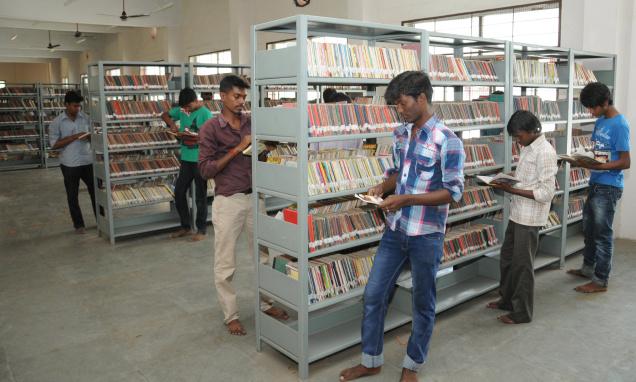
People busy browsing periodicals and newspapers at the New Building of District Central Library at Tiruchi on Wednesday./ Photo: M.Moorthy / The Hindu
Disabled persons residing within 2-km radius of District Central Library can access facility
Differently abled persons residing within a radius of two kilometres of the District Central Library near Singarathope on the West Boulevard Road can now have books from the library delivered at their doorsteps.
The District Central Library plans to implement the novel initiative with the support of the library’s Readers’ Circle for the benefit of differently abled persons who are not able to visit the library personally.
Differently abled persons who wish to avail the service can send in their request specifying their names, full address, and telephone numbers to the District Library Officer, District Central Library Office at West Boulevard Road by surface mail or email to dcltry@tn.nic.in or SMS to 7402603631.
Once the request was received, the library staff will visit the homes of the different abled persons to formally enrol them as members of the library, District Library Officer A.P.Sivakumar told The Hindu.
Once they become members, the differently abled persons will be eligible to have books of their choice from the library delivered at their doorstep once a week. The books, to be delivered by the library staff with the support of the Readers’ Circle, have to be returned within 15 days.
Apart from an annual subscription of Rs.10, the members will be required to pay a deposit of Rs.20 for borrowing one book, Rs.40 for two books, and Rs.50 for three books.
Based on the response to the service to be launched shortly, the initiative will be extended to differently abled persons living more than two km away from the library, Mr.Sivakumar said. He also disclosed that efforts were underway to make the newly built library building more differently abled-friendly.
Amenities such as a differently abled-friendly toilet and ramp were available. Wheelchairs and other amenities are planned to be provided soon.
A separate section for differently abled with specialised infrastructure, especially for the visually and hearing impaired, is also being planned.
source: http://www. thehindu.com / The Hindu / Home> News> Cities> Tiruchirapalli / by Special Correspondent / Tiruchi – July 17th, 2013
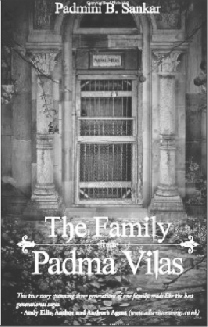
The narration is a true story spanning three generations of a Tamil Brahmin (Iyers) family, the author herself belonging to the fourth. It unfolds with a stunning yet brief vignette of her great-grand father, whom she describes as a herbal healer, upon whom the sprawling family tree has been presented. Its branches get inter-twined to such an amazing complex that going by the large number of names of her relatives of all descriptions (parents, aunts, cousins and so on) the author has taken meticulous care to bring them at appropriate places, one is reminded of Srimad Bhagavatha of Vedavyasa.
The journey of the members belonging to the three generations before the author’s own begins from a small village (Tenkasi, situated at the foothills of the Western Ghats in Tamil Nadu, five kilometers from the famous Kutralam falls) moving to the august offices of South Block in New Delhi, spanning the last century. The author’s grandfather, a doctor, and father, a former officer of Indian Air Force and later a senior bureaucrat are the major dramatis personal of the middle-class family traced to ‘Padma Vilas’, the dwelling that the doctor built, since demolished.
Although the work gives the impression that it is a memoir or family history, it gives a peek into the lives of past generations of a then typical middle-class Indian family, done in a literary style of a high quality, easy on the reader. The many photographs and graphics of documents add to the value of the work as an authentic chronicle of a bygone era. The recall of names of the large number of ‘leaves’, ‘buds’ and ‘flowers’ of the gigantic family tree and recounting of episodes associated with them by the author is bound to spur many to undertake a similar but arduous task.
Nobody can disagree with these words that are said in the foreword; there is no greater understanding in the literary world than the setting down of a family history. How can any of us know who we are if we don’t know from where we came? — BRS
source: http://www.starofmysore.com / Star of Mysore / Home> Feature Articles / October 04th, 2013
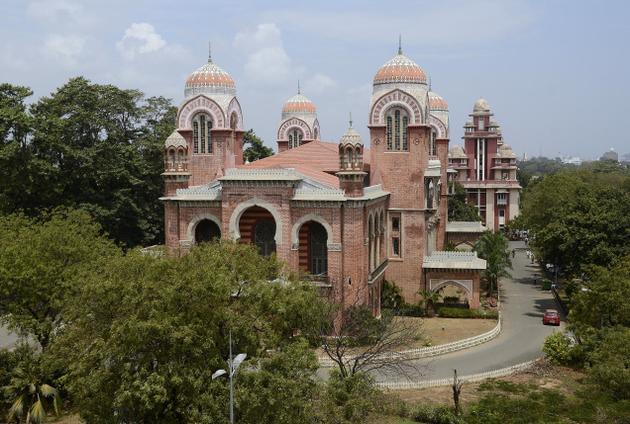
Madras University /. Photo: K.V. Srinivasan / The Hindu
Anusha Parthasarathy flips through the pages of history and writes about three battles that were fought in the city and the places associated with them
Have you ever wondered if battles were fought over Madras? Or if troops marched out of Fort St. George and cannons were loaded and fired whilst a commanding officer shouted out orders? If elephants trumpeted battle calls as foot soldiers followed behind in thousands? If so, where did these battles take place and what happened to the places where they were fought?
In those days, every time a stronghold was established, it was challenged. Take, for instance, Portuguese San Thome. The Portuguese established quite a city within its limits only to be attacked by the French, the Dutch and the Golconda forces. Churches were taken over, buildings were razed to the ground and San Thome fell, before it was handed over to the British. It was a similar story with the Dutch at Sadras. But, those, of course, were separate towns.
Battle of Madras or First Carnatic War
Francis Day landed in Madras and built the first fort in 1640. In 1657, Mir Jumla attacked the fort but was defeated in the Battle of Vepery. In 1690, the city was attacked by a French fleet, while in 1700, the fort was at siege by the Nawab. The fort was also under constant threat from local rulers and parties. But in the 1700s, Madras was the cause of one important war between the British and the French. This war and its outcome eventually led to smaller battles; The First Carnatic War.
The Story of Fort St. George by Col. D.M. Reid has some interesting details on the war. It says that between 1710 and 1746, there was a steady increase in trade, and therefore, the fort was under continual threat of war. Reid explains that whenever England was at war with France in Europe, it had repercussions here as well. And so, when news of war between France and England reached Madras in 1744, a French fleet under Admiral de la Bourdonnais arrived at Madras. There was a skirmish with a part of the English fleet, which was dispersed.
Dupleix, who was the French general then, insisted on an attack and so in September 1746, another fleet appeared off the coast and landed troops near the present Madras University. The fort was bombarded from sea and it fell in three days. Robert Clive was taken prisoner along with the others in the Company and the French occupied the Fort for three years. History of British Rule in India by Edward Thompson, Edward T. and G.T. Garrattsays that the French, with their ‘avaricious exactitude’, took everything they could lay hands on. In 1749, with the Treaty of Aix-La-Chapelle, Madras (Fort St. George) was given back to the British.
Battle of Adyar
In November 1746, the Nawab of Arcot, Anwar-ud-din sent an army to aid the British and take the French out of Madras. His army engaged with a battalion of French soldiers, led by Captain Paradis at Quibble Island, near the Adyar River. Madras Matters by Jim-Brayley Hodgetts says that there were 500 French soldiers who were outnumbered 10 to 1 by the Arcot army. But the battle went down in history because, like History of British Rule in India by Edward Thompson, Edward T. and G.T. Garrattmentions, ‘The French at once broke through the charm of his timorous opinion by defeating the whole army with a single battalion’. The book also points out the probable reason for the Nawab’s defeat.
Quibble Island cemetery. / Photo: R. Ravindran / The Hindu
‘What the skirmish really did was to lift Europeans from temporary pusillanimity, and to show the enormous superiority of the bayonet and musket over the antiquated pike — still more, over the toy weapons of the Orientals.’ Later on, the area between the San Thome Fort and the river where the Nawab’s forces marched, was where several English garden houses were built in the century that followed. Some of the homes were Mowbray’s Gardens (now Madras Club), Brodie’s Castle and Leith Caste.
Siege of Madras
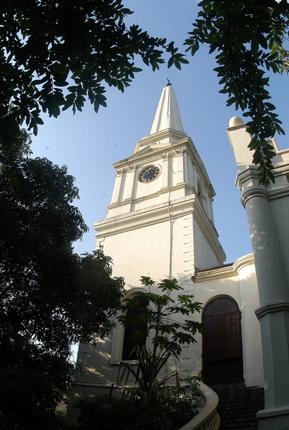
Robert Clive left Madras to work in Bengal and the northern parts of the Fort were being completed. Britain was happy over the many victories it had under Clive’s leadership and had sent him and his men to work in Bengal. At this time, Comte de Lally, a French general, arrived at Pondicherry with his troops to strengthen the French possessions along the coast. The Story of Fort St. George by Col. D.M. Reid, says that the siege began in December 1758 and lasted 67 days. It ended with the arrival of a powerful British fleet in February 1759. The French kept up a continual shell fire for 46 days and the fort was reduced to a wreck. The upper stories of houses were also not spared. The only building inside the fort that survived was the St. Mary’s church. Reid writes that Black Town was ruthlessly pillaged by the French, who also destroyed the village of Chepauk.
St. Mary’s Church./ Photo: Vino John / The Hindu
source: http://www.thehindu.com / The Hindu / Home> Features> MetroPlus / by Anusha Parthasarthy / Chennai – October 08th, 2013
R. Kousalya Devi, Managing Trustee of Gandhigram Trust in Gandhigram, Madurai. / Photo: S. James / The Hindu
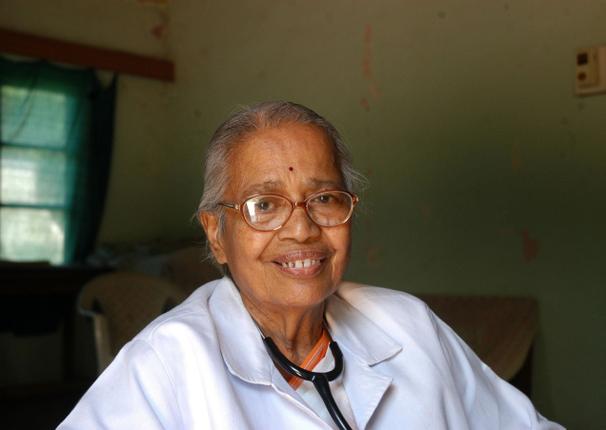
The oldest active gynaecologist at the Kasturba Hospital in Chinnalapatti near Dindigul, Dr. R. Kousalya Devi still goes on night calls and carries out her myriad duties from dawn till well past midnight.
What gives her so much energy at 83? “I am happily unmarried and still able to work by God’s grace,” she says with a warm smile. Having delivered three generations of babies and with people for miles around referring to her kai puniyam or blessed hands, she has quite a cult status in the region, but she doesn’t seem to notice it.
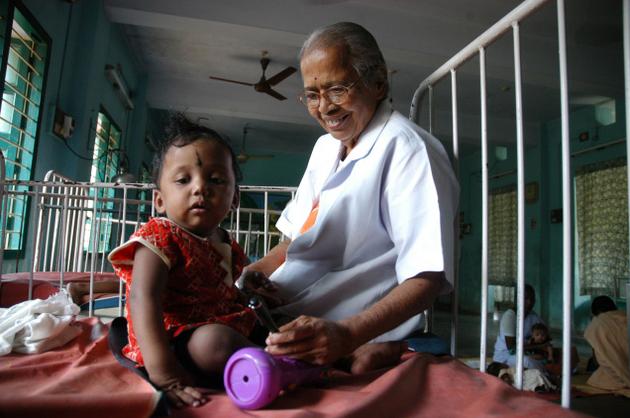
A 2009 file ohoto of Kousalya Devi with a child in Gandhigram. / Photo: S. James / The Hindu
Adviser to Kasturba Hospital and Managing Trustee of Gandhigram Trust, the apex body, Kousalya Devi initially came to this rural hospital in Tamil Nadu on a two-year deputation, quitting a secure government job, on the request of its founder, Dr. T. Soundaram, a disciple of Mahatma Gandhi and the daughter of eminent industrialist T.V.S. Sundaram Iyengar.
When she joined the unpretentious hospital nestled between the Sirumalai and Kodai hills 44 years ago, it had just 22 beds and she was the only doctor with clinical expertise. Today, Kasturba Hospital is a 350-bed top referral centre for high-risk obstetric cases, premature babies, and ailing newborns. It does nearly 400 deliveries a month and 4,000 tubectomies a year.
Under Kausalya Devi’s stewardship, the hospital has won the State Award 14 times and the National Award twice for its contribution to family welfare services. “Working here is a great experience because you see the direct impact you make on peoples’ lives. Acceptance of family planning has gone up, birth rate has decreased, and birth intervals increased,” she says.
Deeply influenced by the founder’s ideals — it is said that despite being an affluent businessman’s daughter Soundaram owned just three saris, one to wear, one to wash, and one to spare — Kousalya Devi says, “I advocate and practise simplicity and whoever works here with me does so by choice and not for want of money and fame.”
Kousalya Devi has refused several awards including the Padma Shri. “It is team work,” she says, “we are serving the rural poor, not doing anything unique.” Kasturba Hospital has a record of treating every patient irrespective of the individual’s capacity to pay or not. For 25 years, the hospital has also run an orphanage and is one of the recognised institutions in Tamil Nadu for in-country adoption.
Over the years, she has busted several myths by introducing the path-breaking re-canalisation procedure, promoting artificial insemination, and raising awareness on hygiene. “Today,” she says, “when a girl from Chinnalapatti gets married, she first checks whether her marital home has a toilet. This is real achievement.”
A two-decade-old battle against breast cancer is another hardship she wears lightly. “God has been kind to me. He has not burdened me with worries,” says the self-effacing doctor.
source: http://www.thehindu.com / The Hindu / Home> Features> The Yin Thing / by Soma Basu / September 30th, 2013
The GDP of Tamil Nadu in fiscal 2013 stood at Rs 72,311 crore as compared with Rs 63,903 crore last fiscal
The foreign direct investment (FDI) equity inflows into Tamil Nadu and Puducherry had touched Rs 5,590 crore during Apr-Jul period 2013. It also grew 18.4 per cent during the fiscal 2009 to fiscal 2013.
Making a presentation at the Madras Chamber of Commerce (MCCI’s) Chamber Day here on Monday, Rajan Ekambaram, partner, Ernst &Young (EY) said the FDI equity inflows in Tamil Nadu and Puducherry stood at Rs 15,250 crore in fiscal 2013 against Rs 6,710 crore in the fiscal 2012 and Rs 6,120 crore in 2010 fiscal.
Quoting Reserve Bank of India’s data, he added, the GDP of Tamil Nadu in fiscal 2013 stood at Rs 72,311 crore as compared with Rs 63,903 crore. However, the real GDP growth rate dropped to five per cent in the fiscal 2013 from 7.4 per cent during 2012.
The share of services sector in the state’s total net domestic product (NDP) increased in the last two decades. In the fiscal 2013 it was at 60 per cent, up from 14 per cent in fiscal 1993. Trade, hotels and restaurants were the biggest contributors to the sector.
The state also has a prominent IT and healthcare services sector (particularly known for medical tourism).
The share of industry in total state NDP has reported a decrease of four per cent since the financial year 1993.
Agriculture, which used to contribute 11.9 per cent to Tamil Nadu’s NDP in fiscal 2011 dropped to 10.9 per cent in fiscal 2013. Manufacturing, which contributed 16.5 per cent in fiscal 2011 too dropped to 14.9 per cent. However, in value terms, it increased to Rs 9,616 crore from Rs 8,395 crore.
Electricity, gas and water supply contributed 0.36 per cent to state’s NDP in fiscal 2011 and increased to 1.4 per cent.
While welcoming the state’s decision to bring out Vision 2023 document, which targets around 10.9 per cent growth in the state’s economy, Ekambaram said executing the document was the key. He noted, in late 80s the state industrial growth was around 35 per cent.
“There are some homegrown issues like power and other infrastructure related issues, which the government should focus on. Power, compliance, export opportunities and labour are the key areas the government has to maintain focus besides having a proper dialogue with the industries and other stakeholders to address these issues,” he said.
source: http://www.business-standard.com / Business Standard / Home> Economy & Policy> News / by BS Reporter / Chennai – September 30th, 2013
Mylapore’s history is inexhaustible and every day, something new comes up. My latest discovery has to do with Devadi Street, a small thoroughfare that links Appu Mudali Street and Kutchery Road. For long, I had assumed that this was once the courtesan quarter of the old town of Mylapore-San Thome, arguably one of the oldest parts of what is Chennai. That was because the name sounded exactly like the Tamil term for the handmaidens of god.
Recently, while reading the biography of the dramatist Pammal Sambanda Mudaliar, I came across an interesting reference. He lived on Acharappan Street in George Town. A part of this street, he wrote, was known as Mahfuz Khan Devadi as it housed a garden belonging to a noble of the Nawab’s Court.
That set me thinking. Could Devadi Street in Mylapore too have some link to a Muslim nobleman? A search in old Corporation records threw up a surprise. The street was registered as Deodi Sardar-ul-mulk Dilawar Jung Bahadur. Deodi or Deorhi is the Persian/Urdu term for a doorway and that made this the street that led to the door of Sardar-ul-mulk Dilawar Jung Bahadur, whoever that was. Over time evidently, the owner was forgotten and only his door was remembered. More probing revealed that this was not a name but actually a string of titles that belonged to none other than Mohammed Ali Wallajah, the Nawab of the Carnatic, who was such a staunch ally of the British. By the 1760s, he had moved from his capital at Arcot to Madras. According to S. Anwar, the photographer who specialises in the Mohammedan history of this region, Wallajah first settled in Mylapore. By 1768, his Chepauk Palace in Triplicane was completed and he shifted there.
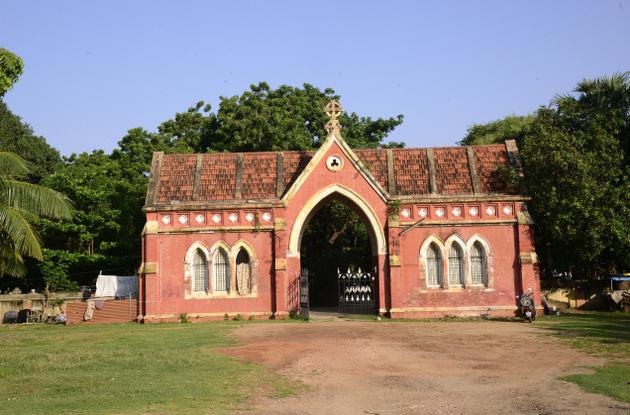
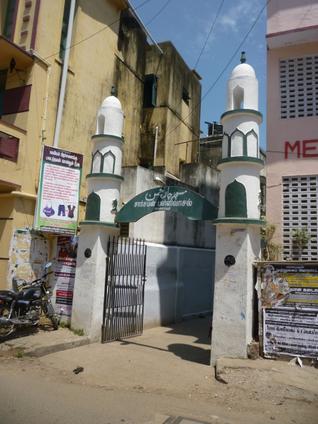
So did Deorhi or now Devadi Street once lead to his garden? It may well have, for this was once the outskirts of Mylapore, beyond which was the pasture land of Mandaveli. An ideal location for a ruler to settle — close to the town and yet just outside of it. The fact that this was once a garden is further confirmed by the presence of a mosque, named the Char Chaman (four garden) Masjid. An old structure that became dilapidated before being modernised, it still has an interesting archway with minarets as can be seen in this picture. This is on Appu Mudali Street, an extension of Devadi Street. Buildings hem it in but a walk around shows that it formed a block by itself once, surrounded by Syed Hameed Hussain, Syed Nadimullah and Syed Wahab Hussain Streets.
More Islamic clues follow. Mosque Street is not far away. And just after Devadi Street meets Kutchery Road is an even older shrine – the Jumma Mosque built in 1699. All this makes Mylapore an amalgam of Hindu, Muslim and Christian faiths. What better example of secularism can there be?
source: http://www.thehindu.com / The Hindu / Home> News> Cities> Chennai / by Sriram V. / March 26th, 2013
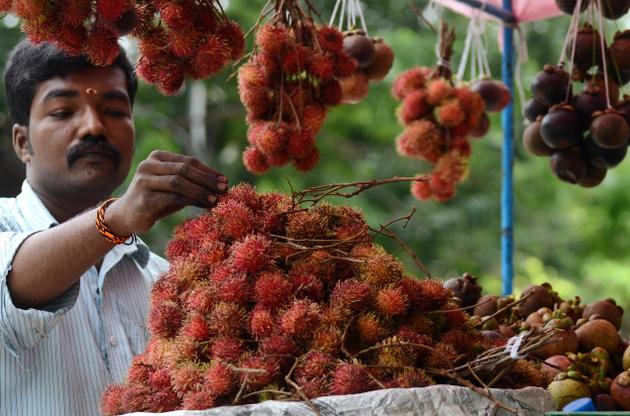
K. Subramani, who sells purple mangosteen (Garcinia mangostana) and rambutan (Nephelium lappaceum) at his fruit cart near Race Course in Coimbatore. / Photo:M.Periasamy. / The Hindu
Ah…the taste. Refreshing, sweet and juicy. I relish the pearly white flesh of rambutan and smile. “It takes nearly 10 minutes to enjoy a single fruit,” says K. Subramani as he arranges the decorative red fruits in a mound on his fruit cart near the Race Course corner.
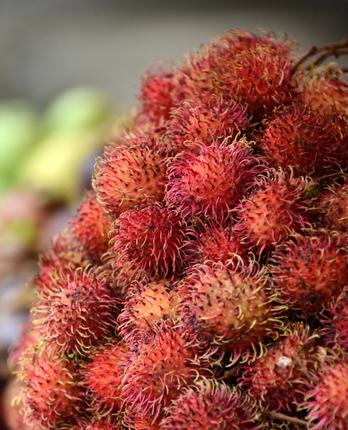
Rambutan (Nephelium lappaceum) from Burliar near Mettupalayam are sought after in Coimbatore for their health benefits. The seasonal fruit is being sold at Rs.300 a kilogram./ Photo: M. Periasamy. / The Hindu
Rambutan mimics lychee in taste and form. Once you peel the spiky red rubbery skin, you find a translucent oval fruit, firm and juicy. Subramani says rambutan helps control blood sugar levels. “Diabetics and those with blood pressure buy it regularly,” he says.
Rambutan is seasonal and available from June to August. It comes from Barliyar, near Mettupalayam.
“People still go in for apples and oranges, which are imported and preserved. They are stale by the time they reach customers. Rambutans are fresh as they are locally grown. Sadly, many are still not aware of its health benefits.”
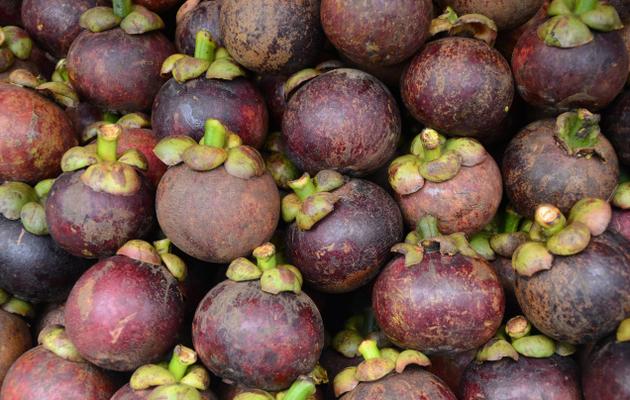
Purple mangosteen (Garcinia mangostana) known for curing stomach ulcers arrive in Coimbatore from Tenkasi during the month of July. The seasonal fruit is being sold at Rs.200 a kilogram./ Photo: M. Periasamy./ The Hindu
Another purple mound on his cart catches my eye. That is mangosteen. I hold the fruit with both hands, pull out the fibrous skin and scoop up the juicy white flesh. It is delicious. “Mangosteen is cooling. It helps heal stomach ulcers and internal surgery wounds. Many doctors buy it regularly,” says Subramani.
Subramani’s day begins at the crack of dawn at the Town Hall market. Every single day, about 3,000 kg of mangosteens arrive from Tenkasi near Madurai. He supplies the mangosteens to about 50 carts and shops in Race Course, Raja Street, Ukkadam and Mettupalayam Road. Then, it’s business as usual at his cart in Race Course, till 8 p.m. He also makes a powder out of the dried skin of mangosteen. This can be consumed with milk or curd, he says. The soft and crunchy seed of Rambutan can also be used in powder form with milk.
Jamun (Syzygium cumini) that come from Andhra Pradesh are known for their health benefits and it arrives in plenty to Coimbatore markets in the month of July. The fruit is being sold at Rs.200 a kilogram./ Photo: M. Periasamy./ The Hindu
Then, there are jamuns, another seasonal fruit that comes from Andhra Pradesh. “Jamuns are always popular and the sweet-sour taste is a big hit among everyone. People now make juice with jamun pulp, salt and a squeeze of lemon. A lot of my customers substitute their morning tea with a drink made from jamun seed powder and warm water for a healthy start.” An added attraction at his cart are plump guavas that have come all way from Ayakudi in Palani.
To know more, call Subramani at 96984-45453.
Price
Rambutan (Rs.200 a kg), Mangosteen (Rs. 200 a kg) and Jamun (Rs. 240 a kg)
Where to find them
At the Race Course corner (opposite to Big Bazaar)
When available
Every year, the fruits are available only for three months. You will find them only from June to August
source: http://www.thehindu.com / The Hindu / Home> Features> MetroPlus> Food / by K. Jeshi / Coimbatore – July 09th, 2013
A mushroom grower hailing from Villupuram district has bagged the Progressive Mushroom Grower award for this year for his outstanding contribution to the mushroom industry in Tamil Nadu.
A R Mohamed Khan from Kallakurichi in Villupuram district was earlier trained at Mushroom Research and Training Centre in Tamil Nadu Agricultural University (TNAU) in 2010.
The average mushroom production at his farm is 100 kg per day and he has also established a mushroom spawn laboratory with the production capacity of 300kg per day, said a statement from TNAU.
Apart from this, he is the only manufacturer of mushroom rusks in Tamil Nadu having the production capacity of 500 kg rusk a day.
Mohamed has also engaged around 10 dealers to supply mushroom rusks in Tamil Nadu and Kerala. His other products include mushroom pickles and mushroom pakodas and he has also developed the technology for producing mushroom noodles and mushroom bathing soap.
Considering such outstanding achievements in the mushroom industry, the award was presented to him by Directorate of Mushroom Research, Indian Council of Agricultural Research (ICAR).
Dr Vijay Singh Thakar, Vice-Chancellor of Dr.Y.S.Parmar University of Horticulture & Forestry at Solan in Himachal Pradesh presented the award during the National Mushroom Mela held recently at Solan. TNAU officials said that his keen interest in providing support to small and marginal mushroom growers and efforts taken to popularise mushroom consumption needs special mention.
Mohamed Khan also gives free consultations to budding entrepreneurs and is a pioneer in introducing value addition of mushroom.
source: http://www.articles.timesofindia.indiatimes.com / The Times of India / Home> City> Coimbatore> Agri Research / TNN / September 30th, 2013
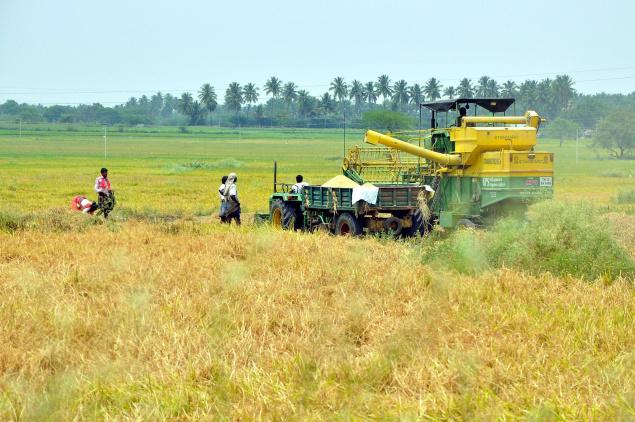
Farmers harvesting paddy in a field using a machine./ File Photo / The Hindu
They reap benefits of automation and modern agro methods
Technology has made inroads into agricultural operations in Madurai district. Farmers have started reaping benefits after they have automated and adopted modern agriculture methods.
Paddy yield has steadily increased over a span of four years. In 2009-10, the yield was 5,554 kg per hectare (ha). It increased to 6,367 kg/ha in 2010-11 and 6,819 kg/ha in 2011-12. Despite a severe drought, it was 5,157 kg/ha in 2012-13, a year in which many districts sought monetary relief to offset losses in the farm sector.
Though slow to embrace the system of Rice Intensification (SRI) technique introduced by the government, farmers are now enjoying the dividends.
Today, small and marginal farmers are quick to use farm implements such as power tillers, transplanters and power weeders, once topics of discussion limited to officials, manufacturers and farmers with large holdings, says S. Kanagaraj, Deputy Director (Watershed Development Agency).
By involving the village youth, ‘Farmers’ interest groups’ (FIG) were formed in all the 13 blocks in Madurai district. The FIGs monitored and fulfilled farmers’ needs. For instance, farmers in Thuyaneri near Othakadai in the Madurai East block were supplied with power tillers and transplanters but were also made accountable for their maintenance, Mr. Kanagaraj said.
Now, S. Ramaiah of Kallanthiri is able to manage his 2.5-acre paddy field with minimum farm labour. “I became familiar with the farm equipment after attending an ATMA programme. The introduction of the harvester machine has come as a big relief. Water conservation techniques are also useful. There were initial hiccups, but I managed to overcome them,” he said.
Like Ramaiah, many other farmers have their own success stories, say officials.
Weather bulletin
Another important scientific advancement that has reached the nook and corners of Madurai district is the easy access to rainfall data. The weather forecast can be accessed on tawn.tnau.ac.in. Established by the Agro Climate Research Centre, the agri-weather bulletin provides data on local temperature, possibility of rainfall in the next 24 hours, humidity level, and other information. The weather forecast enables farmers to plan the day’s work, says Arulprakasam, an FIG member.
Presently, automatic weather stations are functioning in Vadipatti, Madurai East, Madurai West, Alanganallur and Kottampatti blocks. Soon, the other eight blocks too will have the facility, a Tamil Nadu Agricultural University official said.
source: http://www.thehindu.com / The Hindu / Home> News> Cities> Madurai / by L. Srinivasan / Madurai – September 13th, 2013